NASA's Magnetospheric Mission Passes Major Milestone
September 6, 2010 by Susan Hendrix
NASA's Magnetospheric Mission Passes Major Milestone

Enlarge

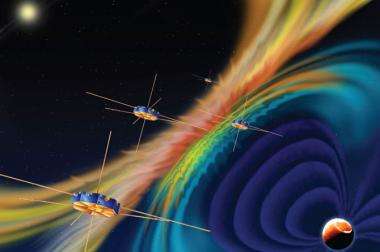
Artist conception of the four Magnetospheric Multiscale (MMS) spacecraft investigating magnetic reconnection within Earth's magnetic field (magnetosphere). Credit: Southwest Research Institute

(PhysOrg.com) -- The universe is still an arcane place that scientists know very little about, but a new NASA Solar Terrestrial Probe mission is going to shed light on one especially mysterious event called magnetic reconnection. It occurs when magnetic lines of force cross, cancel, and reconnect releasing magnetic energy in the form of heat and charged-particle kinetic energy.

On the sun, causes more powerful than several atomic bombs combined. In Earth's atmosphere, magnetic reconnection dispenses magnetic storms and auroras, and in laboratories on Earth it can cause big problems in fusion reactors.

Although the study of magnetic reconnection dates back to the 1950s and despite numerous scientific papers addressing this perplexing issue, scientists still cannot agree on one accepted model.

In 2014, NASA is scheduled to launch a satellite that will greatly increase our understanding of this phenomenon when it launches the Magnetospheric Multiscale (MMS) mission, a suite of four identical spacecraft that will study magnetic reconnection in the best possible laboratory - the Earth’s magnetosphere. The spacecraft will obtain measurements necessary to test prevailing theories as to how reconnection is enabled and how it progresses.

Recently, NASA and members of an independent review board painstakingly reviewed every aspect of the MMS mission, and successfully completed the mission’s critical design review. This technical review is held to ensure that a mission can proceed into fabrication, demonstration and test and can meet stated performance requirements, including cost, schedule, risk and other system constraints.

According to MMS deputy project scientist Mark Adrian of NASA’s Goddard Space Flight Center in Greenbelt, Md., “This is the last hurdle before the spacecraft and instrument teams begin to build actual flight hardware.”

MMS was approved for implementation in June 2009 following a successful Preliminary Design Review in May 2009.

Dr. James L. Burch of the Southwest Research Institute in San Antonio, Texas, will lead the MMS science team. According to Burch, “Magnetic reconnection is a fundamental physical process that occurs throughout the universe,” says Burch. “MMS will enable us to study this dynamic process in the near-Earth space environment, where it transfers energy from the solar wind to the magnetosphere and drives disturbances known as space weather.”

Goddard is the lead Center for the mission. Engineers there will perform the required environmental testing, build the spacecraft and integrate all four sets of instruments into the MMS satellites, support launch vehicle integration and operations, and develop the Mission Operations Center which to monitor and control the spacecraft.

MMS will carry identical suites of plasma analyzers, energetic particle detectors, magnetometers, and electric field instruments as well as a device to prevent spacecraft charging from interfering with the highly sensitive measurements required in and around the diffusion regions.

Scientists and engineers at Goddard have designed and will build one of the instruments - the Fast Plasma Instrument, which will measure the ion and electron distributions and the electric and magnetic fields with unprecedentedly high millisecond time resolution and accuracy.

Currently, MMS is scheduled to launch in August 2014 from Cape Canaveral Air Force Station, FL aboard an Atlas V rocket.

More information: http://stp.gsfc.na … /mms/mms.htm

Provided by NASA's Goddard Space Flight Center (news : web)

4.1 /5 (8 votes)  

Filter


Move the slider to adjust rank threshold, so that you can hide some of the comments.


Display comments: newest first

sender
Sep 07, 2010

Rank: 1 / 5 (2)
cant wait to utilize this space weather for energy systems at home where we need it the most to combat climate change, suppose space offers us a resource too good to be true.
Rank 4.1 /5 (8 votes)
Relevant PhysicsForums posts
  • Titan's lack of impact craters
    created6 hours ago
  • Real pictures of black hole eating a star?
    createdFeb 08, 2012
  • Hypothetical way to travel faster than light, but not technically exceed lightspeed
    createdFeb 06, 2012
  • How do scientists monitor the Sun's activity?
    createdFeb 05, 2012
  • Search patterns in observational studies
    createdFeb 05, 2012
  • Derivation of Pogson's law
    createdFeb 03, 2012
  • More from Physics Forums - General Astronomy

More news stories

NASA's TRMM satellite sees Cyclone Jasmine in 3-D

Data from NASA's TRMM satellite was used to create a 3-Dimensional look at Cyclone Jasmine, currently moving through the South Pacific Ocean.

Space & Earth / Earth Sciences

created 46 minutes ago | popularity not rated yet | comments 0

Deconstructing a mystery: What caused Snowmaggedon?

In the quiet after the storms, streets and cars had all but disappeared under piles of snow. The U.S. Postal Service suspended service for the first time in 30 years. Snow plows struggled to push the evidence ...

Space & Earth / Earth Sciences

created 2 hours ago | popularity 5 / 5 (1) | comments 0 | with audio podcast

New views show old NASA Mars landers

(PhysOrg.com) -- The High Resolution Imaging Science Experiment (HiRISE) camera on NASA's Mars Reconnaissance Orbiter recorded a scene on Jan. 29, 2012, that includes the first color image from orbit showing ...

Space & Earth / Space Exploration

created 10 hours ago | popularity 4.9 / 5 (7) | comments 4 | with audio podcast

Tidal forces could squeeze out planetary water

Alien planets might experience tidal forces powerful enough to remove all their water, leaving behind hot, dry worlds like Venus, researchers said.

Space & Earth / Space Exploration

created 8 hours ago | popularity 5 / 5 (1) | comments 1 | with audio podcast

Black holes and star formation

(PhysOrg.com) -- It has long been recognized that galaxy mergers or even close interactions can play a vital role in shaping the morphology of galaxies. One way they can do so, it is thought, is by triggering ...

Space & Earth / Astronomy

created 9 hours ago | popularity 4 / 5 (4) | comments 2 | with audio podcast


'Dark plasmons' transmit energy

Microscopic channels of gold nanoparticles have the ability to transmit electromagnetic energy that starts as light and propagates via "dark plasmons," according to researchers at Rice University.

Cell biologists describes mechanism by which some people may be more susceptible to colon cancer

An international research team led by cell biologists at the University of California, Riverside has uncovered a new insight into colon cancer, the third leading cause of cancer-related deaths in the United ...

New method makes culture of complex tissue possible in any lab

Scientists at the University of California, San Diego have developed a new method for making scaffolds for culturing tissue in three-dimensional arrangements that mimic those in the body. This advance, published online in ...

Anyone can learn to be more inventive, cognitive researcher says

There will always be a wild and unpredictable quality to creativity and invention, says Anthony McCaffrey, a cognitive psychology researcher at the University of Massachusetts Amherst, because an "Aha moment" is rare and ...

New integrated building model may improve fish farming operations

Today's "locavore" movement with its emphasis on eating more locally-produced food is a natural fit for fruits and vegetables in nearly every region, but few entrepreneurs have dared to apply the concept to ...

FBI file: Steve Jobs was considered for govt post

(AP) -- FBI background interviews of some people who knew Apple co-founder Steve Jobs reveal a man driven by power and alienating some of the people who worked with him.