Cracking flight's mysteries: It's a bird, it's a plane, it's a microrobot
September 6, 2010 By Steve Bradt
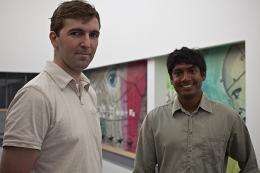
Associate Professor of Electrical Engineering Rob J. Wood (left) and graduate student Pratheev S. Sreetharan are working on miniature flying vehicles that could someday be used to probe environmental hazards, forest fires, and other challenges too perilous for people. Image: Justin Ide
(PhysOrg.com) -- Engineers at Harvard University have created a millionth-scale automobile differential to govern the flight of minuscule aerial robots that could someday be used to probe environmental hazards, forest fires, and other challenges too perilous for people.
Their new approach is the first to passively balance the aerodynamic forces encountered by these miniature flying devices, letting their wings flap asymmetrically in response to gusts of wind, structural damage, and other real-world impediments.
“The drivetrain for an aerial microrobot shares many characteristics with a two-wheel-drive automobile,” said lead author Pratheev S. Sreetharan, a graduate student in Harvard’s School of Engineering and Applied Sciences. “Both deliver power from a single source to a pair of wheels or wings. But our 'PARITy differential' generates torques up to 10 million times smaller than in a car, is 5 millimeters long, and weighs about one-hundredth of a gram — a millionth the mass of an automobile differential.” PARITy stands for passive aeromechanical regulation of imbalanced torques.
High-performance aerial microrobots, such as those that Harvard scientists describe in the Journal of Mechanical Design, could ultimately be used to investigate areas deemed too dangerous for people. Scientists at institutions including the University of California, Berkeley, the University of Delaware, the University of Tokyo, and Delft University of Technology in the Netherlands are exploring aerial microrobots as cheap, disposable tools that might someday be deployed in search-and-rescue operations, agriculture, environmental monitoring, and exploration of hazardous environments.
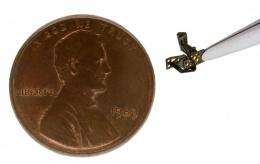
Harvard's 'PARITy differential' for MAVs
To fly successfully through unpredictable environments, aerial microrobots — which resemble insects, nature’s nimblest fliers — have to negotiate conditions that change second by second. Insects usually accomplish this by flapping their wings in unison, a process whose kinematic and aerodynamic basis remains poorly understood.Sreetharan and his co-author, Robert J. Wood, recognized that an aerial microrobot based on an insect did not have to contain complex electronic feedback loops to control wing positions precisely.
“We’re not interested so much in the position of the wings as the torque they generate,” said Wood, an associate professor of electrical engineering at Harvard. “Our design uses ‘mechanical intelligence’ to determine the correct wing speed and amplitude to balance the other forces affecting the robot. It can slow down or speed up automatically to correct imbalances.”
Sreetharan and Wood found that even when a significant part of an aerial microrobot’s wing was removed, the self-correction engendered by their PARITy drivetrain allowed the device to remain balanced in flight. Smaller wings simply flapped harder to keep up with the torque generated by an intact wing, reaching speeds of up to 6,600 beats per minute.
The Harvard engineers say their passive approach to regulating the forces generated in flight is preferable to a more active approach involving electronic sensors and computation, which would add weight and complexity to devices that need to be as small and as lightweight as possible. Current-generation aerial microrobots are about the size and weight of many insects, and even make a similar buzzing sound when flying.
“We suspect that similar passive mechanisms exist in nature, in actual insects,” Sreetharan said. “We take our inspiration from biology, and from the elegant simplicity that has evolved in so many natural systems.”
-
Microrobots: Miniature auto differential helps tiny aerial robots stay aloft
Sep 02, 2010 |
not rated yet |
0
-
Micro flying robots can fly more effectively than flies
Aug 01, 2009 |
not rated yet |
0
-
Staying the course: Fruit flies employ stabilizer reflex to recover from midflight stumbles
Mar 01, 2010 |
not rated yet |
0
-
Flies Don't Think Much Of Turning (w/ Video)
Apr 02, 2010 |
not rated yet |
0
-
Artificial butterfly in flight and filmed (w/ Video)
May 20, 2010 |
not rated yet |
0
-
Engineers build first sub-10-nm carbon nanotube transistor
Feb 01, 2012 |
4.9 / 5 (30) |
30
-
Something old, something new: Evolution and the structural divergence of duplicate genes
Jan 31, 2012 |
4.6 / 5 (7) |
1
-
The hidden nanoworld of ice crystals: Revealing the dynamic behavior of quasi-liquid layers
Jan 30, 2012 |
5 / 5 (3) |
1
-
Stock market network reveals investor clustering
Jan 27, 2012 |
3.9 / 5 (23) |
8
-
Of microchemistry and molecules: Electronic microfluidic device synthesizes biocompatible probes
Jan 26, 2012 |
5 / 5 (1) |
0
-
feed hold button on CNC lathe
17 hours ago
-
Mechanics of Solids ( Final exam question) please help!
19 hours ago
-
RFAC in Fortran
22 hours ago
-
dynamics 2/32
Feb 08, 2012
-
dynamics
Feb 08, 2012
-
Vibration Absorbtion Problem
Feb 08, 2012
- More from Physics Forums - General Engineering
More news stories
Soraa LED light may dim 50-watt halogen rivals
(PhysOrg.com) -- Soraa, a Fremont, California company founded in 2008, this week launched its first product, a light that uses LEDS (light emitting diodes). The "Soraa LED MR16 lamp" is the "perfect" replacement ...
First Google hire leaving for online academy
The first person hired by Google's founders is leaving the Internet giant to devote himself to an innovative online education website called Khan Academy.
6 hours ago |
5 / 5 (1) |
0
FBI file: Steve Jobs was considered for govt post
(AP) -- FBI background interviews of some people who knew Apple co-founder Steve Jobs reveal a man driven by power and alienating some of the people who worked with him.
6 hours ago |
3.4 / 5 (5) |
0
New integrated building model may improve fish farming operations
Today's "locavore" movement with its emphasis on eating more locally-produced food is a natural fit for fruits and vegetables in nearly every region, but few entrepreneurs have dared to apply the concept to ...
6 hours ago |
not rated yet |
0
Samsung can continue selling Galaxy tabs in Germany: court
South Korea's Samsung Electronics can continue to sell its Galaxy Tab 10.1N tablet computer in Germany, a German court ruled Thursday, rejecting a bid by arch-rival Apple to have them banned.
16 hours ago |
5 / 5 (2) |
3
'Dark plasmons' transmit energy
Microscopic channels of gold nanoparticles have the ability to transmit electromagnetic energy that starts as light and propagates via "dark plasmons," according to researchers at Rice University.
Hydrogen from acidic water: Researchers develop potential low cost alternative to platinum for splitting water
A technique for creating a new molecule that structurally and chemically replicates the active part of the widely used industrial catalyst molybdenite has been developed by researchers with the Lawrence Berkeley ...
FDA-approved drug rapidly clears amyloid from the brain, reverses Alzheimer's symptoms in mice
Neuroscientists at Case Western Reserve University School of Medicine have made a dramatic breakthrough in their efforts to find a cure for Alzheimer's disease. The researchers' findings, published in the journal Science, show t ...
Ultraviolet protection molecule in plants yields its secrets
Lying around in the sun all day is hazardous not just for humans but also for plants, which have no means of escape. Ultraviolet (UV) radiation from the sun can damage proteins and DNA inside cells, leading ...
Anyone can learn to be more inventive, cognitive researcher says
There will always be a wild and unpredictable quality to creativity and invention, says Anthony McCaffrey, a cognitive psychology researcher at the University of Massachusetts Amherst, because an "Aha moment" is rare and ...
Flexible paper robots
(PhysOrg.com) -- These inexpensive robots can stretch, bend and twist under control, and lift objects up to 120 times their own weight. Being soft, they can apply gentle and even pressure, and adapt to varied ...

Sep 06, 2010
Rank: not rated yet
Sep 06, 2010
Rank: not rated yet
Sep 07, 2010
Rank: not rated yet
I prefer microbot. Thank you very much.