Carbon mapping breakthrough
September 6, 2010
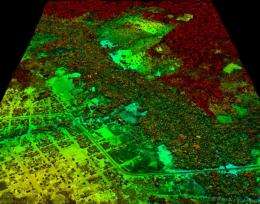
A new high-resolution airborne and satellite mapping approach provides detailed information on carbon stocks in Amazonia. This image shows an area of road building and development adjacent to primary forest in red tones, and secondary forest regrowth in green tones. Image from the Carnegie Airborne Observatory, Carnegie Institution for Science
By integrating satellite mapping, airborne-laser technology, and ground-based plot surveys, scientists from the Carnegie Institution's Department of Global Ecology, with colleagues from the World Wildlife Fund and in coordination with the Peruvian Ministry of the Environment (MINAM), have revealed the first high-resolution maps of carbon locked up in tropical forest vegetation and emitted by land-use practices. These new maps pave the way for accurate monitoring of carbon storage and emissions for the proposed United Nations initiative on Reduced Emissions from Deforestation and Degradation (REDD).
The study is published in the September 6, 2010, early edition of the Proceedings of the National Academy of Sciences.
The United Nations REDD initiative could create financial incentives to reduce carbon emissions from deforestation and degradation. However, this and similar carbon monitoring programs have been hindered by a lack of accurate, high-resolution methods to account for changes in the carbon stored in vegetation and lost through deforestation, selective logging, and other land-use disturbances. The new high-resolution mapping method will have a major impact on the implementation of REDD in tropical regions around the world.
The study covered over 16,600 square miles of the Peruvian Amazon—an area about the size of Switzerland. The researchers used a four-step process: They mapped vegetation types and disturbance by satellite; developed maps of 3-D vegetation structure using a LiDAR system (light detection and ranging) from the fixed-wing Carnegie Airborne Observatory; converted the structural data into carbon density using a small network of field plots on the ground; and integrated the satellite and LiDAR data for high-resolution maps of stored and emitted carbon. The scientists combined historical deforestation and degradation data with 2009 carbon stock information to calculate emissions from 1999-2009 for the Madre de Dios region.
"We found that the total regional forest carbon storage was about 395 million metric tons and emissions reached about 630,000 metric tons per year," explained lead author Greg Asner. "But what really surprised us was how carbon storage differed among forest types and the underlying geology, all in very close proximity to one another. For instance, where the local geology is up to 60 million years old, the vegetation retains about 25% less carbon than the vegetation found on geologically younger, more fertile surfaces. We also found an important interaction between geology, land use, and emissions. These are the first such patterns to emerge from the Amazon forest."
The scientists also found that the paving of the Interoceanic Highway, combined with selective logging and gold mining, caused an increase of deforestation emissions of more than 61% by 2009, while degradation emissions doubled. Forest degradation increased regional carbon emissions by 47% over deforestation alone. However, the researchers were able to detect an 18% offset to these regional emissions in forests regrowing on previously cleared and now abandoned lands.
Members of the Peruvian government participated throughout the research process to familiarize themselves with the new method. In doing so, they aimed to assess the method's advantages, evaluate deforestation and forest disturbance, and determine carbon stocks in an environmentally critical area of Madre de Dios, Peru. "A valuable opportunity has opened for MINAM to count on Carnegie's scientific and technical support. This will strengthen our ability to monitor the Amazon forest, build experience in improving the interpretation of the country's environmental and land management conditions, and contribute to the establishment of the REDD mechanism," says Doris Rueda, director of Land Management at MINAM.
To support REDD, the Intergovernmental Panel on Climate Change (IPCC) issued baseline carbon density estimates for different biomes of the world, while also encouraging higher resolution approaches. When used for the Peruvian study area, the IPCC baseline estimate for carbon storage is 587 million metric tons. Based on the new Carnegie approach, the estimated total is 395 million metric tons. Under REDD-type programs, however, the high-resolution accuracy of the new approach would yield more credit per ton of carbon, thereby providing financial incentives for slowing deforestation and degradation.
Carnegie scientists are expanding their demonstration and training efforts in the high-resolution mapping technique with the governments of Ecuador and Colombia.
Provided by Carnegie Institution
-
Fires in Amazon challenge emission reduction program
Jun 03, 2010 |
not rated yet |
0
-
Scientists warn increase in Amazon fires threatens UN-led carbon savings
Jun 30, 2010 |
not rated yet |
0
-
Breakthrough in monitoring tropical deforestation announced in Copenhagen
Dec 10, 2009 |
not rated yet |
0
-
Cautious conservation: How to ensure that slowing global warming will protect biodiversity
Nov 16, 2009 |
not rated yet |
0
-
Study highlights forest protected areas as a critical strategy for slowing climate change
Mar 16, 2010 |
not rated yet |
0
-
Engineers build first sub-10-nm carbon nanotube transistor
Feb 01, 2012 |
4.9 / 5 (31) |
30
-
Something old, something new: Evolution and the structural divergence of duplicate genes
Jan 31, 2012 |
4.6 / 5 (7) |
1
-
The hidden nanoworld of ice crystals: Revealing the dynamic behavior of quasi-liquid layers
Jan 30, 2012 |
5 / 5 (3) |
1
-
Stock market network reveals investor clustering
Jan 27, 2012 |
3.9 / 5 (23) |
8
-
Of microchemistry and molecules: Electronic microfluidic device synthesizes biocompatible probes
Jan 26, 2012 |
5 / 5 (1) |
0
-
Discrepancy between oxygen and carbon-dioxide levels
Feb 09, 2012
-
where gems are found in the world
Feb 09, 2012
-
Wind Waves in Reservoir ~ Wind run-up and Wind set-up
Feb 08, 2012
-
Balance of oxygen in the atmosphere
Feb 01, 2012
-
The case for a methanol-based economy
Jan 30, 2012
-
Weather in a rotating cylinder
Jan 25, 2012
- More from Physics Forums - Earth
More news stories
Humans may have helped the decline of African rainforests 3000 years ago
(PhysOrg.com) -- Large areas of rainforests in Central Africa mysteriously disappeared over three thousand years ago, to be replaced by savannas. The prevailing theory has been that the cause was a change ...
Could Venus be shifting gear?
(PhysOrg.com) -- ESAs Venus Express spacecraft has discovered that our cloud-covered neighbour spins a little slower than previously measured. Peering through the dense atmosphere in the infrared, the ...
Space & Earth / Space Exploration
12 hours ago |
5 / 5 (7) |
7
|
NASA sees wide-eyed cyclone Jasmine
Cyclone Jasmine's eye has opened wider on NASA satellite imagery, as it moves through the Southern Pacific Ocean.
Space & Earth / Earth Sciences
4 hours ago |
2 / 5 (1) |
1
NASA sees Giovanna reach cyclone strength, threaten Madagascar
Tropical Storm 12S built up steam and became a cyclone on February 10, 2012 as NASA's Terra satellite passed overhead. Residents of east-central Madagascar should prepare for this cyclone to make landfall ...
Space & Earth / Earth Sciences
4 hours ago |
not rated yet |
0
Mars Science Laboratory computer issue resolved
(PhysOrg.com) -- Engineers have found the root cause of a computer reset that occurred two months ago on NASA's Mars Science Laboratory and have determined how to correct it.
Space & Earth / Space Exploration
13 hours ago |
4.7 / 5 (6) |
3
|
Google users warned of threat to smartphone wallets
Users of Google smartphone wallets were being warned on Friday that there is a way to crack pass codes intended to thwart thieves from going on illicit shopping sprees.
Anonymous knocks CIA website offline (Update)
The website of the Central Intelligence Agency was inaccessible on Friday after the hacker group Anonymous claimed to have knocked it offline.
Complex wiring of the nervous system may rely on a just a handful of genes and proteins
Researchers at the Salk Institute have discovered a startling feature of early brain development that helps to explain how complex neuron wiring patterns are programmed using just a handful of critical genes. ...
New error-correcting codes guarantee the fastest possible rate of data transmission
Error-correcting codes are one of the triumphs of the digital age. Theyre a way of encoding information so that it can be transmitted across a communication channel such as an optical fiber o ...
The power of estrogen -- male snakes attract other males
A new study has shown that boosting the estrogen levels of male garter snakes causes them to secrete the same pheromones that females use to attract suitors, and turned the males into just about the sexiest ...
Putting the squeeze on planets outside our solar system
(PhysOrg.com) -- Using high-powered lasers, scientists at Lawrence Livermore National Laboratory and collaborators discovered that molten magnesium silicate undergoes a phase change in the liquid state, abruptly ...
Sep 10, 2010
Rank: not rated yet