These cancer cells will self-destruct in 5...4...
September 6, 2010
These cancer cells will self-destruct in 5...4...

Enlarge

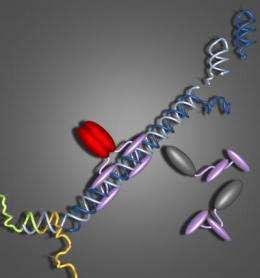
Small conditional RNAs selectively kill cancer cells. In lab-grown human brain, prostate and bone cancer cells, small conditional RNAs (light and dark blue) bind to a targeted RNA cancer mutation (orange and green), triggering self-assembly of a long double-stranded RNA polymer that activates an innate immune response (gray turns to red) leading to cell death. No measurable reduction in numbers is observed for cells lacking targeted cancer mutations. Image courtesy of Suvir Venkataraman, William M. Clemons, Jr. and Niles A. Pierce (Caltech)

Cancer is a difficult disease to treat because it's a personal disease. Each case is unique and based on a combination of environmental and genetic factors. Conventional chemotherapy employs treatment with one or more drugs, assuming that these medicines are able to both "diagnose" and "treat" the affected cells. Many of the side effects experienced by chemotherapy patients are due to the fact that the drugs they are taking aren't selective enough. For instance, taking a drug that targets fast-growing tumor cells frequently results in hair loss, because cells in the hair follicle are among some of the fastest growing in the body. When it comes down to it, these drugs get the diagnosis wrong.

But what if we had cancer treatments that worked more like a computer program, which can perform actions based on conditional statements? Then, a treatment would kill a cell if --and only if-- the cell had been diagnosed with a mutation. Only the defective would be destroyed, virtually eliminating unwanted side effects.

With support from the National Science Foundation (NSF), researchers at the California Institute of Technology have created conditional small RNA molecules to perform this task. Their strategy uses characteristics that are built into our DNA and RNA to separate the diagnosis and treatment steps.

"The molecules are able to detect a mutation within a cancer cell, and then change conformation to activate a therapeutic response in the cancer cell, while remaining inactive in cells that lack the cancer mutation," claims Niles Pierce, co-author of a recent study which appears in the September 6 issue of (PNAS).

This work is part of the Molecular Programming Project, funded by NSF's Directorate for Computer & Information Science & Engineering. One of the goals of the project is to increase understanding of how information can be stored and processed by molecules, and how we might create practical applications that utilize that information.

At the heart of this approach is ribonucleic acid or RNA, and all of the normal tasks it performs each and every day to keep our cells alive and healthy. RNA is the relatively short-lived counterpart of DNA, the coding system that stores full copies of our entire genome within almost every cell of our body. If we think of as information stored on the hard drive of a computer, then RNA is like information stored on a more volatile kind of memory like RAM -- which is erased when you switch off your computer.

RNAs perform all kinds of functions in a cell, acting as messengers and switches to communicate and monitor which genes are expressed in a cell at any given time. A particular class of RNAs, called small RNAs, is less than 30 base pairs in length (an average gene is thousands of base pairs long). These small bits of RNA are involved in many of the processes that maintain life. The treatment developed by Pierce and his colleagues relies on two separate small RNAs that structurally mimic those that occur naturally within our own cells. Because these molecules resemble small RNAs that are normally present, the researchers hope there will be few, if any side effects.

"By de-coupling diagnosis and treatment, we can create molecules that are both highly selective and highly effective in killing cancer cells," said Pierce. "Conceptually, small conditional RNAs have the potential to transform cancer treatment because they change what we can expect from a molecule. Many years of work remain to establish whether this conceptual promise can be realized in human patients."

Here's how it works: Treatment involves two different small RNAS. The first small RNA will open up if --and only if-- it finds the cancer mutation. A positive "diagnosis" exposes a signal that was previously hidden within the small RNA. Once this small RNA is open, a second small binds to it, setting off a chain reaction in which these continue to combine to form a longer chain. The length of the chain is an important part of the "treatment". Longer chains trick the cell into thinking it has been invaded by a virus, tripping a self-destruct response.

In the PNAS study, researchers demonstrated that this approach effectively eliminates lab-grown human brain, prostate and bone cancer cells in a mutation-specific manner. Future experiments will determine whether the treatment is effective on a larger scale.

Provided by National Science Foundation (news : web)

4.6 /5 (14 votes)  

Filter


Move the slider to adjust rank threshold, so that you can hide some of the comments.


Display comments: newest first

fixer
Sep 06, 2010

Rank: 5 / 5 (1)
Looks great guys!
Put it on the list with all the other hopefulls that showcase here and will also be available in a few years maybe.
Got anything available NOW for anyone who might be reading this who can't wait several years?
TabulaMentis
Sep 06, 2010

Rank: not rated yet
"One of the goals of the project is to increase understanding of how information can be stored and processed by molecules, and how we might create practical applications that utilize that information."

Small conditional RNAs sound like a great way to target cancer cells. They are like miniature smart weapons
Arikin
Sep 06, 2010

Rank: not rated yet
fixer. Yes it does look good.
Research goes slowly because actual human testing is very restricted. You can't test anything you want on humans because each has their own right to life :-)

For example if they get it wrong, you might trigger the self destruct in all the cells. With laws and regulations people have decided you can't test every possibility on humans until you get it right. You have to test it on animals first...
ormondotvos
Sep 06, 2010

Rank: not rated yet
I send all the pertinent gee-whizzes to my appropriate doctor. Can't hurt!
maxcypher
Sep 06, 2010

Rank: 5 / 5 (1)
I'm seeing an artificial immune system -- grafted on our already existing and much more complex immune system -- that targets cancerous cells exclusively. Given that they are able to characterize cancerous cells as simply as they imply, I see this getting out to the public in under a decade. Exponential tech development and all that.
Rank 4.6 /5 (14 votes)
Relevant PhysicsForums posts

More news stories

Decoding the molecular machine behind E. coli and cholera

Scientists from Queen Mary, University of London have discovered the workings behind some of the bacteria that kill hundreds of thousands every year, possibly paving the way for new antibiotics that could treat infections ...

Biology / Cell & Microbiology

created 21 minutes ago | popularity not rated yet | comments 0 | with audio podcast

Deadly bird parasite evolves at exceptionally fast rate

A new study of a devastating bird disease that spread from poultry to house finches in the mid-1990s reveals that the bacteria responsible for the disease evolves at an exceptionally fast rate. What's more, ...

Biology / Biotechnology

created 21 minutes ago | popularity not rated yet | comments 0 | with audio podcast

New research reveals why fishermen keep fishing despite dwindling catches

Half of fishermen would not give up their livelihood in the face of drastically declining catches according to research led by the University of East Anglia (UEA).

Biology / Ecology

created 21 minutes ago | popularity not rated yet | comments 0

Ultraviolet protection molecule in plants yields its secrets

Lying around in the sun all day is hazardous not just for humans but also for plants, which have no means of escape. Ultraviolet (UV) radiation from the sun can damage proteins and DNA inside cells, leading ...

Biology / Plants & Animals

created 1 hour ago | popularity 5 / 5 (3) | comments 0 | with audio podcast

Deciding to go left or right: Researchers use device to determine that lower animals can navigate too

For decades, scientists have associated binary decision making — opting to go left or right — with higher-ranking animals, including humans. A team of Harvard researchers, however, is rewriting that ...

Biology / Plants & Animals

created 8 hours ago | popularity not rated yet | comments 2 | with audio podcast


Flexible paper robots

(PhysOrg.com) -- These inexpensive robots can stretch, bend and twist under control, and lift objects up to 120 times their own weight. Being soft, they can apply gentle and even pressure, and adapt to varied ...

Tell me how you are -- and I know how long you will live

The way people rate their health determines their probability of survival in the following decades. Researchers from the Institute of Social and Preventive Medicine at the University of Zurich demonstrate that for ratings ...

Ultrasound study provides first direct evidence of effect of malaria on fetal growth

A study of almost 3,800 pregnancies has provided the most accurate and direct evidence to date that malaria infection reduces early foetal growth. Low birth weight is the most important risk factor for neonatal mortality ...

Seizures in patients with pork tapeworm caused by Substance P

A neuropeptide called Substance P is the cause of seizures in patients with brains infected by the pork tapeworm (Taenia solium), said Baylor College of Medicine researchers in a report that appears online in the open access ...

Further support for a role of synaptic proteins in autism spectrum disorders

A new study combines genetic and neurobiological approaches to confirm that synaptic mutations increase the risk of autism spectrum disorders (ASDs). It also highlights a role for modifier genes in these disorders. Published ...

Potential for incorrect relationship identification in new forensic familial searching techniques

New research suggests that unrelated individuals may be mistakenly identified as genetic family members due to inaccurate genetic assumptions. This is particularly relevant when considering familial searching: a new technique ...