Ritalin improves brain function, task performance in cocaine abusers
September 7, 2010
Ritalin Improves Brain Function, Task Performance in Cocaine Abusers

Enlarge

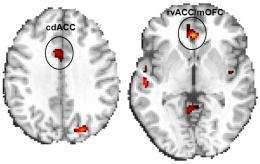
Methylphenidate normalizes functional magnetic resonance imaging cingulate responses and reduces impulsivity on a salient cognitive task in individuals with cocaine addiction. Above is an axial map that shows the caudal dorsal anterior cingulate (cdACC) and rostroventromedial anterior cingulate (extending to the medial orbitofrontal cortex, rvACC/mOFC) — cortical regions that showed enhanced responses to methylphenidate as compared to placebo in cocaine addicted individuals. These regions are crucial for the ability to regulate behavior, cognition and emotion.

(PhysOrg.com) -- Brain-scanning study shows Ritalin improves impaired brain function in people addicted to cocaine, implying it could play a role in facilitating recovery from addiction.

A brain-scanning study at the U.S. Department of Energy’s (DOE) Brookhaven National Laboratory, conducted with collaborators from Stony Brook University, reveals that an oral dose of , commonly known as Ritalin, improves impaired brain function and enhances cognitive performance in people who are addicted to cocaine. The study — to be published in the the week of TKTK, 2010 — suggests that methylphenidate, combined with cognitive interventions, may have a role in facilitating recovery from drug addiction.

“Previous studies have shown that methylphenidate does not decrease cocaine use or prevent relapse in addicted individuals, so it wouldn’t work to treat directly, the way methadone works to treat heroin abuse,” said Rita Z. Goldstein, a psychologist who leads the neuropsychoimaging group at Brookhaven Lab. “But other studies show that methylphenidate does decrease behaviors such as risk taking and impulsivity and improves brain function and cognitive performance in a range of other conditions that also affect the brain’s prefrontal cortex, including (ADHD), some forms of dementia, and certain kinds of brain injury. If it also has these positive effects in cocaine-addicted individuals, then it could be a useful component of a treatment strategy that helps increase recovering addicts’ impulse control.”

To find out, Goldstein’s group performed (fMRI) on 13 cocaine users and 14 healthy control subjects who were asked to perform a cognitive task after being given either a low oral dose of methylphenidate (20 milligrams) or a placebo. The task involved pushing a button to correctly identify the color of a printed word; some words had to do with drug use, others were “neutral.” Subjects received monetary rewards for correct answers.

The scientists were particularly interested in two parts of the prefrontal cortex previously shown to be impaired during this cognitive activity in cocaine-addicted individuals. “These regions help to regulate emotion, cognition, and behavior in response to salient stimuli — the things we find particularly interesting or relevant,” Goldstein said. “Because drug users have deficits in these regions, they may have less ability to regulate their emotions and exert cognitive control over certain behaviors.”

Compared with cocaine users given placebos — who (compared to healthy controls) exhibited reduced function in these prefrontal cortex regions — cocaine users given a low dose of methylphenidate had improved brain function such that they were more like the healthy control subjects. The subjects given methylphenidate were also less likely to make “errors of commission” (pressing a button incorrectly or prematurely), a measure of impulsivity, while performing the cognitive task than subjects given a placebo. Furthermore, the greater the improvement in task accuracy with methylphenidate, the larger the increase in fMRI signal in the prefrontal cortex regions of interest, showing that the improvements in were directly related to improved cognitive performance.

“Future studies need to evaluate whether these results can be generalized to other tasks or activities that involve these specific brain regions,” Goldstein said. “But these results do suggest that by enhancing prefrontal cortex function and associated cognitive performance — particularly the decrease in impulsivity — methylphenidate could help to improve clinical outcomes in people seeking to overcome drug addiction.”

Provided by Brookhaven National Laboratory (news : web)

4.8 /5 (5 votes)  

Rank 4.8 /5 (5 votes)
Related Stories
Relevant PhysicsForums posts
  • Is Everyday Technology Killing Us?
    createdFeb 08, 2012
  • Exercise and weight loss
    createdFeb 08, 2012
  • Why do we have head aches? Our brains can't feel anything.
    createdFeb 07, 2012
  • "The end of diseases" by David Agus, interview from Daily Show with Jon Stewart
    createdFeb 04, 2012
  • Oncolytic adenovirus
    createdFeb 04, 2012
  • Nutrition label stuffs and diets
    createdFeb 02, 2012
  • More from Physics Forums - Medical Sciences

More news stories

US issues guidelines to avoid heparin contamination

Four years after US drug-maker Baxter International's blood thinner heparin was contaminated in China, causing dozens of deaths, US regulators on Friday issued draft guidelines for safe production.

Medicine & Health / Medications

created 54 minutes ago | popularity not rated yet | comments 0

Curry spice component may help slow prostate tumor growth

Curcumin, an active component of the Indian curry spice turmeric, may help slow down tumor growth in castration-resistant prostate cancer patients on androgen deprivation therapy (ADT), a study from researchers ...

Medicine & Health / Cancer

created 3 hours ago | popularity 5 / 5 (3) | comments 0 | with audio podcast

Health experts, scientists to discuss bird flu studies

The World Health Organization said Friday it will meet next week to determine whether scientists can publish research on a bird flu virus that may be easily passed among humans.

Medicine & Health / Diseases

created 1 hour ago | popularity not rated yet | comments 0

Team isolates nerve cells involved in storing long term memory and gene proteins associated with them

(Medical Xpress) -- A research team in Taiwan has succeeded in isolating two nerve cells in fruit fly brains that are believed to be the major players in allowing for the formation of long term memories. Furthermore, ...

Medicine & Health / Neuroscience

created 4 hours ago | popularity 5 / 5 (4) | comments 1 | with audio podcast report

Both maternal and paternal age linked to autism

Older maternal and paternal age are jointly associated with having a child with autism, according to a recently published study led by researchers at The University of Texas Health Science Center at Houston (UTHealth).

Medicine & Health / Psychology & Psychiatry

created 2 hours ago | popularity not rated yet | comments 0 | with audio podcast


Putting the squeeze on planets outside our solar system

(PhysOrg.com) -- Using high-powered lasers, scientists at Lawrence Livermore National Laboratory and collaborators discovered that molten magnesium silicate undergoes a phase change in the liquid state, abruptly ...

Employers feel no love for unscrupulous practice of 'service sweethearting'

A new study led by two Florida State University marketing professors finds that some frontline service employees who are rewarded for hikes in customer loyalty and satisfaction also may engage in "service ...

Expat French get Internet vote for first time

French citizens will for the first time this year be able to vote in a parliamentary election over the Internet, an experiment that could be extended to other elections if successful.

"Twisted Metal" gamers get shot at real gunplay

Fans of "Twisted Metal" will get to welcome a long-awaited sequel of the car-battle videogame with a real-world bang by blasting an ice cream truck to bits with a machine gun.

The power of estrogen -- male snakes attract other males

A new study has shown that boosting the estrogen levels of male garter snakes causes them to secrete the same pheromones that females use to attract suitors, and turned the males into just about the sexiest ...

New error-correcting codes guarantee the fastest possible rate of data transmission

Error-correcting codes are one of the triumphs of the digital age. They’re a way of encoding information so that it can be transmitted across a communication channel — such as an optical fiber o ...