The reindeer and the mammoth already lived on the Iberian Peninsula 150,000 years ago
September 7, 2010
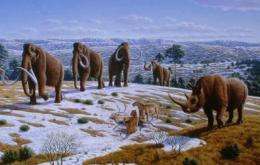
The reindeer and the mammoth already lived on the Iberian Peninsula 150,000 years ago. Credit: Peter Novák
A team made up of members of the University of Oviedo (UO) and the Complutense University of Madrid (UCM) have gathered together all findings of the woolly mammoth, the woolly rhinoceros and the reindeer in the Iberian Peninsula to show that, although in small numbers, these big mammals, prehistoric indicators of cold climates, already lived in this territory some 150,000 years ago.
The presence of the woolly mammoth (Mammuthus primigenius), the woolly rhinoceros (Coelodonta antiquitatis), the reindeer (Rangifer tarandus), and to a lesser extent the wolverine (Gulo gulo), the arctic fox (Alopex lagopus), the musk-ox (Ovibos moschatus) and the Saiga antelope (Saiga tatarica), has been linked to the paleoclimatic scale created on the basis of the isotopic composition of oxygen in the ice of Greenland.
"The findings of cold climate fauna in the Iberian Peninsula coincide with the periods of greatest global cooling recorded in the ice of Greenland", Diego Álvarez-Lao, main author of the work and researcher in the Palaeontology Department of the UO explains to SINC.
The study, which has been published in the journal Quaternary International, reveals that the oldest remains of mammals adapted to cold climates found in the Iberian Peninsula belong to great prehistoric mammals which lived isolated in Spain 150,000 years ago.
The "glacial fauna" entered the Peninsula at that time because "the environmental conditions in central and northern Europe were so extreme that the animals were obliged to migrate to the south, where the climate was less severe", Álvarez-Lao explains.
44,000 years ago these animals became more common in the Iberian Peninsula but only for periods. "The cold periods (with the presence of glacial fauna) alternated with milder periods", adds the researcher.
The increase in temperatures caused a biological crisis
According to the team, the last findings of these cold species date back some 10,000 years, and coincide with the end of the glaciations. At that time, the climate became warmer in the whole northern hemisphere and the favourable habitat for these faunae was reduced to increasingly more northern latitudes and to smaller spaces.
"The increase in temperatures caused a genuine biological crisis for these animals from extremely cold climates. Some species such as the reindeer and the arctic fox found their new habitat in the arctic regions of the planet, where they still survive today. Others, such as the woolly mammoth and the woolly rhinoceros weren't so lucky", specifies the paleontologist.
According to the studies of pollen remains associated with these findings, the landscape of the period in which the great mammals lived in the Iberian Peninsula comprised mainly of steppes, or herbaceous vegetation. "Trees would have been very scarce in these times of extreme cold and environmental aridity", Álvarez-Lao points out.
More than 72 sites with remains of mammals
The Spanish researchers found the fossil remains of glacial climate fauna in 72 Iberian sites, the majority of which are in the north of the peninsula (Cornisa Cantabrica and Catalonia). There are also some traces in inland areas of the peninsula and even in the south, where the site of the woolly mammoths of Padul (Granada) lies.
"These species lived alongside different human cultures. There is evidence in some sites of the Basque country, Navarra and Catalonia that the Neanderthals coexisted with the mammoths and the reindeer at specific times. However, the majority of evidence of these faunae coincides with the periods of the Gravettian, Solutrean and Magdalenian cultures (during the Upper Paleolithic era in West Europe)", states Álvarez-Lao.
More information: Álvarez-Lao, Diego J.; García, Nuria. "Chronological distribution of Pleistocene cold-adapted large mammal faunas in the Iberian Peninsula" Quaternary International 212(2): 120-128, 2010.
Provided by FECYT - Spanish Foundation for Science and Technology
-
Steppe change: Mammoths roamed southern Spain
Jul 09, 2009 |
not rated yet |
0
-
Dwindling green pastures, not hunting, may have killed off the mammoth
Aug 18, 2010 |
not rated yet |
0
-
A new species of lichen discovered in the Iberian Peninsula
Jan 11, 2010 |
not rated yet |
0
-
New study changes conditions for Spanish brown bears
Mar 18, 2008 |
not rated yet |
0
-
Extinct rodent species discovered
Jul 28, 2009 |
not rated yet |
0
-
Engineers build first sub-10-nm carbon nanotube transistor
Feb 01, 2012 |
4.9 / 5 (31) |
30
-
Something old, something new: Evolution and the structural divergence of duplicate genes
Jan 31, 2012 |
4.6 / 5 (7) |
1
-
The hidden nanoworld of ice crystals: Revealing the dynamic behavior of quasi-liquid layers
Jan 30, 2012 |
5 / 5 (3) |
1
-
Stock market network reveals investor clustering
Jan 27, 2012 |
3.9 / 5 (23) |
8
-
Of microchemistry and molecules: Electronic microfluidic device synthesizes biocompatible probes
Jan 26, 2012 |
5 / 5 (1) |
0
-
Mitosis
3 hours ago
-
Stem cell question.
4 hours ago
-
Protease cleavage
11 hours ago
-
Pertubance in a model
17 hours ago
-
Cancer drugs and Alzheimer's, Oh my!
Feb 09, 2012
-
Squishing cells
Feb 09, 2012
- More from Physics Forums - Biology
More news stories
A frank discussion of the power law and linking correlation to causation
(PhysOrg.com) -- Michael Stumpf a mathematics professor at Imperial College in London, and Mason Porter a lecturer at Oxford have teamed together to write and publish a perspective piece in Science regarding the in ...
Employers feel no love for unscrupulous practice of 'service sweethearting'
A new study led by two Florida State University marketing professors finds that some frontline service employees who are rewarded for hikes in customer loyalty and satisfaction also may engage in "service ...
Other Sciences / Economics & Business
11 hours ago |
4 / 5 (1) |
5
The question of life in the ancient world
Theres a general feeling that we dont get the Greeks ancient or modern. Many, including heads of state like Angela Merkel, visibly shake their head in exasperation, rightly or wrongly, at ...
Other Sciences / Archaeology & Fossils
17 hours ago |
1.3 / 5 (3) |
4
Sonic Cradle lands spot in TED exhibition
A Simon Fraser University graduate student project that melds music, meditation and modern technology has landed a rare spot as an exhibit at TEDActive 2012 in Palm Springs, California this month.
13 hours ago |
not rated yet |
0
Do we no longer care about the collective good?
The Transformation of Solidarity, a book co-edited by University of Queensland sociologist Dr Mara Yerkes, tackles the subject of globalisation of national economies and societies where we put a high value ...
Other Sciences / Social Sciences
Feb 06, 2012 |
3.9 / 5 (8) |
39
Anonymous knocks CIA website offline (Update)
The website of the Central Intelligence Agency was inaccessible on Friday after the hacker group Anonymous claimed to have knocked it offline.
Google users warned of threat to smartphone wallets
Users of Google smartphone wallets were being warned on Friday that there is a way to crack pass codes intended to thwart thieves from going on illicit shopping sprees.
New error-correcting codes guarantee the fastest possible rate of data transmission
Error-correcting codes are one of the triumphs of the digital age. Theyre a way of encoding information so that it can be transmitted across a communication channel such as an optical fiber o ...
Humans may have helped the decline of African rainforests 3000 years ago
(PhysOrg.com) -- Large areas of rainforests in Central Africa mysteriously disappeared over three thousand years ago, to be replaced by savannas. The prevailing theory has been that the cause was a change ...
New power source discovered
(PhysOrg.com) -- Researchers at the Massachusetts Institute of Technology (MIT) and RMIT University have made a breakthrough in energy storage and power generation.
The power of estrogen -- male snakes attract other males
A new study has shown that boosting the estrogen levels of male garter snakes causes them to secrete the same pheromones that females use to attract suitors, and turned the males into just about the sexiest ...