What can a New Zealand reptile tell us about false teeth?
September 7, 2010
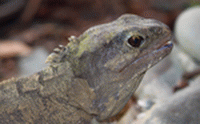
A lizard-like Tuatara, whose ancestors were widespread at the time of the dinosaurs. (c)Brian Gratwicke
Using a moving 3D computer model based on the skull and teeth of a New Zealand reptile called tuatara, a BBSRC-funded team from the University of Hull, University College London and the Hull York Medical School has revealed how damage to dental implants and jaw joints may be prevented by sophisticated interplay between our jaws, muscles and brain. This research will appear in a future edition of the Journal of Biomechanics.
The tuatara is a lizard-like reptile that has iconic status in its homeland of New Zealand because its ancestors were widespread at the time of the dinosaurs. Unlike mammals and crocodiles which have teeth held in sockets by a flexible ligament, tuatara have teeth that are fused to their jaw bone - they have no ligament, much like modern dental implants."
BBSRC postdoctoral fellow Dr Neil Curtis from the University of Hull said "Humans and many other animals prevent damage to their teeth and jaws when eating because the ligament that holds each tooth in place also feeds back to the brain to warn against biting too hard."
Dr Marc Jones from University College London, also a BBSRC postdoctoral fellow, added "In the sugar-rich western world many people end up losing their teeth and have to live with dentures or dental implants instead. They've also lost the periodontal ligament that would attach their teeth so we wanted to know how their brains can tell what's going on when they are eating."
The team has created a 3-D computer model of the skull of the tuatara to investigate the feedback that occurs between the jaw joints and muscles in a creature that lacks periodontal ligaments.
"Tuatara live happily for over 60 years in the wild without replacing their teeth because they have the ability to unconsciously measure the forces in their jaw joint and adjust the strength of the jaw muscle contractions accordingly", said Dr Curtis.
Although this explains why tuatara and people with false teeth manage not to break their teeth and don't end up with jaw joint disorders, it is still clear that having a periodontal ligament is very useful, in particular for fine tuning chewing movements. This may explain why it has evolved independently in the ancestors of mammals, crocodiles, dinosaurs, and even some fish.
There is anecdotal evidence to suggest that people with implants and dentures may make food choices related to their lack of periodontal ligament. However, the tuatara pursues a broad diet on the islands where they live including beetles, spiders, snails, frogs and occasionally young seabirds.
Professor Douglas Kell, BBSRC Chief Executive said "To support the extension of health and wellbeing into old age, it is vital that we appreciate how we as human beings have developed our extraordinary ability to adapt to adverse situations. This work allows us to understand some of the complexities of the feedback and responses occurring in healthy human bodies and brains. It is impossible in evolution to predict future innovations such as dental implants and yet this research indicates a level of redundancy in our biology that opens opportunities to support long term health and wellbeing."
More information: Journal of Biomechanics: "Feedback control from the jaw joints during biting: An investigation of the reptile Sphenodon using multibody modelling", N. Curtis, M.E.H. Jones, S.E. Evans, P. O'Higgins, M.J. Fagan, Journal of Biomechanics, DOI:10.1016/j.jbiomech.2010.08.001
Provided by Biotechnology and Biological Sciences Research Council (news : web)
-
Saving teeth by using periodontal ligament regeneration
Jun 04, 2008 |
not rated yet |
0
-
Researchers use stem cells to regenerate parts of teeth
Dec 20, 2006 |
not rated yet |
0
-
Biologists find gene network that gave rise to first tooth
Feb 10, 2009 |
not rated yet |
0
-
Rare reptile hatchling found on NZ mainland
Mar 19, 2009 |
not rated yet |
0
-
Keeping canines healthy -- canine teeth, that is
Dec 19, 2008 |
not rated yet |
0
-
Engineers build first sub-10-nm carbon nanotube transistor
Feb 01, 2012 |
4.9 / 5 (31) |
30
-
Something old, something new: Evolution and the structural divergence of duplicate genes
Jan 31, 2012 |
4.6 / 5 (7) |
1
-
The hidden nanoworld of ice crystals: Revealing the dynamic behavior of quasi-liquid layers
Jan 30, 2012 |
5 / 5 (3) |
1
-
Stock market network reveals investor clustering
Jan 27, 2012 |
3.9 / 5 (23) |
8
-
Of microchemistry and molecules: Electronic microfluidic device synthesizes biocompatible probes
Jan 26, 2012 |
5 / 5 (1) |
0
-
Mitosis
3 hours ago
-
Stem cell question.
4 hours ago
-
Protease cleavage
11 hours ago
-
Pertubance in a model
17 hours ago
-
Cancer drugs and Alzheimer's, Oh my!
Feb 09, 2012
-
Squishing cells
Feb 09, 2012
- More from Physics Forums - Biology
More news stories
The power of estrogen -- male snakes attract other males
A new study has shown that boosting the estrogen levels of male garter snakes causes them to secrete the same pheromones that females use to attract suitors, and turned the males into just about the sexiest ...
16 hours ago |
4.8 / 5 (6) |
1
|
Grass to gas: Researchers' genome map speeds biofuel development
Researchers at the University of Georgia have taken a major step in the ongoing effort to find sources of cleaner, renewable energy by mapping the genomes of two originator cells of Miscanthus x giganteus, a large perenn ...
13 hours ago |
3.8 / 5 (5) |
0
|
Miami battling invasion of giant African snails
No one knows how they got there. But an invasion of African giant snails has southern Florida in a panic over potential crop damage, disease and general yuckiness surrounding the slimy gastropods.
20 hours ago |
4 / 5 (1) |
4
Experts reveal how plants don't get sunburn
(PhysOrg.com) -- Experts at the University of Glasgow have discovered how plants survive the harmful rays of the sun.
16 hours ago |
4.8 / 5 (5) |
0
|
Protein libraries in a snap
(PhysOrg.com) -- A Rice University undergraduate will depart with not only a degree but also a possible patent for his invention of an efficient way to create protein libraries, an important component of biomolecular ...
19 hours ago |
4.8 / 5 (4) |
1
|
Anonymous knocks CIA website offline (Update)
The website of the Central Intelligence Agency was inaccessible on Friday after the hacker group Anonymous claimed to have knocked it offline.
Google users warned of threat to smartphone wallets
Users of Google smartphone wallets were being warned on Friday that there is a way to crack pass codes intended to thwart thieves from going on illicit shopping sprees.
New error-correcting codes guarantee the fastest possible rate of data transmission
Error-correcting codes are one of the triumphs of the digital age. Theyre a way of encoding information so that it can be transmitted across a communication channel such as an optical fiber o ...
Humans may have helped the decline of African rainforests 3000 years ago
(PhysOrg.com) -- Large areas of rainforests in Central Africa mysteriously disappeared over three thousand years ago, to be replaced by savannas. The prevailing theory has been that the cause was a change ...
New power source discovered
(PhysOrg.com) -- Researchers at the Massachusetts Institute of Technology (MIT) and RMIT University have made a breakthrough in energy storage and power generation.
Small modular reactor design could be a 'SUPERSTAR'
(PhysOrg.com) -- Though most of today's nuclear reactors are cooled by water, we've long known that there are alternatives; in fact, the world's first nuclear-powered electricity in 1951 came from a reactor ...