New lymphoma treatment shows promise in dogs
September 7, 2010
New lymphoma treatment shows promise in dogs

Enlarge

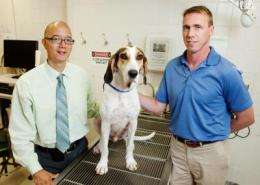
Tim Fan, a professor of veterinary clinical medicine (left) and chemistry professor Paul Hergenrother, (with a research dog named Hoover) led a study of a compound that shows promise in treating lymphoma in dogs. Credit: Photo by L. Brian Stauffer, U. of I. News Bureau.

Researchers have identified a new target for the treatment of lymphoma and are testing a potential new drug in pet dogs afflicted with the disease. At low doses, the compound, called S-PAC-1, arrested the growth of tumors in three of six dogs tested and induced partial remission in a fourth.

The results of the study, conducted by researchers at the University of Illinois, appear this month in the journal Cancer Research.

The new compound targets a , procaspase-3, that when activated spurs a cascade of reactions that kill the cell, said chemistry professor Paul Hergenrother, who co-led the study with Tim Fan, a professor of veterinary clinical medicine.

Procaspase-3 offers an attractive target for , in part because cancers often interfere with normal cell death, and in part because many tumors - including those found in , , lung cancer, lymphoma, melanoma and - contain high levels of procaspase-3.

"In my lab, we try to think of novel targets and novel approaches to cancer and other diseases," Hergenrother said. "We think about the pathways that lead to those diseases, and we try to intervene at spots where others have not."

The new compound is a modified version of a drug the researchers previously tested in mice and one dog.

The original compound, called PAC-1, was found to cause neurological excitation (neurotoxicity) even at low doses, the researchers said. Fan and his colleagues hypothesized that PAC-1, which works in part by grabbing zinc away from other molecules, was crossing the blood/brain barrier and latching onto zinc in the brain.

To prevent the compound from passing into the brain, Hergenrother's laboratory made a derivative of PAC-1 with an added chemical group, called a sulfonamide. Tests in pet dogs with spontaneously occurring lymphoma showed that the new compound, S-PAC-1, stabilized or reduced the size of tumors in a majority of the animals, without neurotoxicity. Other side effects were mild, and recent adjustments to the treatment protocol have minimized or eliminated them, the researchers report.

If S-PAC-1 proves to be effective and safe as a lymphoma treatment and is approved by the FDA for use in dogs and/or humans (a process that could take years, the researchers emphasized), it will likely be added to the arsenal of drugs already used to combat lymphoma in both dogs and humans. It could be used in combination with other drugs as a first treatment option or serve as a second line of defense if the cancer returns.

drug combinations must be carefully tailored to avoid "overlapping toxicities," Fan said, so a drug that effectively treats lymphoma with minimal side effects is very desirable.

The study in pet dogs is also unusual, Fan said, as most studies look at effects in mice and then, if a compound is promising and appears safe, it is tested in clinical trials in humans. The six used in this study were veterinary patients that had spontaneously developed lymphoma, he said.

The similarities between human and canine lymphoma also add to the desirability of this approach, Hergenrother said.

"If you look at the genetic signatures of canine lymphoma and human , they're very, very similar and their response to therapy is very, very similar," he said. "So there's lots of reasons to be optimistic about a compound that has some effect in the canines, that it could have a similar effect in humans."

More information: "Discovery and Canine Preclinical Assessment of a Nontoxic Procaspase-3-Activating Compound," Cancer Research.

Provided by University of Illinois at Urbana-Champaign (news : web)


Rank 5 /5 (1 vote)
Relevant PhysicsForums posts
  • Can I forget a language?
    created1 hour ago
  • Is Everyday Technology Killing Us?
    createdFeb 08, 2012
  • Exercise and weight loss
    createdFeb 08, 2012
  • Why do we have head aches? Our brains can't feel anything.
    createdFeb 07, 2012
  • "The end of diseases" by David Agus, interview from Daily Show with Jon Stewart
    createdFeb 04, 2012
  • Oncolytic adenovirus
    createdFeb 04, 2012
  • More from Physics Forums - Medical Sciences

More news stories

New understanding of DNA repair could eventually lead to cancer therapy

A research group in the Faculty of Medicine & Dentistry at the University of Alberta is hoping its latest discovery could one day be used to develop new therapies that target certain types of cancers.

Medicine & Health / Cancer

created 55 minutes ago | popularity 5 / 5 (3) | comments 0 | with audio podcast

Researchers develop new method for creating tissue engineering scaffolds

Researchers at Northwestern University have developed a new method for creating scaffolds for tissue engineering applications, providing an alternative that is more flexible and less time-intensive than current technology.

Medicine & Health / Research

created 8 minutes ago | popularity not rated yet | comments 0 | with audio podcast

Drug halts organ damage in inflammatory genetic disorder

A new study shows that Kineret (anakinra), a medication approved for the treatment of rheumatoid arthritis, is effective in stopping the progression of organ damage in people with neonatal-onset multisystem inflammatory disease ...

Medicine & Health / Medications

created 19 minutes ago | popularity not rated yet | comments 0

Molecular profiling reveals differences between primary and recurrent ovarian cancers

There is a need to analyze tumor specimens at the time of ovarian cancer recurrence, according to a new study published in Molecular Cancer Therapeutics. Researchers used a diagnostic technology called molecular profiling to examine ...

Medicine & Health / Cancer

created 8 minutes ago | popularity not rated yet | comments 0 | with audio podcast

Both maternal and paternal age linked to autism

Older maternal and paternal age are jointly associated with having a child with autism, according to a recently published study led by researchers at The University of Texas Health Science Center at Houston (UTHealth).

Medicine & Health / Psychology & Psychiatry

created 1 hour ago | popularity not rated yet | comments 0 | with audio podcast


Hovering not hard if you're top-heavy, researchers find

Top-heavy structures are more likely to maintain their balance while hovering in the air than are those that bear a lower center of gravity, researchers at New York University's Courant Institute of Mathematical Sciences ...

Grass to gas: Researchers' genome map speeds biofuel development

Researchers at the University of Georgia have taken a major step in the ongoing effort to find sources of cleaner, renewable energy by mapping the genomes of two originator cells of Miscanthus x giganteus, a large perenn ...

Zuckerberg's focus drives Facebook's ascent

When Mark Zuckerberg showed up to rent Judy Fusco's Los Altos, Calif., house in the fall of 2004, soon after he'd arrived in Silicon Valley, the landlord was immediately struck by his confidence.

Night, weekend delivery OK for babies with birth defects

Weekday delivery is no better than night or weekend delivery for infants with birth defects, according to a new study presented today at The Pregnancy Meeting, the Society for Maternal-Fetal Medicine's annual conference. ...

Sonic Cradle lands spot in TED exhibition

A Simon Fraser University graduate student project that melds music, meditation and modern technology has landed a rare spot as an exhibit at TEDActive 2012 in Palm Springs, California this month.

Cochlear implants may be safe, effective for organ transplant patients

Cochlear implants may be a safe, effective option for some organ transplant patients who've lost their hearing as an unfortunate consequence of their transplant-related drug regime, researchers report.