Researchers show that the big bang was followed by chaos
September 7, 2010 By Megan Fellman
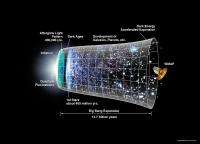
Illustration: Time Line of the Universe Credit: NASA/WMAP
(PhysOrg.com) -- Seven years ago Northwestern University physicist Adilson E. Motter conjectured that the expansion of the universe at the time of the big bang was highly chaotic. Now he and a colleague have proven it using rigorous mathematical arguments.
The study, published by the journal Communications in Mathematical Physics, reports not only that chaos is absolute but also the mathematical tools that can be used to detect it. When applied to the most accepted model for the evolution of the universe, these tools demonstrate that the early universe was chaotic.
Certain things are absolute. The speed of light, for example, is the same with respect to any observer in the empty space. Others are relative. Think of the pitch of a siren on an ambulance, which goes from high to low as it passes the observer. A longstanding problem in physics has been to determine whether chaos -- the phenomenon by which tiny events lead to very large changes in the time evolution of a system, such as the universe -- is absolute or relative in systems governed by general relativity, where the time itself is relative.
A concrete aspect of this conundrum concerns one's ability to determine unambiguously whether the universe as a whole has ever behaved chaotically. If chaos is relative, as suggested by some previous studies, this question simply cannot be answered because different observers, moving with respect to each other, could reach opposite conclusions based on the ticks of their own clocks.
"A competing interpretation has been that chaos could be a property of the observer rather than a property of the system being observed," said Motter, an author of the paper and an assistant professor of physics and astronomy at Northwestern's Weinberg College of Arts and Sciences. "Our study shows that different physical observers will necessarily agree on the chaotic nature of the system."
The work has direct implications for cosmology and shows in particular that the erratic changes between red- and blue-shift directions in the early universe were in fact chaotic.
Motter worked with colleague Katrin Gelfert, a mathematician from the Federal University of Rio de Janeiro, Brazil, and a former visiting faculty member at Northwestern, who says that the mathematical aspects of the problem are inspiring and likely to lead to other mathematical developments.
An important open question in cosmology is to explain why distant parts of the visible universe -- including those that are too distant to have ever interacted with each other -- are so similar.
"One might suggest 'Because the large-scale universe was created uniform,'" Motter said, "but this is not the type of answer physicists would take for granted."
Fifty years ago, physicists believed that the true answer could be in what happened a fraction of a second after the big bang. Though the initial studies failed to show that an arbitrary initial state of the universe would eventually converge to its current form, researchers found something potentially even more interesting: the possibility that the universe as a whole was born inherently chaotic.
The present-day universe is expanding and does so in all directions, Motter explained, leading to red shift of distant light sources in all three dimensions -- the optical analog of the low pitch in a moving siren. The early universe, on the other hand, expanded in only two dimensions and contracted in the third dimension.
This led to red shift in two directions and blue shift in one. The contracting direction, however, was not always the same in this system. Instead, it alternated erratically between x, y and z.
"According to the classical theory of general relativity, the early universe experienced infinitely many oscillations between contracting and expanding directions," Motter said.
"This could mean that the early evolution of the universe, though not necessarily its current state, depended very sensitively on the initial conditions set by the big bang."
This problem gained a new dimension 22 years ago when two other researchers, Gerson Francisco and George Matsas, found that different descriptions of the same events were leading to different conclusions about the chaotic nature of the early universe. Because different descriptions can represent the perspectives of different observers, this challenged the hypothesis that there would be an agreement among different observers. Within the theory of general relativity, such an agreement goes by the name of a "relativistic invariant."
"Technically, we have established the conditions under which the indicators of chaos are relativistic invariants," Motter said. "Our mathematical characterization also explains existing controversial results. They were generated by singularities induced by the choice of the time coordinate, which are not present for physically admissible observables."
More information: The paper is titled "(Non)Invariance of Dynamical Quantities for Orbit Equivalent Flows." http://www.springe … /journal/220
-
Model describes universe with no big bang, no beginning, and no end
Jul 29, 2010 |
not rated yet |
0
-
Discovery that quasars don't show time dilation mystifies astronomers
Apr 09, 2010 |
not rated yet |
0
-
Throwing light on the dark side of the Universe
Oct 21, 2008 |
not rated yet |
0
-
Our universe at home within a larger universe? So suggests wormhole research
Apr 06, 2010 |
not rated yet |
0
-
What is time?
Apr 13, 2005 |
not rated yet |
0
-
Engineers build first sub-10-nm carbon nanotube transistor
Feb 01, 2012 |
4.9 / 5 (31) |
30
-
Something old, something new: Evolution and the structural divergence of duplicate genes
Jan 31, 2012 |
4.6 / 5 (7) |
1
-
The hidden nanoworld of ice crystals: Revealing the dynamic behavior of quasi-liquid layers
Jan 30, 2012 |
5 / 5 (3) |
1
-
Stock market network reveals investor clustering
Jan 27, 2012 |
3.9 / 5 (23) |
8
-
Of microchemistry and molecules: Electronic microfluidic device synthesizes biocompatible probes
Jan 26, 2012 |
5 / 5 (1) |
0
-
Strength of induced magnetic field inside an inductor
2 hours ago
-
Physical laws .... are they material?!!
3 hours ago
-
increasing time of daylight
3 hours ago
-
Light & Sight
4 hours ago
-
Wind Turbine Power
7 hours ago
-
Steam Table issues
9 hours ago
- More from Physics Forums - General Physics
More news stories
Putting the squeeze on planets outside our solar system
(PhysOrg.com) -- Using high-powered lasers, scientists at Lawrence Livermore National Laboratory and collaborators discovered that molten magnesium silicate undergoes a phase change in the liquid state, abruptly ...
2 hours ago |
5 / 5 (1) |
0
|
Hovering not hard if you're top-heavy, researchers find
Top-heavy structures are more likely to maintain their balance while hovering in the air than are those that bear a lower center of gravity, researchers at New York University's Courant Institute of Mathematical Sciences ...
3 hours ago |
5 / 5 (1) |
1
|
SLAC, Stanford team focuses on high-energy electrons to treat cancer
Accelerator physicists at SLAC and cancer specialists from Stanford are working on a new technology that could dramatically reduce the time needed for cancer radiation treatments. The team ran an initial experiment ...
6 hours ago |
5 / 5 (1) |
0
Measurements from high-energy collisions lead to better understanding of why meson particles disappear
For several years, physicists at the Relativistic Heavy Ion Collider (RHIC) at Brookhaven National Laboratory (BNL), USA, have studied an unusual state of matter called the quarkgluon plasma, which they ...
7 hours ago |
5 / 5 (1) |
0
Quantum physicist explains $100K offer for proof scaled-up quantum computing is impossible
(PhysOrg.com) -- MIT researcher Scott Aaronson has certainly riled the physics community with his offer this past Friday, of $100,000 to anyone who can prove that scaled-up quantum computing is impossible. ...
Complex wiring of the nervous system may rely on a just a handful of genes and proteins
Researchers at the Salk Institute have discovered a startling feature of early brain development that helps to explain how complex neuron wiring patterns are programmed using just a handful of critical genes. ...
CIA website offline, Anonymous takes credit
The website of the Central Intelligence Agency was unresponsive on Friday after the hacker group Anonymous claimed to have knocked it offline.
Q&A: Obama and the birth control controversy
(AP) -- What birth control debate? A half-century after the introduction of the pill, acceptance of birth control by American women is virtually universal.
The power of estrogen -- male snakes attract other males
A new study has shown that boosting the estrogen levels of male garter snakes causes them to secrete the same pheromones that females use to attract suitors, and turned the males into just about the sexiest ...
New error-correcting codes guarantee the fastest possible rate of data transmission
Error-correcting codes are one of the triumphs of the digital age. Theyre a way of encoding information so that it can be transmitted across a communication channel such as an optical fiber o ...
Human cognitive performance suffers following natural disasters, researchers find
Not surprisingly, victims of a natural disaster can experience stress and anxiety, but a new study indicates that it might also cause them to make more errors - some serious - in their daily lives. In their upcoming Human Fa ...
Sep 07, 2010
Rank: not rated yet
"They were generated by singularities induced by the choice of the time coordinate, which are not present for physically admissible observables."
I can understand many of the more constrained concepts within the sentence, but when the sentence is contemplated as a whole, I get confused. =/
Sep 07, 2010
Rank: 3.7 / 5 (6)
Still looks like word salad so the 5 cent version is:
We've mathematically shown that initially after the big bang the universe wobbled like a jello mold. The top got short while the sides blew out, then the sides contracted and the top balloned, etc.
Chaotic fluxuation is the situation initially after the "Big Bang".
Very interesting research.
Sep 07, 2010
Rank: 5 / 5 (30)
In GR certain measurable quantities are invariant, meaning the values are independent of the observer's coordinate system (like the square of the space time interval in Minkowski sp); are left the same under coordinate transformations. Other measurable quantities are dependent on the observer reference frame.
It appears to me, that they where able to "established the conditions under which the indicators of chaos are relativistic invariants", and in so doing explained why "Francisco and Matsas, found that different descriptions of the same events were leading to different conclusions about the chaotic nature of the early universe" (not relativistically invariant, a problem),.. because they [Francisco and Matsas events] where "generated by singularities induced by the choice of the time coordinate, which are not present for physically admissible observables."
Sep 07, 2010
Rank: 1 / 5 (1)
Sep 08, 2010
Rank: 1 / 5 (8)
Like from the inside out.
Each galaxy was once a small big bang in three dimensions.
Space does not expand.
Energy is more densely concentrated together and they are expanding three-dimensionally in space which does not expand.
Simultaneously focus on the visible universe composed of energy field expands and moves three-dimensionally in a certain direction of the "new" to an existing state.
This movement because of all the energy is composed of clusters suitable for expanding the three-dimensionally like out of the pre-existing condition
against the will of energy particles that are very much smaller than photons. They move the visible energy in the universe formed by mergers of energy through the field overnight. Visible crack in the universe / through one "second".
These particles (dark energy) to obtain the apparent concentration of energy in the universe to explode or expand three-dimensionally.
Sep 08, 2010
Rank: 1 / 5 (6)
Well, every stable object in it will be formed with transverse waves of 2cm in wavelength preferably. At both large, both small scales the transverse waves will disperse into longitudinal waves, which will be the more pronounced, the larger is the distance from observer.
Sep 08, 2010
Rank: 1 / 5 (4)
Actually our visual experience with observable Universe shouldn't differ conceptually from experience of hypothetical observer, sitting like bubble of 2cm in diameter at the water surface and detecting neighboring objects (i.e. bubbles or density fluctuations) via transverse waves there.
What such observer will see?
Sep 08, 2010
Rank: 1 / 5 (6)
At the larger distance from observer scale all objects will become gradually regular and symmetric (i.e. spherical). This is why both atoms and atom nuclei, both planets and stars are of roughly spherical shape. This intermediate distance scale is just the scope of validity of quantum mechanics and relativity theories, where our Universe can be described with simple set of rules.
But at even larger distance the regularity and symmetry of Universe will decrease again and very small or large objects will change into fuzzy unparticle objects again. These objects are observed in mostly longitudinal waves there, so they're lack sharp boundaries. They appear rather like density fluctuations inside of gas.
Sep 08, 2010
Rank: 1 / 5 (6)
This is because at the water surface the very small ripples are spreading in the same longitudinal way, like the very large ones. We can say, at the dimensional scales which are very distant from 2cm scale we will see our Universe from both inside, both outside perspective. At small scale all objects from outside will appear like very large objects from inside - and vice-versa. Recently physicists got the same insight with finding, elementary particles appear like tiny black holes, whereas whole Universe appears like interior of black hole. With using of water surface model you can IMAGINE, why is it so...
http://www.techno...v/23530/
http://www.tgdail...hysicist
Sep 08, 2010
Rank: 1 / 5 (6)
At this wavelength the laws of quantum mechanics are switching into laws of relativity and vice-versa. The gravity becomes repulsive force of radiation pressure bellow this size and the seeming expansion of Universe is replaced with seeming contraction here. The Lorentz symmetry is violated with refraction and dispersion and the inverse square law is violated in most pronounced way there due the presence of many composite forces, which are spreading in extradimensions, which are all around us.
This number of these extradimensions makes our Universe so complex just at the 2cm distance scale.
Sep 08, 2010
Rank: 1 / 5 (1)
What does this mean?
Sep 08, 2010
Rank: 5 / 5 (6)
No, gravity does that.
Sep 10, 2010
Rank: 1 / 5 (6)
How?
There is no drawing force at all.
It is same, if you say,
No, god does that.
If you cant explain gravity, then you just believe, there is some drawing force.
There is no drawing force at all.
Space dont expanding at all.
Quarks and particle like phtons expanding / exploding in space who is nothing.
.
Sep 12, 2010
Rank: 1 / 5 (2)
Sep 12, 2010
Rank: 5 / 5 (4)
Sep 12, 2010
Rank: 3 / 5 (1)
Sep 13, 2010
Rank: 1 / 5 (1)
Sep 23, 2010
Rank: not rated yet
Sep 25, 2010
Rank: not rated yet