Big quake aftershocks plague New Zealand city
(AP) -- A powerful new 5.1-magnitude aftershock rattled terrified residents of New Zealand's earthquake-stricken city of Christchurch on Wednesday, as officials doubled their estimate for repairing the damage from nearly 300 aftershocks in five days.
The latest quake, just four miles (6.4 kilometers) below the earth's surface and centered six miles (10 kilometers) southeast of the city, was felt by residents as the strongest aftershock in Christchurch since Saturday's 7.1 magnitude earthquake wrecked hundreds of buildings. Nobody was reported injured by the latest temblor.
"My guts is just churning up here. When will this thing end? It is like living in a maelstrom," Christchurch Mayor Bob Parker said as workers streamed from the city's emergency headquarters.
"We have got staff in tears ... power is out and a lot of people are very, very churned up by that," he told the NewstalkZB radio station.
"We were restarting to think maybe, just maybe, we are over the worst of this, and now we have had this shocking event," Parker said. "This is a hammer blow to the spirit of a lot of people."
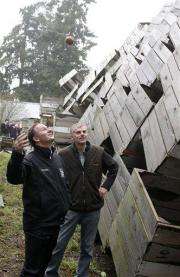
After his second, closer look at the quake carnage on Wednesday, Prime Minister John Key said he thought that rebuilding the city would cost more than the initial estimates of 2 billion New Zealand dollars ($1.4 billion), with at least 500 buildings already condemned and about 100,000 of the area's 160,000 house damaged.
Treasury Secretary John Whitehead said later the full bill for quake damage could reach NZ$4 billion, with the nation's Earthquake Commission likely to pay half of that.
Initial reports from geological agency GNS Science that the Wednesday morning temblor was magnitude-6.1 were quickly corrected downward.
Tavern owner Dean Calvert said he has written off his building after the latest quake.
"I'm not going back in there. The plaster has fallen off the walls inside, you can see holes from inside to outside," he told National Radio. "The assessor saw it yesterday and it was more or less condemned then - today's the icing on the cake, really."
Tony Stuart, a roofing contractor, was in his home office when the latest quake hit.
"This is the biggest aftershock we have had," he said. "There is stuff falling all over the place. It is very scary."
Resident David Alexander said it was a "helluva shake" that prompted his family to dive under a table for protection.
"We've got more stuff down (and) we almost had the house back in order," he said.
Civil defense director John Hamilton said the safety status of some buildings would be reassessed after Wednesday's quake, though Christchurch had suffered no "significant" new damage.
The city's main road tunnel, closed while cracks were inspected following the aftershock, was reopened after it was deemed structurally sound, he said.
GNS Science reported that more than 280 aftershocks of magnitude 3.0 or greater have struck the region in the five days since the destructive 7.1 earthquake early Saturday.
Seismologist Brian Ferris said people would have felt about 150 of those quakes.
Earthquake experts warned that another strong aftershock, up to magnitude-6.1, could hammer the region in coming days.
"With an earthquake of magnitude-7.1, like this one, the rule of thumb is you could get aftershocks as large as one unit lower - so magnitude-6.1," seismologist John Townend of Victoria University in the capital, Wellington, said Wednesday.
Saturday's powerful earthquake smashed buildings and homes, wrecked roads and disrupted the central city, though nobody was killed and only two people were seriously injured - which authorities attributed to good building codes and the quake's early morning timing.
The city center remained cordoned off by troops Wednesday, as authorities extended a state of civil emergency for another seven days. Only building owners and workers are allowed into the central city to begin clearing up the mess - with much of the center taking on the mantle of a ghost town.
On Wednesday, the prime minister traveled north of the city to inspect houses in the town of Kaiapoi that had been torn from their foundations by the quake.
"It shows you how well the building code works in New Zealand as they had been picked up, ripped apart and yet the structure has survived enough that people could escape," Key said after looking through one wrecked house.
"There are (citizens) who are really struggling under the weight of these earthquakes, both emotionally and in terms of their prized possessions," particularly homes, he told reporters.
Key has called off a planned nine-day trip to Britain and France, citing what he called the quake zone's continuing "instability."
He spoke by telephone with Britain's Queen Elizabeth II to explain that he had canceled his trip.
Key also canceled meetings with British Prime Minister David Cameron, French President Nicolas Sarkozy and French Prime Minister Francois Fillon.
The main quake struck at 4:35 a.m. Saturday near the South Island city of 400,000 people, ripping open a new fault line in the earth's surface, destroying hundreds of buildings and cutting power and water, which have been gradually restored in recent days.
New Zealand sits above an area where two tectonic plates collide. The country records more than 14,000 earthquakes a year - but only about 150 are felt by residents. Fewer than 10 a year do any damage.
©2010 The Associated Press. All rights reserved. This material may not be published, broadcast, rewritten or redistributed.


