Galileo revisited: How ribbons roll
September 8, 2010 by David L. Chandler, MIT News
Galileo revisited: How ribbons roll

Enlarge

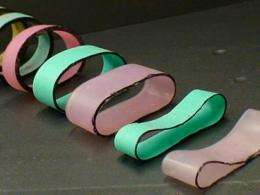
The MIT team made a variety of “ribbons” using polymers that have different degrees of flexibility. Image: Pascal Raux and Pedro Reis

Galileo Galilei’s experiments on the motions of falling and rolling objects, described in his 1638 book, “Two New Sciences,” are considered by many to be the beginning of modern science. Now researchers at MIT have conducted a variation on his experiments that has produced unexpected results.

Galileo used rigid materials — metal balls and a wooden ramp — for his tests on how bodies move down an inclined plane. Since then, a few tests have been done with solid balls rolling down a flexible surface. But until recently, nobody had tried rolling flexible objects down a solid plane. MIT professors Pedro Reis and John Bush, along with visiting student Pascal Raux and visiting professor Christophe Clanet, have now carried out experiments using a variety of flexible, hollow cylinders  — essentially wide rubber bands — with different degrees of elasticity, and have derived a set of equations to describe the behavior of these "rolling ribbons." The work was described in a paper published in July in the journal .

Flexible ribbons initially settle into an oval shape because of gravity, and one might expect them to get rounder as they roll due to centrifugal force. But the opposite occurs. The faster the ribbons roll, the more they lose their circular shape, eventually assuming a two-lobed “peanut” shape. At even higher speeds, the sagging middle droops so far that it comes in contact with the bottom of the ribbon, causing friction that makes the loop suddenly lurch backward. The researchers say the behavior is the result of “a delicate coupling between rolling, bending and stretching.”

Though this was basic research, Reis speculates that the resulting analysis might ultimately be useful for applications as varied as predicting the motions of microscopic cylinders called carbon nanotubes, the behavior of drill casings in deep wells, and the way blood cells move through veins and arteries. ( are known to have a similar characteristic peanut-like shape, but that shape has never been fully explained.) Bush, a professor of applied mathematics, explains that “one of our goals is to better understand the role of flexibility in locomotion.”

The research was prompted by a suggestion from Clanet, who taught a course at MIT during a stint as a visiting lecturer. He is a professor working at the Laboratory of Hydrodynamics at the Ecole Polytechnique in Palaiseau, outside Paris. Raux, a student visiting MIT from Paris, was the lead author of the paper.


Video courtesy of Pascal Raux and Pedro Reis. This video illustrates the shape transformation of a flexible polymer ribbon, otherwise circular, when rotated on a treadmill.

Why has it taken almost four centuries for scientists to take this next step from Galileo’s work? Reis explains that despite their apparent simplicity, the behavior of flexible structures is often nonlinear — that is, it requires more complicated mathematical equations to describe than that of simple rigid objects, and so the analysis wasn’t feasible before the advent of computers. And in addition, only relatively recently has it become easy to make objects out of flexible polymers with any desired degree of elasticity and shape using modern fabrication tools.

In this case, team members had to create the flexible cylinders from scratch — they employed a polymer that dentists use to make casts — because commercially available versions, such as wide rubber bands, do not have precise enough shapes with constant thickness.

Lakshminarayanan Mahedevan, a professor of applied mathematics at Harvard University, has published research on a different variation of Galileo’s experiments but was not involved in this work. Mahedevan says this basic research “has implications for how surfaces in contact move relative to each other.” But what really matters, he says, is the basic principles discovered in this way: “The particular manifestation is less important than the general principles that underlie these types of deformations.”

As with much basic research, the ultimate usefulness of the work is hard to predict, although there are clear examples of areas where such rolling behavior occurs. But for the researchers, there was a real thrill in finding a way to extend work that has such a fabled history. “One thing that made it really neat for us from the start was the connection with Galileo, to take an experiment that has been a classic” and extend it in a new direction, says Reis, the Esther and Harold E. Edgerton Assistant Professor of Civil and Environmental Engineering and Mechanical Engineering.


This story is republished courtesy of MIT News (http://web.mit.edu/newsoffice/), a popular site that covers news about MIT research, innovation and teaching.

Provided by Massachusetts Institute of Technology (news : web)

4.4 /5 (5 votes)  

Filter


Move the slider to adjust rank threshold, so that you can hide some of the comments.


Display comments: newest first

A_Paradox
Sep 08, 2010

Rank: not rated yet
?? I refreshed the page but still no video

Ah well
A_Paradox
Sep 08, 2010

Rank: 5 / 5 (2)
I thought the shape of the red blood cell was optimal because it:
* maximises surface area, which is good both for interchange of dissolved oxygen and carbon dioxide and also for increasing drag within the blood plasma which sweeps them along,
* minimises regions of internal volume not reachable by diffusion, and
* all but eliminates the potential for snagging within small capillaries.

HungOnGravity
Sep 08, 2010

Rank: not rated yet
This is news?

"The faster the ribbons roll, the more they lose their circular shape, eventually assuming a two-lobed “peanut” shape."

Of course, otherwise the tracks of an army tank would loosen and become unattached.
Rank 4.4 /5 (5 votes)
Related Stories
Relevant PhysicsForums posts
  • electrostatic induction in a conductor should be immpossible
    created3 hours ago
  • Help! Physics Momentum/Impulse problem!
    created6 hours ago
  • Gauss' law cubes, how to prove
    created7 hours ago
  • what is significance of torque
    created9 hours ago
  • Difference between volume displaced fluid and volume of the object
    created10 hours ago
  • Questions about Galileo statement?
    created10 hours ago
  • More from Physics Forums - General Physics

More news stories

Explained: Sigma

It's a question that arises with virtually every major new finding in science or medicine: What makes a result reliable enough to be taken seriously? The answer has to do with statistical significance -- but ...

Physics / General Physics

created 23 hours ago | popularity 5 / 5 (13) | comments 32

Borexino Collaboration succeeds in spotting pep neutrinos emitted from the sun

(PhysOrg.com) -- To learn more about how the sun works, scientists study particles that are emitted from it into space due to thermonuclear reactions that occur inside; by applying known physics principles, ...

Physics / General Physics

created 23 hours ago | popularity 4.6 / 5 (7) | comments 0 | with audio podcast report

Physics research suggests new pathways for cancer progression

Observing that certain cancer cells may exhibit greater flexibility than normal cells, some scientists believe that this capability promotes rapid tumor growth. Now computer simulations developed by Boston University Biomedical ...

Physics / General Physics

created 20 hours ago | popularity 5 / 5 (1) | comments 0

Quantum physicist explains $100K offer for proof scaled-up quantum computing is impossible

(PhysOrg.com) -- MIT researcher Scott Aaronson has certainly riled the physics community with his offer this past Friday, of $100,000 to anyone who can prove that scaled-up quantum computing is impossible. ...

Physics / Quantum Physics

created Feb 08, 2012 | popularity 4.1 / 5 (11) | comments 32 | with audio podcast weblog

Physicists 'record' magnetic breakthrough

An international team of scientists has demonstrated a revolutionary new way of magnetic recording which will allow information to be processed hundreds of times faster than by current hard drive technology.

Physics / General Physics

created Feb 07, 2012 | popularity 4.5 / 5 (39) | comments 14 | with audio podcast


Protein libraries in a snap

(PhysOrg.com) -- A Rice University undergraduate will depart with not only a degree but also a possible patent for his invention of an efficient way to create protein libraries, an important component of biomolecular ...

Sleep breathing machine shows clear benefits in children with sleep apnea

Children and adolescents with obstructive sleep apnea had substantial improvements in attention, anxiety and quality of life after treatment with positive airway pressure (PAP)—a nighttime therapy in which a machine ...

Neurologic improvement detected in rats receiving stem cell transplant

In a study to be presented today at the Society for Maternal-Fetal Medicine's annual meeting, The Pregnancy Meeting, in Dallas, Texas, researchers will report that early transplantation of human placenta-derived mesenchymal ...

NASA budget will axe Mars deal with Europe: scientists

US President Barack Obama's budget proposal to be submitted next week for 2013 will cut NASA's budget by 20 percent and eliminate a major partnership with Europe on Mars exploration, scientists said Thursday.

Breastfeeding protects against asthma up to six years of age

(Medical Xpress) -- Research by the University of Otago in Christchurch and Wellington has shown that breastfeeding of infants has a clear protective effect against children developing asthma or wheezing up to six years of ...

Study finds stress hormones fluctuate with mood during pregnancy

(Medical Xpress) -- While pregnant, women pay particular attention to factors such as diet and exercise to ensure their babies are born healthy and develop normally. New research from the University of Calgary’s Faculty ...