Tractor beams come to life
September 8, 2010 By Mike Lucibella, ISNS
Tractor beams come to life

Enlarge

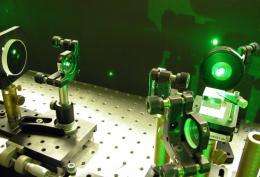
The tractor beam in action suspends a small particle over an optics table. Credit: Courtesy of the Australian National University

Tractor beams, energy rays that can move objects, are a science fiction mainstay. But now they are becoming a reality -- at least for moving very tiny objects.

Researchers from the Australian National University have announced that they have built a device that can move small particles a meter and a half using only the power of light.

Physicists have been able to manipulate tiny particles over miniscule distances by using lasers for years. Optical tweezers that can move particles a few millimeters are common.

Andrei Rhode, a researcher involved with the project, said that existing are able to move particles the size of a bacterium a few millimeters in a liquid. Their new technique can move objects one hundred times that size over a distance of a meter or more.

The device works by shining a hollow around tiny glass particles. The air surrounding the particle heats up, while the dark center of the beam stays cool. When the particle starts to drift out of the middle and into the bright laser beam, the force of heated air molecules bouncing around and hitting the particle's surface is enough to nudge it back to the center.

A small amount of light also seeps into the darker middle part of the beam, heating the air on one side of the particle and pushing it along the length of the laser beam. If another such laser is lined up on the opposite side of the beam, the speed and direction the particle moves can be easily manipulated by changing the brightness of the beams.

Rhode said that their technique could likely work over even longer distances than they tested.


• PhysOrg.com iPhone / iPad Apps
PhysOrg.com Audio Podcasts / iTunes
• PhysOrg.com Android apps (new version available)
Join PhysOrg.com on Facebook!
Follow PhysOrg.com on Twitter!
"With the particles and the laser we use, I would guess up to 10 meters in air should not be a problem. The max distance we had was 1.5 meters, which was limited by the size of the optical table in the lab," Rhode said.

Because this technique needs heated gas to push the particles around, it can't work in the vacuum of outer space like the tractor beams in . But on Earth there are many possible applications for the technology. The meter-long distances that the research team was able to move the particles could open up new avenues for tweezers in the transport of dangerous substances and microbes, and for sample taking and biomedical research.

"There is the possibility that one could use the hollow spheres as a means of chemical delivery agents, or microscopic containers of some kind, but some more work would need to be done here just to check what happens inside the spheres, in terms of sample heating," said David McGloin, a physicist at the University of Dundee in the U.K not connected with the Australian team.

Provided by Inside Science News Service (news : web)

4.5 /5 (47 votes)  

Filter


Move the slider to adjust rank threshold, so that you can hide some of the comments.


Display comments: newest first

Justavian
Sep 08, 2010

Rank: 5 / 5 (6)
Tractor beam? Isn't it pushing the particle, rather than pulling? That may seem like a minor distinction, but i would have been infinitely more impressed with a single laser attracting a particle rather than propelling it.
Hemo_jr
Sep 08, 2010

Rank: 5 / 5 (2)
Correct, this is a pressor beam rather than a tractor beam. Doc Smith knew proper usage.
Skultch
Sep 08, 2010

Rank: 5 / 5 (1)
If another such laser is lined up on the opposite side...


I would be more impressed if even a single laser pushed it. You could always launch some kind of mirror on the opposite end. This tech is more of a moving net than a tractor.
ralbol
Sep 08, 2010

Rank: not rated yet
One word: Lightsaber!

Not the real thing(?) but probably a nice fake, using the technique to hold particles, a gas or something prisonner in the hollow laser beam.

Would that work?
bugmenot23
Sep 08, 2010

Rank: not rated yet
Sowdi
Sep 08, 2010

Rank: not rated yet
Actually as this in air the laser would disperse creating a cone of hot air. By increasing the dispersion rate of the laser over time the cone would get shorter and 'pull' the glass bead towards the source of the beam.

Or you could have a secondary laser that crosses the first beam and so you can move the bead as you like, I believe this was stated in the article.
priyesh_jain
Sep 08, 2010

Rank: not rated yet
This is pretty cool. I wonder what variations could be made?

Perhaps using the laser in heavier inert gases with higher beam strength could increase the speed of transportation to make it viable in the distant future.

I wonder what could be the affect of lasers on the matter being transported, or if special materials containers might get better transportation results.

Great work Aussie mates! I wish my work was so cool. :)
jsa09
Sep 08, 2010

Rank: not rated yet
The heading "Tractor beams to come" is the heading but the article does describe what is actually happening and yes it is not a tractor beam and nothing like it.

But it is very useful and may well be incorporated amongst other devices in nuclear fusion or other cutting edge science.
Graeme
Sep 09, 2010

Rank: not rated yet
Instead of light tweezers this is more like light tongs.
MarkyMark
Sep 09, 2010

Rank: not rated yet
I know its been pointed out already! But a tractor beam pulls not pushes.
sender
Sep 09, 2010

Rank: not rated yet
Along with pressure chamber centrifugal processes spinning and weaving vapor into thinfilms or materials such as diamonds and exotic ceramics from simple gasses, optical tweezers and magnetic fields becomes a simple possibility.
M__Veen
Sep 10, 2010

Rank: not rated yet
Teleportation. Cloaking. The entire spectrum of the moustache sciences.
WirelessPhil
Sep 12, 2010

Rank: 1 / 5 (1)
Fail!
They are doing this on an object in air.
Do it in a vacuum and then get back to me.

""When the particle starts to drift out of the middle and into the bright laser beam, the force of heated air molecules bouncing around and hitting the particle's surface is enough to nudge it back to the center.""
Rank 4.5 /5 (47 votes)
Relevant PhysicsForums posts
  • Rubber production is likely to gradually reduce
    created1 hour ago
  • Help! Physics Momentum/Impulse problem!
    created1 hour ago
  • Gauss' law cubes, how to prove
    created3 hours ago
  • A grandfather pulls his granddaughter, whose mass is 20.5 kg
    created4 hours ago
  • what is significance of torque
    created4 hours ago
  • Difference between volume displaced fluid and volume of the object
    created5 hours ago
  • More from Physics Forums - General Physics

More news stories

Explained: Sigma

It's a question that arises with virtually every major new finding in science or medicine: What makes a result reliable enough to be taken seriously? The answer has to do with statistical significance -- but ...

Physics / General Physics

created 19 hours ago | popularity 5 / 5 (10) | comments 30

Borexino Collaboration succeeds in spotting pep neutrinos emitted from the sun

(PhysOrg.com) -- To learn more about how the sun works, scientists study particles that are emitted from it into space due to thermonuclear reactions that occur inside; by applying known physics principles, ...

Physics / General Physics

created 19 hours ago | popularity 4.6 / 5 (7) | comments 0 | with audio podcast report

Physics research suggests new pathways for cancer progression

Observing that certain cancer cells may exhibit greater flexibility than normal cells, some scientists believe that this capability promotes rapid tumor growth. Now computer simulations developed by Boston University Biomedical ...

Physics / General Physics

created 16 hours ago | popularity 5 / 5 (1) | comments 0

Quantum physicist explains $100K offer for proof scaled-up quantum computing is impossible

(PhysOrg.com) -- MIT researcher Scott Aaronson has certainly riled the physics community with his offer this past Friday, of $100,000 to anyone who can prove that scaled-up quantum computing is impossible. ...

Physics / Quantum Physics

created Feb 08, 2012 | popularity 4.1 / 5 (11) | comments 32 | with audio podcast weblog

Physicists 'record' magnetic breakthrough

An international team of scientists has demonstrated a revolutionary new way of magnetic recording which will allow information to be processed hundreds of times faster than by current hard drive technology.

Physics / General Physics

created Feb 07, 2012 | popularity 4.5 / 5 (39) | comments 14 | with audio podcast


'Dark plasmons' transmit energy

Microscopic channels of gold nanoparticles have the ability to transmit electromagnetic energy that starts as light and propagates via "dark plasmons," according to researchers at Rice University.

FDA-approved drug rapidly clears amyloid from the brain, reverses Alzheimer's symptoms in mice

Neuroscientists at Case Western Reserve University School of Medicine have made a dramatic breakthrough in their efforts to find a cure for Alzheimer's disease. The researchers' findings, published in the journal Science, show t ...

Hydrogen from acidic water: Researchers develop potential low cost alternative to platinum for splitting water

A technique for creating a new molecule that structurally and chemically replicates the active part of the widely used industrial catalyst molybdenite has been developed by researchers with the Lawrence Berkeley ...

Ultraviolet protection molecule in plants yields its secrets

Lying around in the sun all day is hazardous not just for humans but also for plants, which have no means of escape. Ultraviolet (UV) radiation from the sun can damage proteins and DNA inside cells, leading ...

Soraa LED light may dim 50-watt halogen rivals

(PhysOrg.com) -- Soraa, a Fremont, California company founded in 2008, this week launched its first product, a light that uses LEDS (light emitting diodes). The "Soraa LED MR16 lamp" is the "perfect" replacement ...

Anyone can learn to be more inventive, cognitive researcher says

There will always be a wild and unpredictable quality to creativity and invention, says Anthony McCaffrey, a cognitive psychology researcher at the University of Massachusetts Amherst, because an "Aha moment" is rare and ...