Quasimodo dino leaves experts grappling for a hunch
September 8, 2010
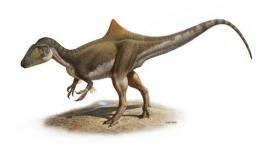
Handout photo released by Nature magazine shows the reconstitution of a new species of dinosaur

Enlarge

Handout photo released by Nature magazine and the Universidad Nacional de Educacion shows the reconstitution of a new species of dinosaur, Concavenator corcovatus, with an unusual hump-like structure of the vertebrae and a series of small bumps on the ulna, discovered in Spain according to a study published today by Nature Magazine.

Palaeontologists in Spain have discovered the remains of a strange dinosaur with a hump that they believe is the forerunner of flesh-eating leviathans which once ruled the planet.

The fossil was uncovered in the Las Hoyas formation in central Spain's Cuenca province, a treasure trove of finds that date to the Lower of between 120 and 150 million years ago.

The nearly-complete skeleton is as exquisite as the dinosaur is "bizarre," Fernando Escaso of the Autonomous University of Madrid, told AFP by phone.

"This dinosaur is very remarkable," Ecaso said.

"It is a unique specimen. It is the most complete dinosaur ever found in the and is a new species of theropod," a carnivore that moved on two rear limbs.

Six metres (20 feet) long from snout to tailtip, the dinosaur is the earliest member ever found of a branch of Carcharodontosauria, the largest predatory dinos that ever lived and which until now were thought to be confined to southern continents.

The lineage expanded hugely over the aeons, both in size and number of species.

Its numbers include Giganotosaurus, estimated up to 14.5m (47 feet) long, and Carcharodontosaurus, up to 13 metres (44 feet) long, and each weighing some seven or eight tonnes.

The new find has jaws and small, clawed forelimbs that bear a resemblance to the which belongs to a different dinosaur family.

But all similarities end with the spine, which is astonishingly curved and has a small hump, Ecaso said.

"It is the first time we have ever seen a structure like this on the spine of a dinosaur, although it is common on some animals today, such as cows," Escaso said.

"At the moment, the function of this structure is unclear. We believe that the animal was not diseased because the spine shows no sign of being cracked or broken, we think it is a feature of this species. One hypothesis is that it was a reservoir of fat."

The new species has been named Concavenator corcovatus, from "Conca," the Latin word for Cuenca; "venator," for hunter; and "corcovatus," or hump-backed.

The study is published on Thursday by the British science journal Nature.

(c) 2010 AFP

Filter


Move the slider to adjust rank threshold, so that you can hide some of the comments.


Display comments: newest first

jsa09
Sep 08, 2010

Rank: 5 / 5 (1)
If is it something like the hump on a Brahma cow or even a camel it would not be pointy as it is illustrated. So does the illustration bear any resemblance to the fossil or is it based on artists impressions like the ones we often see of planets or star systems that are too far away to actually see.
xznofile
Sep 08, 2010

Rank: not rated yet
bison have long vertebra on their upper back. besides storing fat and mass above the lungs for insulation, it also makes it harder for a carnivore to reach the neck from above. many hadrosaur skeletons show tooth marks in the area of that hump, perhaps it was used the same way as bison.
baudrunner
Sep 09, 2010

Rank: not rated yet
It evloved to allow the creature to detect the ceiling height of dark places like caves and undergrowth. Notice its hunched forward stance. The hump would be the tallest part of it as it foraged the floor for smaller prey, while the tail was actually usually down and swaying left to right, so that it wouldn't give itself away, which it would if it were pointing straight up.
Rank 4 /5 (6 votes)
Related Stories
Relevant PhysicsForums posts

More news stories

US workers are 'giving away the store,' costing firms billions

Nearly 70 percent of the nation's service employees give away free goods and services – from hamburgers to cable TV – costing companies billions of dollars a year, according to a groundbreaking study.

Other Sciences / Economics & Business

created 8 hours ago | popularity not rated yet | comments 6

Prague gets hold of modern genetics founder Mendel's papers

Germany has handed to the Czech Republic a manuscript of Johann Gregor Mendel, founder of modern genetics, on his plant hybridization experiments, the Czech foreign minister said Thursday.

Other Sciences / Other

created 5 hours ago | popularity not rated yet | comments 1

Storm warning: Financial tsunami heading this way

In today's global village, national coffers are more interconnected than ever before. And as the current economic crisis has proven, a downturn in one country can travel in a wave across the globe, like a financial tsunami. ...

Other Sciences / Economics & Business

created 9 hours ago | popularity 3 / 5 (2) | comments 5

Kids show cultural gender bias

(PhysOrg.com) -- Talk about gender confusion! A recent study by University of Alberta researchers Elena Nicoladis and Cassandra Foursha-Stevenson in the Journal of Cross-Cultural Psychology into whether speaki ...

Other Sciences / Social Sciences

created 14 hours ago | popularity 2 / 5 (1) | comments 2

'Flipped classroom' teaching model gains an online community

Researchers at Harvard University have launched the Peer Instruction (PI) Network, a new global social network for users of interactive teaching methods.

Other Sciences / Social Sciences

created 9 hours ago | popularity 5 / 5 (2) | comments 0


'Dark plasmons' transmit energy

Microscopic channels of gold nanoparticles have the ability to transmit electromagnetic energy that starts as light and propagates via "dark plasmons," according to researchers at Rice University.

Hydrogen from acidic water: Researchers develop potential low cost alternative to platinum for splitting water

A technique for creating a new molecule that structurally and chemically replicates the active part of the widely used industrial catalyst molybdenite has been developed by researchers with the Lawrence Berkeley ...

FDA-approved drug rapidly clears amyloid from the brain, reverses Alzheimer's symptoms in mice

Neuroscientists at Case Western Reserve University School of Medicine have made a dramatic breakthrough in their efforts to find a cure for Alzheimer's disease. The researchers' findings, published in the journal Science, show t ...

Ultraviolet protection molecule in plants yields its secrets

Lying around in the sun all day is hazardous not just for humans but also for plants, which have no means of escape. Ultraviolet (UV) radiation from the sun can damage proteins and DNA inside cells, leading ...

Anyone can learn to be more inventive, cognitive researcher says

There will always be a wild and unpredictable quality to creativity and invention, says Anthony McCaffrey, a cognitive psychology researcher at the University of Massachusetts Amherst, because an "Aha moment" is rare and ...

Cell biologists describes mechanism by which some people may be more susceptible to colon cancer

An international research team led by cell biologists at the University of California, Riverside has uncovered a new insight into colon cancer, the third leading cause of cancer-related deaths in the United ...