Satellite data reveal seasonal pollution changes over India
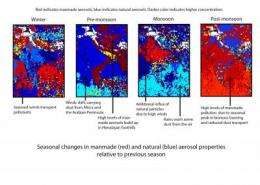
Armed with a decade's worth of satellite data, University of Illinois atmospheric scientists have documented some surprising trends in aerosol pollution concentration, distribution and composition over the Indian subcontinent.
In addition to environmental impact, aerosol pollution, or tiny particles suspended in the air, can be detrimental to human health by causing a range of respiratory problems. Aerosols can come from natural sources, such as dust and pollen carried on the wind, but the most hazardous aerosols are generated by human activity - soot and other hydrocarbons released from burning various fuels, for example.
"The man-made aerosols tend to have a nastier effect on human health," said Larry Di Girolamo, a professor of atmospheric sciences at U. of I. "Once we have a handle on how much, and the factors that influence the amount of aerosols that can build up, we can propose emission regulations."
Aerosol pollution levels can be measured on the ground, but only the most developed countries have widespread sensor data. Standard satellite imaging cannot measure aerosols over land, so Di Girolamo worked with NASA to develop the Multi-angle Imaging Spectro-Radiometer (MISR).
Launched onboard NASA's Terra satellite platform in 1999, MISR's unique multi-view design allows researchers to differentiate surface variability from the atmosphere so they can observe and quantitatively measure particles in the air.
"Ten years later, we are mapping the globe in terms of particle properties," Di Girolamo said. "We've gone beyond just the amount of aerosols. We also can tell what kind of particles they are - how much is dust, how much is manmade."
Di Girolamo and postdoctoral scientist Sagnik Dey recently published a 10-year comprehensive analysis of MISR data of aerosol pollution over the Indian subcontinent in the Journal of Geophysical Research. The densely populated region lacks on-the-ground monitoring sites, so until recently researchers could only guess at aerosol distribution over the area, where air quality is known to be poor.
"This study has shown that the level of atmospheric pollution across most of the country is two to five times larger than what the World Health Organization guidelines call for - and it's home to one-sixth of the world's population," Di Girolamo said.
The MISR data show very high levels of both natural and manmade aerosol pollutants in the air over the Indian subcontinent, but the longitudinal study also revealed some surprising trends. For example, the researchers noticed consistent seasonal shifts in manmade versus natural aerosols. The winds over the subcontinent shift before the monsoon season, blowing inland instead of out to sea. The air quality during the pre-monsoon season is notoriously bad as these winds carry an immense amount of dust from Africa and the Arabian Peninsula to India.
"Just before the rains come the air gets really polluted, and for a long time everyone blamed the dust," Di Girolamo said, "but MISR has shown that not only is there an influx of dust, there's also a massive buildup of manmade pollutants that's hidden within the dust."
During the monsoon season, rains wash some of the dust and soot from the air, but other manmade pollutants continue to build up.
During the post-monsoon season, dust transport is reduced but manmade pollutant levels skyrocket as biomass burning and the use of diesel-fueled transportation soar. During the winter, seaward breezes disperse both natural and human-generated pollution across the subcontinent and far out to sea until the pre-monsoon winds blow again.
The MISR data also revealed an especially dense area of manmade particles in India's Gangetic Basin, in the foothills of the Himalayan Mountains. This raises questions about the effects that soot and other particles may be having on weather patterns and water sources for the entire region. Di Girolamo and his team hope to continue to study the area and investigate the cause of the buildup.
As MISR continues to collect worldwide aerosol data - Di Girolamo expects up to another five years of orbit - atmospheric scientists can continue to refine models for India and other areas and begin to propose new regulatory measures. MISR may also reveal trends in aerosol concentration over time, which can be compared with climate and health data.
"We desperately needed these observations to help validate our atmospheric models. We're finding that in a complex area like India, we have a long way to go. But these observations help give us some guidance," Di Girolamo said. "I think that now that we have the observational analysis, we're going to see massive improvements in our models' ability to predict the temporal and spatial distribution of these aerosols."
NASA makes all MISR data freely available to the public, so its data can fuel research for many scientists for years to come. In addition, MISR's success has inspired other multi-view-angle satellite projects around the world.
"I suspect if we jump 50 years into the future, multi-angle imagers like MISR will be the norm in terms of monitoring," Di Girolamo said.
Provided by University of Illinois at Urbana-Champaign


