Novel sensing mechanism discovered in dendritic cells to increase immune response to HIV
September 8, 2010
Novel sensing mechanism discovered in dendritic cells to increase immune response to HIV

Enlarge

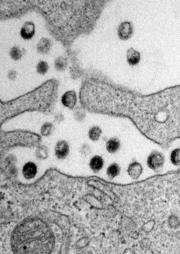
HIV-1 viral particles, shown here as dark spheres, are recognized by infected human dendritic cells, the sentinels of the immune system, through a newly discovered sensor. The viruses are then released in special packets that are presented to T-cells to indicate which invaders the T-cell army should attack. Manipulating this novel response system could aid in vaccine design, a new study shows. Credit: Credit: Nicolas Manel, Alice Liang and Eric Roth

Dendritic cells are the grand sentinels of the immune system, standing guard 24/7 to detect foreign invaders such as viruses and bacteria, and bring news of the invasion to other immune cells to marshal an attack. These sentinels, however, nearly always fail to respond adequately to HIV, the virus causing AIDS. Now a team of scientists at NYU Langone Medical Center has discovered a sensor in dendritic cells that recognizes HIV, spurring a more potent immune response by the sentinels to the virus. They report their findings in the September 9, 2010, issue of Nature.

"This is the first time that an alarm system that recognizes retroviruses like HIV has been discovered," says Dan Littman, MD, PhD, the Helen L. and Martin S. Kimmel Professor of in the Departments of Pathology and Microbiology at NYU Langone Medical Center and a Howard Hughes Medical Institute investigator, and the study's lead author.

"The ability to stimulate a protective against HIV is critical to the development of therapeutic or preventive vaccines for the virus," says Dr. Littman. In contrast to normal vaccines, which prevent infection, therapeutic vaccines are designed to boost the severely weakened immune systems of people infected with HIV.

Dendritic cells, named for their branching, tree-like shape, have been called the maestros of the because they orchestrate a dynamic range of immune responses. These cells have attracted intense interest from researchers in many fields because of their potential to fight disease and prevent rejection of organ transplants.

When a dendritic cell captures a dangerous pathogen, it tears it apart and delivers a piece to the soldiers of the immune system cells, called T-cells, which in turn expand like a clonal army to coordinate immune defenses and destroy the invader. But dendritic cells fail to recognize HIV as a danger. Instead, HIV exploits the cells to get a free ride to T-cells, which become infected with the virus. "The virus actually infects the same soldiers that are supposed to protect us from it," explains co-author Derya Unutmaz, MD, associate professor in the Departments of Microbiology, Pathology and Medicine at NYU Langone Medical Center.

Although HIV enters dendritic cells, an unknown mechanism blocks the virus from infecting them—going into the nucleus of the cells to make copies of itself. Recently, a technique was discovered to overcome this block by bathing the cells with a protein derived from SIV, a relative of HIV that only infects monkeys. Using these techniques, the researchers discovered that when HIV was forced to enter the nucleus of , the cells unexpectedly recognized the virus as an intruder and went into action to initiate a program to stimulate a stronger T-cell response against the virus.

What set off the alarm, the researchers found, was a protein called capsid, which encapsulates HIV's genetic material. "It's surprisingly unexpected that the sensing mechanism of the dendritic cell recognizes the capsid of the virus, rather than the genetic material inside," says co-author Nicolas Manel, PhD, of The Kimmel Center for Biology and Medicine at the Skirball Institute at NYU Langone Medical Center and the Institut de Genetique Moleculaire de Montpellier. "Nevertheless, by adding elements of this capsid to a vaccine," says Dr. Manel, "it may be possible to improve the immune response of those who already have HIV or actually mount a potent immune response before the individual is infected."

"We still don't understand why this sensor is triggered only when we force HIV to integrate into dendritic cell genome to make its own copies," adds Dr. Unutmaz. "One possibility is that this cryptic sensing mechanism has evolved to recognize the thousands of ancient retroviruses that have infected us in the past and now make up almost 10% our genome. It is conceivable that dendritic have evolved this internal sensor in case any of these archaic retroviruses were reawakened. Nonetheless, the finding is extremely exciting because not only it could lead to new directions in vaccine research but it can also be exploited to enhance vaccines against other viruses."

Provided by New York University School of Medicine (news : web)

Filter


Move the slider to adjust rank threshold, so that you can hide some of the comments.


Display comments: newest first

gmurphy
Sep 08, 2010

Rank: not rated yet
While this is some outstanding research, it makes me a little uneasy to think that their strategy is to "mix in bits" of the capsid to see if provokes a reaction, although, I perfectly willing to concede that this uneasiness arises from my broad ignorance of the subject matter.
Rank 5 /5 (3 votes)
Related Stories
Relevant PhysicsForums posts

More news stories

Complex wiring of the nervous system may rely on a just a handful of genes and proteins

Researchers at the Salk Institute have discovered a startling feature of early brain development that helps to explain how complex neuron wiring patterns are programmed using just a handful of critical genes. ...

Medicine & Health / Research

created 13 hours ago | popularity 4.9 / 5 (9) | comments 1 | with audio podcast

Team isolates nerve cells involved in storing long term memory and gene proteins associated with them

(Medical Xpress) -- A research team in Taiwan has succeeded in isolating two nerve cells in fruit fly brains that are believed to be the major players in allowing for the formation of long term memories. Furthermore, ...

Medicine & Health / Neuroscience

created 19 hours ago | popularity 5 / 5 (4) | comments 2 | with audio podcast report

Seeing colors in music, tasting flavors in shapes may happen in life's early months

Famed violinist Itzhak Perlman sees a deep forest green whenever he plays a B-flat on his Stradivarius' G string. The A on the E string is red.

Medicine & Health / Psychology & Psychiatry

created 20 hours ago | popularity 4.5 / 5 (2) | comments 2 | with audio podcast

Both maternal and paternal age linked to autism

Older maternal and paternal age are jointly associated with having a child with autism, according to a recently published study led by researchers at The University of Texas Health Science Center at Houston (UTHealth).

Medicine & Health / Psychology & Psychiatry

created 17 hours ago | popularity 4.3 / 5 (3) | comments 0 | with audio podcast

New understanding of DNA repair could eventually lead to cancer therapy

A research group in the Faculty of Medicine & Dentistry at the University of Alberta is hoping its latest discovery could one day be used to develop new therapies that target certain types of cancers.

Medicine & Health / Cancer

created 16 hours ago | popularity 4.8 / 5 (6) | comments 0 | with audio podcast


Anonymous knocks CIA website offline (Update)

The website of the Central Intelligence Agency was inaccessible on Friday after the hacker group Anonymous claimed to have knocked it offline.

New error-correcting codes guarantee the fastest possible rate of data transmission

Error-correcting codes are one of the triumphs of the digital age. They’re a way of encoding information so that it can be transmitted across a communication channel — such as an optical fiber o ...

Humans may have helped the decline of African rainforests 3000 years ago

(PhysOrg.com) -- Large areas of rainforests in Central Africa mysteriously disappeared over three thousand years ago, to be replaced by savannas. The prevailing theory has been that the cause was a change ...

New power source discovered

(PhysOrg.com) -- Researchers at the Massachusetts Institute of Technology (MIT) and RMIT University have made a breakthrough in energy storage and power generation.

Small modular reactor design could be a 'SUPERSTAR'

(PhysOrg.com) -- Though most of today's nuclear reactors are cooled by water, we've long known that there are alternatives; in fact, the world's first nuclear-powered electricity in 1951 came from a reactor ...

The power of estrogen -- male snakes attract other males

A new study has shown that boosting the estrogen levels of male garter snakes causes them to secrete the same pheromones that females use to attract suitors, and turned the males into just about the sexiest ...