Study identifies critical 'traffic engineer' of the nervous system
September 8, 2010
Study identifies critical 'traffic engineer' of the nervous system

Enlarge

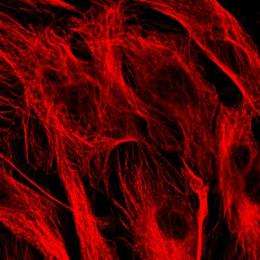
In this image, mammalian cells are labeled with an antibody that reveals microtubules, which serve as tracks for the shuttling of materials from one part of the cell to another. A new University of Georgia study published in the journal Nature has identified a critical enzyme that keeps traffic flowing in the right direction in the microtubules of nervous system cells. Credit: Dorota Wloga/University of Georgia

A new University of Georgia study published in the journal Nature has identified a critical enzyme that keeps traffic flowing in the right direction in the nervous system, and the finding could eventually lead to new treatments for conditions such as Alzheimer's and Parkinson's disease.

"There was no medical or any other applied science drive for this project; it was purely curiosity about how transport inside cells works," said study co-author Jacek Gaertig, professor in the cellular biology department in the UGA Franklin College of Arts and Sciences. "But it looks like we have identified an important that acts in the ."

He explained that cells contain a network of tubes known as microtubules that are made of protein and serve as tracks for the shuttling of materials from one part of the cell to another. The traffic signs on this microtubule network are chemical additions such as acetylation marks. Microtubules in parts of in the brain that send signals, for example, are loaded with acetylation marks. Microtubules in parts of neurons that receive signals, on the other hand, have few.

Acetylation marks were discovered in 1983, and researchers recently determined their role in regulating the binding of the motor proteins that shuttle materials along microtubules. What has been unclear for more than 25 years, however, was the cellular process by which these acetylation marks are formed. In other words, which enzyme decides where the traffic signs go?

Through a series of studies using the microscopic protozoan Tetrahymena, the C. elegans, and human cancer cells, Gaertig and his colleagues revealed that an a protein known as MEC-17 is the traffic engineer in charge of microtubule acetylation.

MEC-17 acts as an enzyme to catalyze the acetylation reaction on microtubules, and is involved in the sensation of touch in the nematode. Its depletion in zebrafish, which are commonly used as a to study basic processes, results in neuromuscular defects. Importantly, several research groups have previously reported that the levels of acetylation marks on microtubules are altered in human neurodegenerative diseases such as Huntington's, Parkinson's and Alzheimer's.

Gaertig said that with the enzyme identified and its mechanism of action known, it is now possible for drug manufacturers to search for compounds that block or enhance its activity.

Graduate student Shilpa Akella and postdoctoral associate Dorota Wloga in Gaertig's lab studied the enzyme in the protozoan and in vitro, while Jihyun Kim and Natalia Starostina in the lab of Edward Kipreos, professor of cellular biology, showed how it worked in the nematode and found that the enzyme is active in human cancer cells. The lab of associate professor and Georgia Cancer Coalition Distinguished Scholar Scott Dougan deduced its role in zebrafish, and Sally Lyons-Abbott and Naomi Morrissette at the University of California-Irvine biochemically purified that are marked by MEC-17.

"Working together allowed us to use all kinds of models to establish that this microtubule acetylation process using MEC-17 is an evolutionarily conserved function," Gaertig said. "Without close collaboration, that would not have been possible."

Provided by University of Georgia (news : web)


Rank 5 /5 (4 votes)
Related Stories
Relevant PhysicsForums posts
  • Is Everyday Technology Killing Us?
    createdFeb 08, 2012
  • Exercise and weight loss
    createdFeb 08, 2012
  • Why do we have head aches? Our brains can't feel anything.
    createdFeb 07, 2012
  • "The end of diseases" by David Agus, interview from Daily Show with Jon Stewart
    createdFeb 04, 2012
  • Oncolytic adenovirus
    createdFeb 04, 2012
  • Nutrition label stuffs and diets
    createdFeb 02, 2012
  • More from Physics Forums - Medical Sciences

More news stories

Complex wiring of the nervous system may rely on a just a handful of genes and proteins

Researchers at the Salk Institute have discovered a startling feature of early brain development that helps to explain how complex neuron wiring patterns are programmed using just a handful of critical genes. ...

Medicine & Health / Research

created 1 hour ago | popularity 5 / 5 (2) | comments 0 | with audio podcast

Curry spice component may help slow prostate tumor growth

Curcumin, an active component of the Indian curry spice turmeric, may help slow down tumor growth in castration-resistant prostate cancer patients on androgen deprivation therapy (ADT), a study from researchers ...

Medicine & Health / Cancer

created 6 hours ago | popularity 4.5 / 5 (4) | comments 0 | with audio podcast

Both maternal and paternal age linked to autism

Older maternal and paternal age are jointly associated with having a child with autism, according to a recently published study led by researchers at The University of Texas Health Science Center at Houston (UTHealth).

Medicine & Health / Psychology & Psychiatry

created 5 hours ago | popularity not rated yet | comments 0 | with audio podcast

Team isolates nerve cells involved in storing long term memory and gene proteins associated with them

(Medical Xpress) -- A research team in Taiwan has succeeded in isolating two nerve cells in fruit fly brains that are believed to be the major players in allowing for the formation of long term memories. Furthermore, ...

Medicine & Health / Neuroscience

created 7 hours ago | popularity 5 / 5 (4) | comments 1 | with audio podcast report

Seeing colors in music, tasting flavors in shapes may happen in life's early months

Famed violinist Itzhak Perlman sees a deep forest green whenever he plays a B-flat on his Stradivarius' G string. The A on the E string is red.

Medicine & Health / Psychology & Psychiatry

created 8 hours ago | popularity 4.5 / 5 (2) | comments 1 | with audio podcast


NASA sees wide-eyed cyclone Jasmine

Cyclone Jasmine's eye has opened wider on NASA satellite imagery, as it moves through the Southern Pacific Ocean.

NASA sees Giovanna reach cyclone strength, threaten Madagascar

Tropical Storm 12S built up steam and became a cyclone on February 10, 2012 as NASA's Terra satellite passed overhead. Residents of east-central Madagascar should prepare for this cyclone to make landfall ...

CIA website offline, Anonymous takes credit

The website of the Central Intelligence Agency was unresponsive on Friday after the hacker group Anonymous claimed to have knocked it offline.

The power of estrogen -- male snakes attract other males

A new study has shown that boosting the estrogen levels of male garter snakes causes them to secrete the same pheromones that females use to attract suitors, and turned the males into just about the sexiest ...

New error-correcting codes guarantee the fastest possible rate of data transmission

Error-correcting codes are one of the triumphs of the digital age. They’re a way of encoding information so that it can be transmitted across a communication channel — such as an optical fiber o ...

Humans may have helped the decline of African rainforests 3000 years ago

(PhysOrg.com) -- Large areas of rainforests in Central Africa mysteriously disappeared over three thousand years ago, to be replaced by savannas. The prevailing theory has been that the cause was a change ...