Divine dione captured by Cassini
September 8, 2010
Cassini captures a divine dione

Enlarge

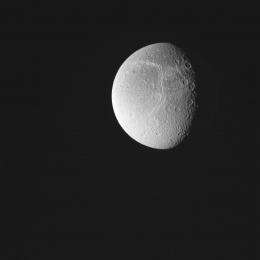
NASA's Cassini spacecraft obtained this image of Saturn's moon Dione on Sept. 3, 2010. The camera was pointing toward Dione at approximately 44,173 kilometers (27,448 miles) away.

Cruising past Saturn's moon Dione this past weekend, NASA's Cassini spacecraft got its best look yet at the north polar region of this small, icy moon and returned stark raw images of the fractured, cratered surface.

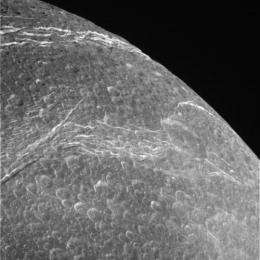
The new images also show new views of the long, bright canyon ice walls, which scientists working with NASA's called "wispy terrain" in the early 1980s. These ice walls thread along the surface of the moon's trailing hemisphere and cut across craters.
Divine dione captured by Cassini
Enlarge

This image was taken on September 03, 2010 and received on Earth September 04, 2010. The camera was pointing toward DIONE at approximately 49,969 kilometers away, and the image was taken using the CL1 and CL2 filters. It has not been validated or calibrated. Image Credit: NASA/JPL/Space Science Institute

The Cassini-Huygens mission is a cooperative project of NASA, the European Space Agency and the Italian Space Agency. JPL, a division of the California Institute of Technology in Pasadena, manages the mission for NASA's Science Mission Directorate, Washington, D.C. The Cassini orbiter and its two onboard cameras were designed, developed and assembled at JPL. The imaging operations center is based at the Space Science Institute in Boulder, Colo.

More raw images of Dione are available at http://saturn.jpl. … /photos/raw/ .

More information: More information about the Cassini-Huygens mission is at http://www.nasa.gov/cassini and http://saturn.jpl.nasa.gov

Provided by JPL/NASA (news : web)


Rank 5 /5 (5 votes)
Related Stories
Relevant PhysicsForums posts
  • Titan's lack of impact craters
    created21 hours ago
  • Real pictures of black hole eating a star?
    createdFeb 08, 2012
  • Hypothetical way to travel faster than light, but not technically exceed lightspeed
    createdFeb 06, 2012
  • How do scientists monitor the Sun's activity?
    createdFeb 05, 2012
  • Search patterns in observational studies
    createdFeb 05, 2012
  • Derivation of Pogson's law
    createdFeb 03, 2012
  • More from Physics Forums - General Astronomy

More news stories

Mars Science Laboratory computer issue resolved

(PhysOrg.com) -- Engineers have found the root cause of a computer reset that occurred two months ago on NASA's Mars Science Laboratory and have determined how to correct it.

Space & Earth / Space Exploration

created 13 minutes ago | popularity not rated yet | comments 0 | with audio podcast

Putin receives 'prehistoric' water from Antarctic lake

Prime Minister Vladimir Putin was given a water sample Friday taken from a pristine lake hidden under Antarctic ice for over a million years, after Russian scientists drilled down to its surface.

Space & Earth / Earth Sciences

created 19 minutes ago | popularity 5 / 5 (1) | comments 0

Rockot to launch two Sentinel satellites

ESA and Eurockot today signed contracts for launching two ESA satellites: Sentinel-2A and Sentinel-3A will fly in 2013 on Rockot vehicles from the Plesetsk Cosmodrome in northern Russia for Europe’s GMES ...

Space & Earth / Space Exploration

created 15 minutes ago | popularity 5 / 5 (1) | comments 0

Probing a link from Sahara dust to climate change

Qilong Min, Ph.D., Senior Research Associate and Professor with the Atmospheric Sciences Research Center (ASRC) at the University at Albany is developing innovative ways to measure how dust in the Sahara Desert ...

Space & Earth / Earth Sciences

created 8 minutes ago | popularity not rated yet | comments 0

Humans may have helped the decline of African rainforests 3000 years ago

(PhysOrg.com) -- Large areas of rainforests in Central Africa mysteriously disappeared over three thousand years ago, to be replaced by savannas. The prevailing theory has been that the cause was a change ...

Space & Earth / Environment

created 3 hours ago | popularity 5 / 5 (2) | comments 0 | with audio podcast report


New error-correcting codes guarantee the fastest possible rate of data transmission

Error-correcting codes are one of the triumphs of the digital age. They’re a way of encoding information so that it can be transmitted across a communication channel — such as an optical fiber o ...

A frank discussion of the power law and linking correlation to causation

(PhysOrg.com) -- Michael Stumpf a mathematics professor at Imperial College in London, and Mason Porter a lecturer at Oxford have teamed together to write and publish a perspective piece in Science regarding the in ...

Advanced power-grid model finds low-cost, low-carbon future in West

(PhysOrg.com) -- The least expensive way for the Western U.S. to reduce greenhouse gas emissions enough to help prevent the worst consequences of global warming is to replace coal with renewable and other ...

Small modular reactor design could be a 'SUPERSTAR'

(PhysOrg.com) -- Though most of today's nuclear reactors are cooled by water, we've long known that there are alternatives; in fact, the world's first nuclear-powered electricity in 1951 came from a reactor ...

High school students test best with 7 hours' rest

(Medical Xpress) -- Whether or not you know any high school students that actually get nine hours of sleep each night, that’s what federal guidelines currently prescribe.

The question of life in the ancient world

There’s a general feeling that we don’t get the Greeks – ancient or modern. Many, including heads of state like Angela Merkel, visibly shake their head in exasperation, rightly or wrongly, at ...