More hurricanes in greener seas? Ocean color linked to formation, movement of tropical cyclones
September 8, 2010 By Morgan Bettex, MIT News
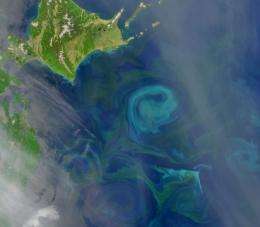
The swirls of color visible in the waters southeast of Japan's Hokkaido (island in upper left part of image) show where different kinds of phytoplankton are using chlorophyll and other pigments to capture sunlight and produce food. It turns out that phytoplankton affect how deeply sunlight is absorbed by the oceans, which affects how and where tropical cyclones form. Image: NASA
More hurricanes may form in greener waters, where sunlight tends to be absorbed at shallower depths, than in clear seas, according to new research that draws a link between ocean color and the formation and movement of tropical cyclones.
It’s no secret that hurricanes depend on a recipe of moist air, warm water and converging winds. But in a paper due to be published this month in Geophysical Research Letters, researchers from MIT and the National Oceanic and Atmospheric Administration’s Geophysical Fluid Dynamics Laboratory say ocean color — which is typically influenced by the concentration of tiny marine organisms — may also be a factor.
Ocean color varies around the globe. In the northern Pacific Ocean, the sea surface is dark green because it is packed with sediment and microscopic plants known as phytoplankton that absorb sunlight and keep the ocean’s surface warm. But the crystal-clear waters around the Bahamas lack biological material near the surface, and sunlight is absorbed much deeper. The depth of absorption is important because it affects ocean circulation, and ocean circulation redistributes heat throughout the world’s oceans, thereby affecting sea-surface temperatures.
“For this study, the question was, what difference does two meters versus 20 meters make?” says co-author Kerry Emanuel, the Breene M. Kerr Professor of Atmospheric Science in the Department of Earth, Atmospheric and Planetary Sciences. “We find that the difference is in the pattern of hurricane movement.”
In their analysis, the researchers used computer models to simulate the effects of ocean color on the paths of tropical cyclones — commonly called hurricanes and typhoons. In one simulation, they depleted the phytoplankton in a large region of the North Pacific, which led to cooler sea-surface temperatures. This resulted in a 70 percent decrease in tropical cyclones in the area’s subtropical regions, and a 20 percent increase in tropical cyclones appearing close to the equator. That’s because without phytoplankton, the sea-surface temperature was warmer close to the equator but cooler in the subtropics. As a result, the storms formed closer to the equator where the water was warmer.
“This research underscores how we’re trying to model such a complex system, and how we are probably missing some important physics in those models,” says Jim Kossin, an adjunct professor of atmospheric science at the University of Wisconsin. “Ocean color is one example of that physics.” Although Kossin finds the link between ocean color and tropical cyclones “fascinating,” he points out that because the variability of ocean color isn’t yet well understood, the parameters used in the analysis may not be realistic.
Emanuel cautions against interpreting the study as one that can be used to forecast hurricanes, stressing instead that the research more importantly highlights how closely life in the oceans is linked to the climate system. More than anything, he says, the research provides new impetus for using satellites to monitor ocean color. Although a NASA satellite has done this for about 12 years, budget cuts have threatened its future.
New satellite data would help researchers like lead author Anand Gnanadesikan, an atmospheric scientist with NOAA and lecturer at Princeton, gain a better understanding of how global warming may affect ocean color. This relationship is still unclear, since previous studies have linked global warming to both an increase and a decrease in phytoplankton. “We are very interested in understanding how ocean color might change in the future, and how it might have changed in the past, and seeing whether we can attribute changes in sea-surface temperatures to those changes in ocean color,” he says of future modeling efforts.
This story is republished courtesy of MIT News (http://web.mit.edu/newsoffice/), a popular site that covers news about MIT research, innovation and teaching.
Provided by Massachusetts Institute of Technology (news : web)
-
Ocean's color affects hurricane paths
Aug 13, 2010 |
not rated yet |
0
-
More tropical cyclones in past could play role in warmer future
Feb 24, 2010 |
not rated yet |
0
-
Hurricanes' effects on ocean temperature revisited
Mar 04, 2010 |
not rated yet |
0
-
Ocean height indicator of climate
Oct 07, 2005 |
not rated yet |
0
-
Climate change signal detected in the Indian Ocean
May 30, 2007 |
not rated yet |
0
-
Engineers build first sub-10-nm carbon nanotube transistor
Feb 01, 2012 |
4.9 / 5 (31) |
30
-
Something old, something new: Evolution and the structural divergence of duplicate genes
Jan 31, 2012 |
4.6 / 5 (7) |
1
-
The hidden nanoworld of ice crystals: Revealing the dynamic behavior of quasi-liquid layers
Jan 30, 2012 |
5 / 5 (3) |
1
-
Stock market network reveals investor clustering
Jan 27, 2012 |
3.9 / 5 (23) |
8
-
Of microchemistry and molecules: Electronic microfluidic device synthesizes biocompatible probes
Jan 26, 2012 |
5 / 5 (1) |
0
-
Discrepancy between oxygen and carbon-dioxide levels
16 hours ago
-
where gems are found in the world
19 hours ago
-
Wind Waves in Reservoir ~ Wind run-up and Wind set-up
Feb 08, 2012
-
Balance of oxygen in the atmosphere
Feb 01, 2012
-
The case for a methanol-based economy
Jan 30, 2012
-
Weather in a rotating cylinder
Jan 25, 2012
- More from Physics Forums - Earth
More news stories
Could Venus be shifting gear?
(PhysOrg.com) -- ESAs Venus Express spacecraft has discovered that our cloud-covered neighbour spins a little slower than previously measured. Peering through the dense atmosphere in the infrared, the ...
Space & Earth / Space Exploration
4 hours ago |
5 / 5 (5) |
7
|
Humans may have helped the decline of African rainforests 3000 years ago
(PhysOrg.com) -- Large areas of rainforests in Central Africa mysteriously disappeared over three thousand years ago, to be replaced by savannas. The prevailing theory has been that the cause was a change ...
Mars Science Laboratory computer issue resolved
(PhysOrg.com) -- Engineers have found the root cause of a computer reset that occurred two months ago on NASA's Mars Science Laboratory and have determined how to correct it.
Space & Earth / Space Exploration
5 hours ago |
5 / 5 (5) |
3
|
Clam fields found at deep, low-temperature Mariana vents
(PhysOrg.com) -- Scientists have marveled at the unusual life forms thriving at high temperature hydrothermal vents of the deep ocean.
Space & Earth / Earth Sciences
5 hours ago |
not rated yet |
0
|
Two new moons for Jupiter
Advances in technology have lead to the discovery of new planets outside of our Solar System, and now even new moons in our own backyard.
Space & Earth / Space Exploration
4 hours ago |
not rated yet |
2
Putting the squeeze on planets outside our solar system
(PhysOrg.com) -- Using high-powered lasers, scientists at Lawrence Livermore National Laboratory and collaborators discovered that molten magnesium silicate undergoes a phase change in the liquid state, abruptly ...
India probes Google over 'forex transactions'
Indian authorities are probing whether online giant Google broke domestic foreign-exchange transactions rules while shifting funds abroad, the Press Trust of India reported on Friday.
Germany freezes signing of disputed Internet pact
Germany on Friday halted the signing of a controversial international accord billed as a way to beat online piracy that has sparked angry protests, saying it needed more time to consider it.
Health experts, scientists to discuss bird flu studies
The World Health Organization said Friday it will meet next week to determine whether scientists can publish research on a bird flu virus that may be easily passed among humans.
Employers feel no love for unscrupulous practice of 'service sweethearting'
A new study led by two Florida State University marketing professors finds that some frontline service employees who are rewarded for hikes in customer loyalty and satisfaction also may engage in "service ...
Obama forges compromise birth control plan
US President Barack Obama Friday announced a compromise to defuse a row over access to birth control which prompted election-year Republican critics to claim he was waging a war on religion.
Sep 08, 2010
Rank: 1 / 5 (1)
It is, of course, nice that existing computer simulations agree.
But I think this article is an example of some forms of current science. We tend to "do computer simulations" and then take the results at face value -- instead of trying to think through the problem.
In other words, if we don't understand the problem, then how can we know we can trust the model results? (Especially when the models are often created by other people, and we know neither the assumption details, the math, nor the source code.)
Sep 08, 2010
Rank: 5 / 5 (1)
Sep 08, 2010
Rank: 1 / 5 (1)
Models, it depends. The models currently used in hurricane study, simply are too complicated for any single individual to go through once and for all, to state that they're good enough, or not.
In any small surroundings, models are testable. But then you end up with situations like hurricane modelling, where tens, if not hundreds of smaller models are incorporated together, possibly added with "wisdom from the old" on the top level (and, secretly, some tweak factors (hey, even Einstein had a tweak factor!!)). Are you the one to tell us that this is not the case here?