Portable laser backpack revolutionizes 3-D mapping
September 8, 2010
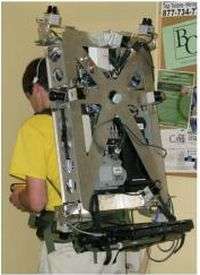
A portable, laser backpack for 3-D mapping has been developed at the University of California, Berkeley where it is being hailed as a breakthrough technology capable of producing fast, automatic and realistic 3-D mapping of even difficult interior environments. Credit: Credit: John Kua, University of California, Berkeley
A portable, laser backpack for 3D mapping has been developed at the University of California, Berkeley, where it is being hailed as a breakthrough technology capable of producing fast, automatic and realistic 3D mapping of difficult interior environments.
Research leading to the development of the reconnoitering backpack, was funded by the Air Force Office of Scientific Research and the Army Research Office under the guidance of program managers, Dr. Jon Sjogren (AFOSR) and Dr. John Lavery (ARO).
The backpack is the first of a series of similar systems to work without being strapped to a robot or attached to a cart. At the same time, its data acquisition speed is very fast, as it collects the data while the human operator is walking; this is in contrast with existing systems in which the data is painstakingly collected in a stop and go fashion, resulting in days and weeks of data acquisition time.
Using this technology, Air Force personnel will be able to collectively view the interior of modeled buildings and interact over a network in order to achieve military goals like mission planning.
Under the direction of Dr. Avideh Zakhor, lead researcher and UC Berkeley professor of electrical engineering, the scientists have been able to use this more portable method of mapping by way of sensors or lightweight (less than eight ounces) laser scanners.
"We have also developed novel sensor fusion algorithms that use cameras, lasers range finders and inertial measurement units to generate a textured, photo-realistic, 3D model that can operate without GPS input and that is a big challenge," said Zakhor.
There are many basic research issues to achieve a working system, including calibration, sensor registration and localization. Using multiple sensors facilitates the modeling process, though the data from various sensors do need to be registered and precisely fused with each other in order to result in coherent, aligned, and textured 3D models. Localization is another technical challenge since without it; it is not possible to line up scans from laser scanners in order to build the 3D point cloud, which is the first step in the modeling process.
"It is fair to say that embarking on such a hands-on project, to make indoor 3D modeling a matter of routine, a number of research questions of a fundamental nature came up," said Sjogren. "It is typical of the work that Prof. Zakhor has done for AFOSR/Air Force Research Laboratory over the years, that she meets these challenges head-on, and in most cases solves the problem sufficient to demonstrate a prototype system."
Sjogren noted that what is left for others is to examine the approach that was taken, and extend the techniques that were brought in, to a wider context.
"We are gratified to see how technology can drive science in a domain of critical relevance to practical defense implementations," he said.
Even though they don't have all the answers yet, the scientists are boldly looking ahead to how this technology can be used in the future when they plan to model entire buildings and develop interactive viewers that allow users to virtually walk through buildings before they are there in person.
In the meantime, the cutting-edge technology is being successfully implemented on campus.
"We have already generated 3D models of two stories of the electrical engineering building at UC Berkeley, including the stairway and that is a first," said Zakhor.
Provided by Air Force Office of Scientific Research
-
Breakthrough in split second 3D face imaging
Mar 24, 2006 |
not rated yet |
0
-
Creating 3D models with a simple webcam (w/ Video)
Nov 11, 2009 |
not rated yet |
0
-
National Robotics Engineering Center Demonstrates the Future of Smart Work
Dec 21, 2009 |
not rated yet |
0
-
Japanese Researchers Develop Portable 3D Display System
Sep 29, 2006 |
not rated yet |
0
-
Researchers develop fast methods for making 3D city models
Mar 29, 2010 |
not rated yet |
0
-
Engineers build first sub-10-nm carbon nanotube transistor
Feb 01, 2012 |
4.9 / 5 (30) |
30
-
Something old, something new: Evolution and the structural divergence of duplicate genes
Jan 31, 2012 |
4.6 / 5 (7) |
1
-
The hidden nanoworld of ice crystals: Revealing the dynamic behavior of quasi-liquid layers
Jan 30, 2012 |
5 / 5 (3) |
1
-
Stock market network reveals investor clustering
Jan 27, 2012 |
3.9 / 5 (23) |
8
-
Of microchemistry and molecules: Electronic microfluidic device synthesizes biocompatible probes
Jan 26, 2012 |
5 / 5 (1) |
0
-
Empirical data regarding shower heads and water
4 hours ago
-
feed hold button on CNC lathe
Feb 09, 2012
-
RFAC in Fortran
Feb 09, 2012
-
dynamics 2/32
Feb 08, 2012
-
dynamics
Feb 08, 2012
-
Vibration Absorbtion Problem
Feb 08, 2012
- More from Physics Forums - General Engineering
More news stories
Zynga partners with toy maker Hasbro
Old school toy maker Hasbro and online social game star Zynga on Thursday announced a partnership to mesh the Internet firm's hits with real-world products.
35 minutes ago |
not rated yet |
0
US video game sales fall 34 percent in January
(AP) -- U.S. retail sales of video game hardware, software and accessories fell 34 percent in January from a year earlier to $751 million due to the lack of new game titles, according to market researcher NPD Group.
1 hour ago |
not rated yet |
0
Samsung can continue selling Galaxy tabs in Germany: court
South Korea's Samsung Electronics can continue to sell its Galaxy Tab 10.1N tablet computer in Germany, a German court ruled Thursday, rejecting a bid by arch-rival Apple to have them banned.
22 hours ago |
4 / 5 (4) |
3
Digital photos could put kids at risk
A study published in the International Journal of Electronic Security and Digital Forensics this month suggests that parents and carers could be putting children at risk if they upload digital photos that are automatically "geota ...
18 hours ago |
5 / 5 (1) |
3
Google launches Chrome browser for Android smartphones
With more and more people connecting to the Internet through a phone or a tablet instead of a PC, Google Inc. is bringing its fast-growing browser, Chrome, to the newest Android-powered mobile devices.
21 hours ago |
5 / 5 (5) |
0
Humans may have helped the decline of African rainforests 3000 years ago
(PhysOrg.com) -- Large areas of rainforests in Central Africa mysteriously disappeared over three thousand years ago, to be replaced by savannas. The prevailing theory has been that the cause was a change ...
Japan scientist makes 'Avatar' robot
A Japanese-developed robot that mimics the movements of its human controller is bringing the Hollywood blockbuster "Avatar" one step closer to reality.
Protein libraries in a snap
(PhysOrg.com) -- A Rice University undergraduate will depart with not only a degree but also a possible patent for his invention of an efficient way to create protein libraries, an important component of biomolecular ...
Sleep breathing machine shows clear benefits in children with sleep apnea
Children and adolescents with obstructive sleep apnea had substantial improvements in attention, anxiety and quality of life after treatment with positive airway pressure (PAP)a nighttime therapy in which a machine ...
Neurologic improvement detected in rats receiving stem cell transplant
In a study to be presented today at the Society for Maternal-Fetal Medicine's annual meeting, The Pregnancy Meeting, in Dallas, Texas, researchers will report that early transplantation of human placenta-derived mesenchymal ...
Miami battling invasion of giant African snails
No one knows how they got there. But an invasion of African giant snails has southern Florida in a panic over potential crop damage, disease and general yuckiness surrounding the slimy gastropods.