Anti-aphrodisiac protects young bedbugs
September 9, 2010
Anti-aphrodisiac protects young bedbugs

Enlarge

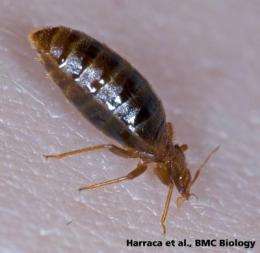
This is a bedbug. Credit: Harraca et al., BMC Biology

Male bedbugs are known to be very unfussy when it comes to mating, mounting any well-fed bug they can see - regardless of age or gender. Researchers writing in the open access journal BMC Biology have discovered how immature bedbug nymphs, who would be harmed by the traumatic insemination technique practiced by the males, release alarm pheromones to deter this unwanted attention.

Vincent Harraca, from Lund University, Sweden, worked with a team of researchers to stage encounters between males and females or nymphs. He said, "The chemical communication, as well as the mating behavior, of bed bugs has received increased attention in recent years as bed bug infestations have increased worldwide. Mating is exclusively traumatic, with the male piercing an opening in the female and ejaculating directly into the abdominal cavity. In order to avoid this, we've found that bedbug nymphs release aldehyde pheromones that let the male know that they should look elsewhere. These results may be applied to decrease bed bug populations by mating disruption".

Harraca and his colleagues prevented a group of nymphs from signaling by blocking their scent glands with nail polish. These 'silenced' nymphs were then found to experience the same percentage of mating with sperm transfer as a normal female. Furthermore, application of the pheromones, to a male/female pair during mounting initiation caused a decrease in frequency. The anti-aphrodisiac blend of aldehydes was shown to signal through olfactory receptor neurons in the antennae of the repelled males. This research provides new insights into the chemical communication system of bed bugs and challenges the common view that alarm pheromones are used as a predator only.

Speaking about the results, Harraca said, "The system of the is only just unfolding, and further analyses on longevity costs to nymphs as well as males who have been pierced is a high priority to fully understand the picture of traumatic insemination".

More information: Nymphs of the common bed bug (Cimex lectularius) produce anti-aphrodisiac defence against conspecific males, Vincent Harraca, Camilla Ryne and Rickard Ignell, BMC Biology (in press), http://www.biomedc … com/bmcbiol/

Provided by BioMed Central (news : web)


Rank 3 /5 (2 votes)
Related Stories
Relevant PhysicsForums posts

More news stories

Ultraviolet protection molecule in plants yields its secrets

Lying around in the sun all day is hazardous not just for humans but also for plants, which have no means of escape. Ultraviolet (UV) radiation from the sun can damage proteins and DNA inside cells, leading ...

Biology / Plants & Animals

created 10 hours ago | popularity 5 / 5 (4) | comments 0 | with audio podcast

Deadly bird parasite evolves at exceptionally fast rate

A new study of a devastating bird disease that spread from poultry to house finches in the mid-1990s reveals that the bacteria responsible for the disease evolves at an exceptionally fast rate. What's more, ...

Biology / Biotechnology

created 8 hours ago | popularity 5 / 5 (2) | comments 0 | with audio podcast

Decoding the molecular machine behind E. coli and cholera

Scientists from Queen Mary, University of London have discovered the workings behind some of the bacteria that kill hundreds of thousands every year, possibly paving the way for new antibiotics that could treat infections ...

Biology / Cell & Microbiology

created 8 hours ago | popularity not rated yet | comments 0 | with audio podcast

Deciding to go left or right: Researchers use device to determine that lower animals can navigate too

For decades, scientists have associated binary decision making — opting to go left or right — with higher-ranking animals, including humans. A team of Harvard researchers, however, is rewriting that ...

Biology / Plants & Animals

created 16 hours ago | popularity not rated yet | comments 2 | with audio podcast

5-10 percent corn yield jump using erosion-slowing cover crops shown in new study

The most recent annual results from a four-year Iowa State University study on using cover crops between rows of corn reveals that higher yields – by as much as 10 percent – are possible using the ...

Biology / Other

created 12 hours ago | popularity not rated yet | comments 2


'Dark plasmons' transmit energy

Microscopic channels of gold nanoparticles have the ability to transmit electromagnetic energy that starts as light and propagates via "dark plasmons," according to researchers at Rice University.

FDA-approved drug rapidly clears amyloid from the brain, reverses Alzheimer's symptoms in mice

Neuroscientists at Case Western Reserve University School of Medicine have made a dramatic breakthrough in their efforts to find a cure for Alzheimer's disease. The researchers' findings, published in the journal Science, show t ...

Hydrogen from acidic water: Researchers develop potential low cost alternative to platinum for splitting water

A technique for creating a new molecule that structurally and chemically replicates the active part of the widely used industrial catalyst molybdenite has been developed by researchers with the Lawrence Berkeley ...

Anyone can learn to be more inventive, cognitive researcher says

There will always be a wild and unpredictable quality to creativity and invention, says Anthony McCaffrey, a cognitive psychology researcher at the University of Massachusetts Amherst, because an "Aha moment" is rare and ...

Soraa LED light may dim 50-watt halogen rivals

(PhysOrg.com) -- Soraa, a Fremont, California company founded in 2008, this week launched its first product, a light that uses LEDS (light emitting diodes). The "Soraa LED MR16 lamp" is the "perfect" replacement ...

Flexible paper robots

(PhysOrg.com) -- These inexpensive robots can stretch, bend and twist under control, and lift objects up to 120 times their own weight. Being soft, they can apply gentle and even pressure, and adapt to varied ...