Pacific sockeye salmon return in record numbers
September 9, 2010 by Deborah Jones
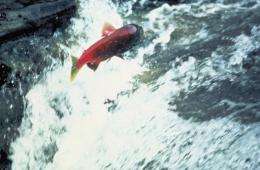
Photo courtesy the US Fish & Wildlife Service, shows a salmon swimming up a stream in Alaska. Sockeye salmon, whose stocks ran perilously low last year, are gushing in record numbers from the Pacific Ocean toward their spawning grounds far inland.
After years of scarcity, the rivers of the US and Canadian Pacific Northwest are running red, literally, with a vast swarm of a salmon species considered to be in crisis.
Sockeye salmon, whose stocks ran perilously low last year, are gushing in record numbers from the Pacific Ocean toward their spawning grounds far inland.
Since mid-August, in a torrent expected to last through early October, sockeye have plunged and leapt up Alaskan streams, massed through the mouth of the mighty Fraser River in Vancouver, and filled Oregon and Washington waterways.
"We don't know why for certain," said Barry Rosenberger, a manager with Canada's federal fisheries department.
All experts agree that conditions have been near-perfect for this year's sockeye, a strikingly red species with a dramatic four-year life cycle.
Since they hatched inland in 2006, then migrated from freshwater to the ocean in 2008, the fish enjoyed such plentiful food of krill and plankton, preferred cold ocean temperatures, and a dearth of predators, that massive numbers have matured to return to their birthplaces to spawn and die.
"Salmon have had us on a roller coaster," said marine biologist John Reynolds of Simon Fraser University. "Last year we had the lowest return in at least 50 years, and this year it looks like it will be the highest in nearly a century."
The bounty follows years of intense scarcity that closed or restricted many fishing areas, mostly in Canada where the 2009 near-demise of sockeye in the Fraser River prompted Canada to appoint a commission to investigate.
It began holding public meetings in August just as the massive 2010 return began.
The numbers this year affect Japan and Russia as well as North America, and are shocking: in the United States, an estimated 40 million sockeye entering six Alaskan river systems through Bristol Bay broke all records, Rosenberger told AFP.
The Columbia River in Oregon has seen "the largest sockeye return since 1938," he said, while Japan and Russia are enjoying "phenomenal returns."
But the biggest news is in Vancouver, where the largest sockeye return in nearly a century is entering the mouth of the Fraser River -- arguably the world's single largest historic salmon migration route.
On Tuesday the joint Canada-US Pacific Salmon Commission increased its estimate of Fraser sockeye to 34.5 million fish, while Canada's fisheries department said native, commercial and sports fishers caught some 10.7 million.
Before the local commercial fishery wrapped up Tuesday, the glut overwhelmed local canneries and sent consumer prices plunging by as much as 70 percent to 15 dollars per fish, as people lined up at wharves to buy directly from boats.
The last major Fraser run was some 39 million fish in 1913 -- before disaster struck at the aptly-named Hell's Gate, 200 kilometers (124 miles) northeast of Vancouver.
After a railroad construction crew sent a rockslide crashing into Hell's Gate, more than 38 million salmon battered themselves to death against the barrier; only about two percent of the run made it through, according to the fisheries department.
The disaster was devastating in a region where salmon are iconic: local aboriginals are known as "people of the salmon."
Explained Rashid Sumaila, director of the University of British Columbia Fisheries Centre, "everybody (here) has some special attachment to salmon."
Following decades of conservation measures and repairs to migration routes, local residents are now expressing hope.
"These are days of miracle and wonder for those of us who care about the fate of wild salmon," wrote author Stephen Hume in a local newspaper column.
"This is what the river was like every year in the past," Joe Becker, a special commissioner for salmon with the Musqueam Indian Band told AFP from his boat on the Fraser.
"There was this fear hanging on us, maybe this salmon has gone forever -- but maybe they can come back, we haven't lost them," said Sumaila.
Still, no one is calling the bonanza of 2010 the start of a trend.
"Wait to see if it builds up over years before we get confident," said Sumaila.
(c) 2010 AFP
-
Canada's lost salmon found
Aug 25, 2010 |
not rated yet |
0
-
Scientists wonder where salmon are
Jul 07, 2005 |
not rated yet |
0
-
Feds vote to halt Calif. chinook salmon fishing
Apr 09, 2009 |
not rated yet |
0
-
Salmon fishing season at risk in Calif.
Mar 13, 2008 |
not rated yet |
0
-
Unfavorable ocean conditions likely cause of low 2007 salmon returns along West Coast
Mar 03, 2008 |
not rated yet |
0
-
Engineers build first sub-10-nm carbon nanotube transistor
Feb 01, 2012 |
4.9 / 5 (31) |
30
-
Something old, something new: Evolution and the structural divergence of duplicate genes
Jan 31, 2012 |
4.6 / 5 (7) |
1
-
The hidden nanoworld of ice crystals: Revealing the dynamic behavior of quasi-liquid layers
Jan 30, 2012 |
5 / 5 (3) |
1
-
Stock market network reveals investor clustering
Jan 27, 2012 |
3.9 / 5 (23) |
8
-
Of microchemistry and molecules: Electronic microfluidic device synthesizes biocompatible probes
Jan 26, 2012 |
5 / 5 (1) |
0
-
Protease cleavage
1 hour ago
-
Pertubance in a model
8 hours ago
-
Cancer drugs and Alzheimer's, Oh my!
16 hours ago
-
Squishing cells
17 hours ago
-
Any books/articles for evolutionary stable strategy models in humans?
Feb 09, 2012
-
Science behind the bore feeling?
Feb 09, 2012
- More from Physics Forums - Biology
More news stories
The power of estrogen -- male snakes attract other males
A new study has shown that boosting the estrogen levels of male garter snakes causes them to secrete the same pheromones that females use to attract suitors, and turned the males into just about the sexiest ...
6 hours ago |
5 / 5 (2) |
0
|
Experts reveal how plants don't get sunburn
(PhysOrg.com) -- Experts at the University of Glasgow have discovered how plants survive the harmful rays of the sun.
6 hours ago |
5 / 5 (2) |
0
|
Grass to gas: Researchers' genome map speeds biofuel development
Researchers at the University of Georgia have taken a major step in the ongoing effort to find sources of cleaner, renewable energy by mapping the genomes of two originator cells of Miscanthus x giganteus, a large perenn ...
3 hours ago |
3.7 / 5 (3) |
0
|
Protein libraries in a snap
(PhysOrg.com) -- A Rice University undergraduate will depart with not only a degree but also a possible patent for his invention of an efficient way to create protein libraries, an important component of biomolecular ...
10 hours ago |
5 / 5 (2) |
0
|
Miami battling invasion of giant African snails
No one knows how they got there. But an invasion of African giant snails has southern Florida in a panic over potential crop damage, disease and general yuckiness surrounding the slimy gastropods.
10 hours ago |
not rated yet |
2
Complex wiring of the nervous system may rely on a just a handful of genes and proteins
Researchers at the Salk Institute have discovered a startling feature of early brain development that helps to explain how complex neuron wiring patterns are programmed using just a handful of critical genes. ...
CIA website offline, Anonymous takes credit
The website of the Central Intelligence Agency was unresponsive on Friday after the hacker group Anonymous claimed to have knocked it offline.
Q&A: Obama and the birth control controversy
(AP) -- What birth control debate? A half-century after the introduction of the pill, acceptance of birth control by American women is virtually universal.
New error-correcting codes guarantee the fastest possible rate of data transmission
Error-correcting codes are one of the triumphs of the digital age. Theyre a way of encoding information so that it can be transmitted across a communication channel such as an optical fiber o ...
Humans may have helped the decline of African rainforests 3000 years ago
(PhysOrg.com) -- Large areas of rainforests in Central Africa mysteriously disappeared over three thousand years ago, to be replaced by savannas. The prevailing theory has been that the cause was a change ...
Both maternal and paternal age linked to autism
Older maternal and paternal age are jointly associated with having a child with autism, according to a recently published study led by researchers at The University of Texas Health Science Center at Houston (UTHealth).
Sep 09, 2010
Rank: 5 / 5 (1)
Sep 09, 2010
Rank: not rated yet
Sep 10, 2010
Rank: not rated yet