Lasers keep mini helicopter hovering for hours
September 9, 2010 by Lin Edwards report
Lasers keep mini helicopter hovering for hours

Enlarge

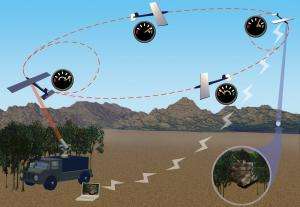
Multi-mission UAV, recharging in between missions. Image credit: LaserMotive

(PhysOrg.com) -- Seattle research and development company LaserMotive has succeeded in keeping a model helicopter hovering for six hours, powered only by the energy of a laser.

Conventional unmanned aerial vehicles (UAVs) are limited in their flying time because of the fuel or batteries they carry. Operation times can be extended if solar power is used in conjunction with batteries, as in Qinetiq’s ultralight Zephyr, which has been able to fly for 82 hours. , a Swiss company, has also demonstrated solar powered piloted craft.

Unmanned vehicles used by the military tend to be stronger and heavier than ultralights, and it is difficult to power them with solar power because of their greater energy requirements, and this is where LaserMotive hopes to provide a solution.

The laser-powered model helicopter, which weighed only 22 grams, was demonstrated at Denver, Colorado last week at the AUVSI Unmanned Systems Conference. The tethered, radio-controlled model helicopter was powered by an array of semiconductor-diode near-infrared lasers, which produced laser beams that were then focused down to a single beam seven centimeters in diameter.

The beam, which will not damage eyes, tracked the helicopter automatically and illuminated the helicopter’s photovoltaic (PV) cells, which were optimized for the laser’s wavelength. The then converted around 50 percent of the laser power to electricity, providing just a few watts, but enough to keep the helicopter rotors spinning.

Tom Nugent, president, CEO and co-founder of LaserMotive, said he believed the six hour limit was set by the quality of the motor that drives the helicopter rotors, since it was only a small brush motor not designed to run continuously for that long. The tiny model flies under until the motor burns out, he said.

Nugent also said he expected the system could be scaled to “anything anybody is interested in.” An could fly missions and return to recharge over the laser, or could hover over a laser base for lengthy periods.

LaserMotive demonstrated the use of lasers to power robots wirelessly last year, when it won the $900,000 Power Beaming Challenge sponsored by NASA for using a to power a robot climbing a 900-meter-long cable suspended from a full-scale helicopter.

This video is not supported by your browser at this time.

The power beaming prize winnings could enable the company to help in powering space elevators to lift objects into orbit in the future, but such elevators are still at the concept stage. Other possible applications include delivering emergency power in disaster situations and to forward military bases or remote rural communities.

UAVs are among the fastest growing sectors in the aerospace industry and in defense, and the global market is expected to grow from the current $4.9 billion to $11.5 billion within ten years, according to industry analysts the Teal Group.

More information: LaserMotive - http://lasermotive.com/

© 2010 PhysOrg.com

4.5 /5 (21 votes)  

Filter


Move the slider to adjust rank threshold, so that you can hide some of the comments.


Display comments: newest first

O2BOOM
Sep 13, 2010

Rank: not rated yet
Remote energy projection...

Oh, the possibilities.
Rank 4.5 /5 (21 votes)
Related Stories
Relevant PhysicsForums posts
  • Does anyone make a small high temperature and high pressure pump?
    created6 hours ago
  • Strange indexing in Fortran Code
    created17 hours ago
  • Car Port post load calculation
    created18 hours ago
  • attempting to spin-cast parabola
    createdFeb 07, 2012
  • Flow around a reducing bend - effect on pumping work
    createdFeb 06, 2012
  • Formula for deflection of 6061 T6 hollow tube, please help.
    createdFeb 06, 2012
  • More from Physics Forums - General Engineering

More news stories

Scientists break satellite telephony security standards

Satellite telephony was thought to be secure against eavesdropping. German researchers at the Horst Gortz Institute for IT-Security (HGI) at the Ruhr University Bochum (RUB) have cracked the encryption algorithms of the European ...

Technology / Computer Sciences

created 5 hours ago | popularity 5 / 5 (2) | comments 0 | with audio podcast

Solar start-ups set new efficiency records

(PhysOrg.com) -- Although Alta Devices and Semprius make different types of solar panels, both start-ups have been breaking records in the past few days. Santa Clara, Calif.-based Alta Devices announced that ...

Technology / Energy & Green Tech

created 10 hours ago | popularity 4.9 / 5 (10) | comments 8 | with audio podcast report

Amazon strikes video deal with Viacom

Amazon announced a deal with entertainment giant Viacom on Wednesday, building up its arsenal of television shows as it takes on video streaming market leader Netflix.

Technology / Business

created 3 hours ago | popularity not rated yet | comments 0

Rambus, Nvidia sign patent licensing deal

Technology licensing company Rambus Inc. said Wednesday it has signed a licensing agreement with chip maker Nvidia Corp. to settle a long-running patent dispute.

Technology / Business

created 3 hours ago | popularity 3 / 5 (1) | comments 0

Darpa's Legged Squad Support System (LS3) to lighten troops' load

Today’s dismounted warfighter can be saddled with more than 100 pounds of gear, resulting in physical strain, fatigue and degraded performance. Reducing the load on dismounted warfighters has become a ...

Technology / Engineering

created 6 hours ago | popularity 4.8 / 5 (5) | comments 9


Short fasting cycles work as well as chemotherapy in mice

Man may not live by bread alone, but cancer in animals appears less resilient, judging by a study that found chemotherapy drugs work better when combined with cycles of short, severe fasting.

Physicists build highly efficient 'no-waste' laser

A team of University of California, San Diego researchers has built the smallest room-temperature nanolaser to date, as well as an even more startling device: a highly efficient, "thresholdless" laser that ...

Study shows how DNA finds its match

It's been more than 50 years since James Watson and Francis Crick showed that DNA is a double helix of two strands that complement each other. But how does a short piece of DNA find its match, out of the millions ...

Transparent iron? For the first time, an experiment shows that atomic nuclei can become transparent

At the high-brilliance synchrotron light source PETRA III, a team of DESY scientists headed by Dr. Ralf Röhlsberger has succeeded in making atomic nuclei transparent with the help of X-ray light. At the ...

'Explorers,' who embrace the uncertainty of choices, use specific part of cortex

Life shrouds most choices in mystery. Some people inch toward a comfortable enough spot and stick close to that rewarding status quo. Out to dinner, they order the usual. Others consider their options systematically ...

Scientists delve into the brain roots of hunger and eating

Synaptic plasticity – the ability of the synaptic connections between the brain's neurons to change and modify over time -- has been shown to be a key to memory formation and the acquisition of new learning behaviors. ...