Optical interface to link robotic limbs, human brain
Lightning-fast connections between robotic limbs and the human brain may be within reach for injured soldiers and other amputees with the establishment of a multimillion-dollar research center led by Southern Methodist University engineers.
Funded by a Department of Defense initiative dedicated to audacious challenges and intense time schedules, the Neurophotonics Research Center will develop two-way fiber optic communication between prosthetic limbs and peripheral nerves.
This connection will be key to operating realistic robotic arms, legs and hands that not only move like the real thing, but also "feel" sensations like pressure and heat.
Successful completion of the fiber optic link will allow for sending signals seamlessly back and forth between the brain and artificial limbs, allowing amputees revolutionary freedom of movement and agility.
Potential to patch injured spinal cord
Partners in the Neurophotonics Research Center also envision man-to-machine applications that extend far beyond prosthetics, leading to medical breakthroughs like brain implants for the control of tremors, neuro-modulators for chronic pain management and implants for patients with spinal cord injuries.
The researchers believe their new technologies can ultimately provide the solution to the kind of injury that left actor Christopher Reeve paralyzed after a horse riding accident. "This technology has the potential to patch the spinal cord above and below a spinal injury," said Marc Christensen, center director and electrical engineering chair in SMU's Lyle School of Engineering. "Someday, we will get there."
The Defense Advanced Research Projects Agency (DARPA) is funding the $5.6 million center with industry partners as part of its Centers in Integrated Photonics Engineering Research (CIPhER) project, which aims to dramatically improve the lives of the large numbers of military amputees returning from war in Iraq and Afghanistan.
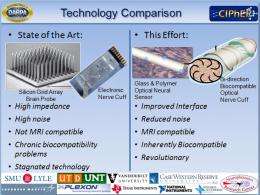
Currently available prosthetic devices commonly rely on cables to connect them to other parts of the body for operation — for example, requiring an amputee to clench a healthy muscle in the chest to manipulate a prosthetic hand. The movement is typically deliberate, cumbersome, and far from lifelike.
A link compatible with living tissue
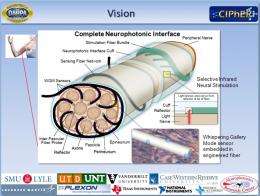
The goal of the Neurophotonics Research Center is to develop a link compatible with living tissue that will connect powerful computer technologies to the human nervous system through hundreds or even thousands of sensors embedded in a single fiber.
Unlike experimental electronic nerve interfaces made of metal, fiber optic technology would not be rejected or destroyed by the body's immune system.
"Enhancing human performance with modern digital technologies is one of the great frontiers in engineering," said Christensen. "Providing this kind of port to the nervous system will enable not only realistic prosthetic limbs, but also can be applied to treat spinal cord injuries and an array of neurological disorders."
The center brings together researchers from SMU, Vanderbilt University, Case Western Reserve University, the University of Texas at Dallas and the University of North Texas.
The Neurophotonics Research Center's industrial partners include Lockheed Martin (Aculight), Plexon, Texas Instruments, National Instruments and MRRA.
Integrated system at cellular level
Together, this group of university and industry researchers will develop and demonstrate new increasingly sophisticated two-way communication connections to the nervous system.
Every movement or sensation a human being is capable of has a nerve signal at its root. "The reason we feel heat is because a nerve is stimulated, telling the brain there's heat there," Christensen said.
The center formed around a challenge from the industrial partners to build a fiber optic sensor scaled for individual nerve signals: "Team members have been developing the individual pieces of the solution over the past few years, but with this new federal funding we are able to push the technology forward into an integrated system that works at the cellular level," Christensen said.
The research builds on partner universities' recent advances in light stimulation of individual nerve cells and new, extraordinarily sensitive optical sensors being developed at SMU. Volkan Otugen, SMU site director for the center and Lyle School mechanical engineering chair, has pioneered research on tiny spherical devices that sense the smallest of signals utilizing a concept known as "whispering gallery modes." A whispering gallery is an enclosed circular or elliptical area, like that found beneath an architectural dome, in which whispers can be heard clearly on the other side of the space.
Ultimate combination for two-way interface
The ultimate combination of advanced optical nerve stimulation and nerve-sensing technologies will create a complete, two-way interface that does not currently exist. "It will revolutionize the field of brain interfaces," Christensen said.
"Science fiction writers have long imagined the day when the understanding and intuition of the human brain could be enhanced by the lightning speed of computing technologies," said Geoffrey Orsak, dean of the SMU Lyle School of Engineering. "With this remarkable research initiative, we are truly beginning a journey into the future that will provide immeasurable benefits to humanity."


