Ancient data discovered with new U of A technology
September 9, 2010 By Brian Murphy
Ancient data discovered with new U of A technology

Enlarge

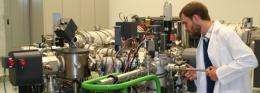
The Cameca IMS-1280 ion probe is the centrepiece of the U of A’s new Canadian Centre for Isotopic Microanalysis.

The University of Alberta has new multi-million dollar technology that can analyze an ancient mineral sample and tell you how it was created, its chemical makeup and its potential commercial value. It can also analyze teeth from an animal and tell you about the environmental conditions it experienced.

The machine is an ion probe and this model, the Cameca IMS-1280, is the only one of its kind in Canada. It is also the centrepiece of the U of A’s new Canadian Centre for Isotopic Microanalysis, which was officially opened Sept. 7.

The probe allows for the closest look possible into the atomic make up of material such as a rock sample or bone.

“The probe can capture a moment in time, possibly millions or billions of years ago when the of a mineral was being formed,” said Thomas Stachel, researcher and director of the centre.

The probe’s powerful resolution gets down to a level of 10 microns, about one-tenth the width of a human hair.

The natural-resources industry will use the centre’s equipment, including the ion probe, to capture new information about mineral and fossil-fuel formations, which will aid in extraction and development. Stachel says geologists looking for diamonds in Canada’s North are concerned with the carbon of mineral samples and the new ion probe can pick out the exact they’re looking for.

“Our machine determines what geological forces created the carbon and the period of time it took to form,” said Stachel. “Knowing how and when a diamond was formed tells you a lot about its value.”

Stachel explains that resource companies will use data from the centre to improve their chances of finding the most valuable diamond deposits. “Mineral revenue from the north is 98 or 99 per cent diamonds,” said Stachel. “Keeping the costs and efficiency of exploration down is essential for keeping that Canadian industry alive.”

In addition to natural-resource clients, the centre will carry out work in a variety of university disciplines.

Stachel says biologists can use the probe to learn a lot from an animal’s tooth. Instead of grinding up a polar bear’s tooth and analyzing its molecular content in bulk, a tiny slice of the tooth is put into the new probe. Stachel likens the process to analyzing the rings of a tree. “We can look at every single year in the life of that polar bear and analyze what it ate, where it lived and extrapolate the environmental conditions it experienced.”

The centre is funded with approximately $14.8 million from the Canada Foundation for Innovation, the Alberta government—through the Alberta Science and Research Partnership Initiative—and the University of Alberta, through the Faculty of Science and the Department of Earth and Atmospheric Sciences.

“The expertise and equipment required to conduct this kind of research now and into the future is highly specialized and expensive,” says U of A President Indira Samarasekera. “The Canadian Centre for Isotopic Microanalysis will get to the answers and solutions we all need faster and more efficiently.”

Provided by University of Alberta (news : web)

Filter


Move the slider to adjust rank threshold, so that you can hide some of the comments.


Display comments: newest first

omatumr
Sep 10, 2010

Rank: 3 / 5 (1)
Congratulations to the U of A!

I look forward to reading about the findings.

With kind regards,
Oliver K. Manuel
Former NASA Principal
Investigator for Apollo
Rank 4 /5 (1 vote)
Related Stories
Relevant PhysicsForums posts
  • Discrepancy between oxygen and carbon-dioxide levels
    created23 hours ago
  • where gems are found in the world
    createdFeb 09, 2012
  • Wind Waves in Reservoir ~ Wind run-up and Wind set-up
    createdFeb 08, 2012
  • Balance of oxygen in the atmosphere
    createdFeb 01, 2012
  • The case for a methanol-based economy
    createdJan 30, 2012
  • Weather in a rotating cylinder
    createdJan 25, 2012
  • More from Physics Forums - Earth

More news stories

Humans may have helped the decline of African rainforests 3000 years ago

(PhysOrg.com) -- Large areas of rainforests in Central Africa mysteriously disappeared over three thousand years ago, to be replaced by savannas. The prevailing theory has been that the cause was a change ...

Space & Earth / Environment

created 16 hours ago | popularity 4.2 / 5 (9) | comments 10 | with audio podcast report

NASA sees wide-eyed cyclone Jasmine

Cyclone Jasmine's eye has opened wider on NASA satellite imagery, as it moves through the Southern Pacific Ocean.

Space & Earth / Earth Sciences

created 4 hours ago | popularity 2 / 5 (1) | comments 1

Could Venus be shifting gear?

(PhysOrg.com) -- ESA’s Venus Express spacecraft has discovered that our cloud-covered neighbour spins a little slower than previously measured. Peering through the dense atmosphere in the infrared, the ...

Space & Earth / Space Exploration

created 12 hours ago | popularity 5 / 5 (7) | comments 7 | with audio podcast

NASA sees Giovanna reach cyclone strength, threaten Madagascar

Tropical Storm 12S built up steam and became a cyclone on February 10, 2012 as NASA's Terra satellite passed overhead. Residents of east-central Madagascar should prepare for this cyclone to make landfall ...

Space & Earth / Earth Sciences

created 4 hours ago | popularity not rated yet | comments 0

Mars Science Laboratory computer issue resolved

(PhysOrg.com) -- Engineers have found the root cause of a computer reset that occurred two months ago on NASA's Mars Science Laboratory and have determined how to correct it.

Space & Earth / Space Exploration

created 13 hours ago | popularity 4.7 / 5 (6) | comments 3 | with audio podcast


Google users warned of threat to smartphone wallets

Users of Google smartphone wallets were being warned on Friday that there is a way to crack pass codes intended to thwart thieves from going on illicit shopping sprees.

Anonymous knocks CIA website offline (Update)

The website of the Central Intelligence Agency was inaccessible on Friday after the hacker group Anonymous claimed to have knocked it offline.

Complex wiring of the nervous system may rely on a just a handful of genes and proteins

Researchers at the Salk Institute have discovered a startling feature of early brain development that helps to explain how complex neuron wiring patterns are programmed using just a handful of critical genes. ...

New error-correcting codes guarantee the fastest possible rate of data transmission

Error-correcting codes are one of the triumphs of the digital age. They’re a way of encoding information so that it can be transmitted across a communication channel — such as an optical fiber o ...

The power of estrogen -- male snakes attract other males

A new study has shown that boosting the estrogen levels of male garter snakes causes them to secrete the same pheromones that females use to attract suitors, and turned the males into just about the sexiest ...

Putting the squeeze on planets outside our solar system

(PhysOrg.com) -- Using high-powered lasers, scientists at Lawrence Livermore National Laboratory and collaborators discovered that molten magnesium silicate undergoes a phase change in the liquid state, abruptly ...