World traveling godwits keep a strict schedule
September 9, 2010
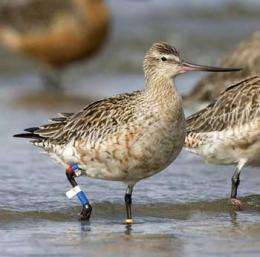
A bar-tailed godwit with leg-mounted geo-locator at the Manawatu River estuary.
New research has shown bar-tailed godwits are hard-wired to keep to tight schedules for their extraordinary annual 30,000km return journey between New Zealand and Alaska.
A study by PhD ecology candidate Jesse Conklin, published this week in the international on-line science journal Nature Communications, is the first to use small, light-sensitive geo-locators to track shorebirds from non-breeding grounds to breeding sites in the opposite hemisphere.
Mr. Conklin was able to link the departure of 16 godwits from a single New Zealand estuary with breeding locations scattered across 1800km of Alaskan tundra and the precise timing of their return six months later. He says differences in departure and arrival times among birds are directly linked to the location of breeding sites.
His study showed godwits that departed New Zealand first were also first to arrive back - a finding he says is remarkable given that the godwits span out across 59-71° north latitude and may experience very different conditions and breeding success. "We knew that a given breeding site might have a narrow optimal arrival window to ensure breeding success, but this shows that even southbound migration is tightly-scheduled," he says.
The study strongly indicates the migratory birds' rigid timing is hard-wired, because they time their migration perfectly to arrive in Alaska just as melting snow makes their nest sites available - "an event that could hardly be predicted by cues available to godwits in New Zealand nearly two months previously".
The two-year project involved capturing birds from a small population of 200-280 godwits at the Manawatu River estuary in Foxton, and attaching leg-mounted, light-sensitive geo-locators before they departed in March and early April. The geo-locators record sunrise and sunset, allowing calculation of a latitude and longitude for each day of a bird’s journey - starting with a 10,000km stretch to the Yellow Sea coast of Korea and China, and then a 6000km flight to southwest Alaska. After dispersing to coastal tundra across west and north Alaska to breed, they again congregate in southwest Alaska to refuel for the astonishing non-stop return flight to New Zealand between late August and early October.
The study suggests a biological predisposition for an optimal breeding arrival date as the primary driver of variation in the migration schedule. "The latitude of an individual bird's breeding site - and, by extension, the approximate timing of snow melt from that patch of Alaskan tundra - could be traced back to the bird's departure 7-10 weeks earlier and more than half a world away," Mr Conklin writes in the paper.
"The departure of birds from New Zealand and Alaska (two events separated by six months and over 11,000km) in approximately the same order and span of days is quite surprising, in light of potential intervening variation caused by individual differences in flight speed, stopover duration, migration distance, duration of suitable breeding conditions, breeding success, body size, moult speed, foraging ability and habitat quality.”
He says his findings also highlight the potential impact of climate change on migratory birds because changes in the timing of annual snow melt may cause a mismatch between the timing of migration and breeding, which have been delicately balanced through millennia of evolution.
More information: Nature Communications website: http://www.nature. … s/index.html
-
Godwits readying for Alaska migration
Mar 07, 2008 |
not rated yet |
0
-
Bird holds distance record
Apr 02, 2007 |
not rated yet |
0
-
With climate change, birds are taking off for migration sooner; not reaching destinations earlier
Jan 28, 2010 |
not rated yet |
0
-
Tropical winter habitat drives natal dispersal of young migratory birds
Feb 18, 2008 |
not rated yet |
0
-
Songbirds fly 3 times faster than expected (Video)
Feb 12, 2009 |
not rated yet |
0
-
Engineers build first sub-10-nm carbon nanotube transistor
Feb 01, 2012 |
4.9 / 5 (31) |
30
-
Something old, something new: Evolution and the structural divergence of duplicate genes
Jan 31, 2012 |
4.6 / 5 (7) |
1
-
The hidden nanoworld of ice crystals: Revealing the dynamic behavior of quasi-liquid layers
Jan 30, 2012 |
5 / 5 (3) |
1
-
Stock market network reveals investor clustering
Jan 27, 2012 |
3.9 / 5 (23) |
8
-
Of microchemistry and molecules: Electronic microfluidic device synthesizes biocompatible probes
Jan 26, 2012 |
5 / 5 (1) |
0
-
Mitosis
2 hours ago
-
Stem cell question.
3 hours ago
-
Protease cleavage
10 hours ago
-
Pertubance in a model
16 hours ago
-
Cancer drugs and Alzheimer's, Oh my!
Feb 09, 2012
-
Squishing cells
Feb 09, 2012
- More from Physics Forums - Biology
More news stories
The power of estrogen -- male snakes attract other males
A new study has shown that boosting the estrogen levels of male garter snakes causes them to secrete the same pheromones that females use to attract suitors, and turned the males into just about the sexiest ...
14 hours ago |
4.8 / 5 (6) |
1
|
Grass to gas: Researchers' genome map speeds biofuel development
Researchers at the University of Georgia have taken a major step in the ongoing effort to find sources of cleaner, renewable energy by mapping the genomes of two originator cells of Miscanthus x giganteus, a large perenn ...
11 hours ago |
3.8 / 5 (5) |
0
|
Experts reveal how plants don't get sunburn
(PhysOrg.com) -- Experts at the University of Glasgow have discovered how plants survive the harmful rays of the sun.
14 hours ago |
4.8 / 5 (5) |
0
|
Miami battling invasion of giant African snails
No one knows how they got there. But an invasion of African giant snails has southern Florida in a panic over potential crop damage, disease and general yuckiness surrounding the slimy gastropods.
18 hours ago |
4 / 5 (1) |
4
Protein libraries in a snap
(PhysOrg.com) -- A Rice University undergraduate will depart with not only a degree but also a possible patent for his invention of an efficient way to create protein libraries, an important component of biomolecular ...
18 hours ago |
4.8 / 5 (4) |
0
|
Google users warned of threat to smartphone wallets
Users of Google smartphone wallets were being warned on Friday that there is a way to crack pass codes intended to thwart thieves from going on illicit shopping sprees.
Anonymous knocks CIA website offline (Update)
The website of the Central Intelligence Agency was inaccessible on Friday after the hacker group Anonymous claimed to have knocked it offline.
New error-correcting codes guarantee the fastest possible rate of data transmission
Error-correcting codes are one of the triumphs of the digital age. Theyre a way of encoding information so that it can be transmitted across a communication channel such as an optical fiber o ...
Humans may have helped the decline of African rainforests 3000 years ago
(PhysOrg.com) -- Large areas of rainforests in Central Africa mysteriously disappeared over three thousand years ago, to be replaced by savannas. The prevailing theory has been that the cause was a change ...
New power source discovered
(PhysOrg.com) -- Researchers at the Massachusetts Institute of Technology (MIT) and RMIT University have made a breakthrough in energy storage and power generation.
Complex wiring of the nervous system may rely on a just a handful of genes and proteins
Researchers at the Salk Institute have discovered a startling feature of early brain development that helps to explain how complex neuron wiring patterns are programmed using just a handful of critical genes. ...