Fourth warmest U.S. summer on record according to NOAA
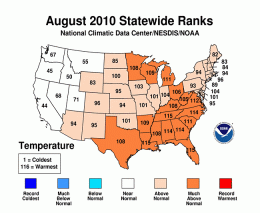
The contiguous United States had its fourth-warmest summer (June-August) on record, according to the latest NOAA State of the Climate report issued today. The report also showed the August average temperature was 75.0 degrees F, which is 2.2 degrees F above the long-term (1901-2000) average. Last month’s average precipitation was 2.41 inches, 0.19 inch below the 1901-2000 average.
This monthly analysis, based on records dating back to 1895, is prepared by scientists at NOAA’s National Climatic Data Center in Asheville, N.C., and is part of the suite of climate services NOAA provides.
U.S. Temperature Highlights - Summer (June through August)
• It was the fourth warmest summer on record in the United States. Three climate regions had temperatures in the top five: the Southeast (warmest), the Central (third warmest) and the Northeast (fourth warmest).
• Abnormal warmth dominated much of the east, where a record warm summer occurred in Rhode Island, New Jersey, Delaware, Maryland, Virginia, North Carolina, Tennessee, South Carolina, Georgia and Alabama. Nineteen other states experienced “much above normal” average temperatures.
• Several cities broke summer temperature records, including New York (Central Park); Philadelphia; Trenton, N.J.; Wilmington, Del.; Tallahassee, Fla. (tied); and Asheville, N.C.
U.S. Temperature Highlights - August
• Persistently strong high pressure continued to dominate the weather pattern in the United States during August. This was the seventh warmest August on record, with a temperature that was 2.2 degrees F above the long term average.
• The majority of the U.S. had above-average temperatures last month; Florida, Louisiana and Tennessee experienced their second warmest August on record. Fourteen other states had an August temperature among their warmest ten percent. No state experienced an average temperature significantly below its long-term average.
• Regionally, the Southeast had its third warmest August on record, while it was the seventh warmest in the South and the eighth warmest in the East North Central region. Of the nine climate regions in the contiguous U.S., only the West and Northwest observed near normal August temperatures.
U.S. Temperature Highlights - Year-to-Date (January through August)
• The Northeast climate region experienced its warmest January-August period with an average temperature more than 3.4 degrees F above the long-term average.
• Maine, New Hampshire, Vermont, Rhode Island, Connecticut and New Jersey each had their warmest year-to-date period and all of the Northeastern states ranked in the top ten percent of warmest periods on record. Only Florida and Texas had below normal temperatures for the period.
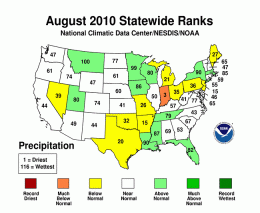
U.S. Precipitation Highlights - Summer (June through August)
• The summer storm pattern brought significant precipitation to the Upper Midwest. Wisconsin had its wettest summer on record, 6.91 inches above average. Several states in the region had a top-10 wettest summer: Michigan and Iowa (third wettest), Illinois and Nebraska (sixth), South Dakota (ninth) and Minnesota (10th). The East North Central climate region had its second wettest summer on record, and the nationally averaged precipitation was above average.
• A persistent high pressure system and the lack of any significant tropical weather during the summer months contributed to below average precipitation in much of the Southeast and Mid-Atlantic. Long-term dryness in the Mid-Atlantic led to the development of severe drought in parts of Virginia, Maryland and West Virginia.
• Heavy rainfall during the summer months across the Upper Midwest helped diminish rainfall deficits from the first five months of the year.
U.S. Precipitation Highlights - August
• August precipitation was highly variable across the contiguous United States, typical of a late-summer weather pattern. Eleven states experienced below normal precipitation and another eleven experienced above normal precipitation, yet the overall national average was below normal.
U.S. Precipitation Highlights - Year-to-Date (January through August)
• Wetness during the first eight months of 2010 in the northern Plains was offset by below average precipitation across a wide swath of the Southeast and Mid-Atlantic. The nationally averaged precipitation for the period was near normal. Dryness has persisted throughout 2010 in Louisiana, where parts of the state have been in drought since April.
• The year-to-date precipitation was much above average in the East North Central (5th wettest) and the West North Central (10th wettest) regions. Iowa experienced its third wettest January-August, and South Dakota its’ ninth wettest. Wisconsin and Nebraska also experienced much above average precipitation for the year-to-date period.
Other Highlights
• Tornado activity during August was slightly below average. However, numerous August tornadoes in Minnesota, combined with an active summer, will likely help break the state’s annual tornado record of 74, which was set in 2001.
• NCDC’s Climate Extremes Index (CEI) for summer 2010 was about one-and-a-half times its historical average. The CEI measures the occurrence of several types of climate extremes (like record or near-record warmth, dry spells or rainy periods). Factors contributing to this summer’s value: a very large area with extremely warm nighttime low temperatures (six times larger than average and the largest since 1910) and an above-average number of days with average to heavy precipitation.
• Based on NOAA's Residential Energy Demand Temperature Index (REDTI), the contiguous U.S. temperature-related energy demand for summer 2010 was the highest of the 116-year record and eighth-highest for August itself. The unusual warmth in the highly populated mid-Atlantic and Southeast contributed to the highest Summer REDTI value on record.
• Wildfire activity during the January-August and August periods was exceptionally quiet. The acreage burned during August was the lowest in 11 years and the acres burned during the year-to-date period was less than half the long-term average due to the lack of extremely hot or extremely dry weather in the Western states where large fires are most common.
NCDC’s State of the Climate reports, which assess the current state of the climate, are released soon after the end of each month. These analyses are based on preliminary data, which are subject to revision. Additional quality control is applied to the data when late reports are received several weeks after the end of the month and as increased scientific methods improve NCDC’s processing algorithms.
Provided by NOAA


