Webb telescope's guiding light from Canada received by NASA Goddard
September 9, 2010 By Lynn Chandler
Webb telescope's guiding light from Canada received by NASA Goddard

Enlarge

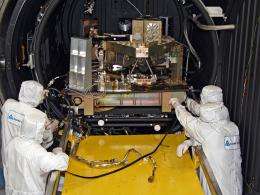
An engineering test unit of the Fine Guidance Sensor is about to undergo cryogenic testing at the David Florida Lab in Canada. Credit: CSA, COMDEV

The Canadian Space Agency has delivered a test unit of the Fine Guidance Sensor to the James Webb Space Telescope to NASA's Goddard Space Flight Center in Greenbelt, Md.

The arrival of the engineering test unit marks a major milestone for the Canadian team. The hardware has been put through its paces at the Canadian Space Agency's David Florida Lab to ensure that the final version will function at peak performance. While all space missions undergo extensive testing, this step is particularly crucial for Webb because it will be located at the L2 point in space, which is about 930,000 miles away from the Earth in the exact opposite direction from the sun, and too far to be serviced by astronauts.

Scott Lambros, Webb instrument systems manager at NASA Goddard said, "The delivery of the Fine Guidance Sensor (FGS) Engineering Test Unit is another milestone towards launch of the Webb telescope. In the coming months we will use the ETU to test interfaces between the FGS instrument and the Webb Observatory, to ensure that any discrepancies will be accounted for in the flight versions of the hardware." Just as important, the milestone is an indication of the great working relationship we have between NASA and the CSA/COM DEV team. "It's been a joy working with this group of people. I look forward to continuing that work to the next milestone of delivery of the flight model FGS next year," Lambros said.

The Fine Guidance Sensor consists of two specialized cameras that are critical to Webb’s ability to "see": they will work like a guiding scope to allow the Webb space telescope to locate its celestial targets, determine its own position and remain pointed at an object so that the telescope can collect high-quality data. The FGS will measure the position of guide stars with incredible precision, pinpointing them with an accuracy of one millionth of a degree. The angle formed by someone holding up a quarter at a distance of 930 miles away, which is almost as far from Boston to Chicago.

In addition to providing the Webb telescope’s Fine Guidance Sensor (FGS), the Canadian Space Agency will also provide the Tunable Filter Imager (TFI). Both actual instruments are also being built by COM DEV International for the Canadian Space Agency.

The TFI’s unique capabilities will allow astronomers to peer through clouds of dust to see stars forming and planetary systems, possibly even exoplanets (planets outside our Solar System). It also offers unique capability to find the earliest objects in the Universe’s history. The Canadian Project Scientist for Webb is Dr. John Hutchings of the National Research Council of Canada. Dr. René Doyon of the Université de Montréal is the principal investigator for TFI. Canada is also providing functional support of the science operations for the Webb space telescope. The Canadian Space Agency will deliver the flight units of the FGS and the TFI to NASA in 2011.

Webb will be the first next-generation large space observatory and will serve thousands of astronomers worldwide for a planned lifetime of 10 years or more. Designed to detect light from as far away as approximately 14 billion light years, it will study every phase in the history of our Universe, ranging from the first luminous glows after the Big Bang, to the formation of solar systems capable of supporting life on planets like Earth, to the evolution of our own Solar System. Its advanced technology also enables it to discover hitherto unknown phenomena in the Universe.

The Webb telescope is an international collaboration between NASA, the European Space Agency and the Canadian Space Agency.

Provided by NASA's Goddard Space Flight Center (news : web)

4.5 /5 (2 votes)  

Filter


Move the slider to adjust rank threshold, so that you can hide some of the comments.


Display comments: newest first

baudrunner
Sep 09, 2010

Rank: not rated yet
The angle formed by someone holding up a quarter at a distance of 930 miles away, which is almost as far from Boston to Chicago.
I take it you mean if the Earth were flat.
StarDust21
Sep 09, 2010

Rank: not rated yet
Feels good to know we contributed to this great project
Rank 4.5 /5 (2 votes)
Relevant PhysicsForums posts
  • Titan's lack of impact craters
    created19 hours ago
  • Real pictures of black hole eating a star?
    createdFeb 08, 2012
  • Hypothetical way to travel faster than light, but not technically exceed lightspeed
    createdFeb 06, 2012
  • How do scientists monitor the Sun's activity?
    createdFeb 05, 2012
  • Search patterns in observational studies
    createdFeb 05, 2012
  • Derivation of Pogson's law
    createdFeb 03, 2012
  • More from Physics Forums - General Astronomy

More news stories

Humans may have helped the decline of African rainforests 3000 years ago

(PhysOrg.com) -- Large areas of rainforests in Central Africa mysteriously disappeared over three thousand years ago, to be replaced by savannas. The prevailing theory has been that the cause was a change ...

Space & Earth / Environment

created 1 hour ago | popularity not rated yet | comments 0 | with audio podcast report

NASA budget will axe Mars deal with Europe: scientists

US President Barack Obama's budget proposal to be submitted next week for 2013 will cut NASA's budget by 20 percent and eliminate a major partnership with Europe on Mars exploration, scientists said Thursday.

Space & Earth / Space Exploration

created 27 minutes ago | popularity not rated yet | comments 0

New views show old NASA Mars landers

(PhysOrg.com) -- The High Resolution Imaging Science Experiment (HiRISE) camera on NASA's Mars Reconnaissance Orbiter recorded a scene on Jan. 29, 2012, that includes the first color image from orbit showing ...

Space & Earth / Space Exploration

created 22 hours ago | popularity 4.9 / 5 (7) | comments 9 | with audio podcast

Black holes and star formation

(PhysOrg.com) -- It has long been recognized that galaxy mergers or even close interactions can play a vital role in shaping the morphology of galaxies. One way they can do so, it is thought, is by triggering ...

Space & Earth / Astronomy

created 21 hours ago | popularity 4.1 / 5 (7) | comments 5 | with audio podcast

Deconstructing a mystery: What caused Snowmaggedon?

In the quiet after the storms, streets and cars had all but disappeared under piles of snow. The U.S. Postal Service suspended service for the first time in 30 years. Snow plows struggled to push the evidence ...

Space & Earth / Earth Sciences

created 14 hours ago | popularity 4.7 / 5 (3) | comments 1 | with audio podcast


Protein libraries in a snap

(PhysOrg.com) -- A Rice University undergraduate will depart with not only a degree but also a possible patent for his invention of an efficient way to create protein libraries, an important component of biomolecular ...

Sleep breathing machine shows clear benefits in children with sleep apnea

Children and adolescents with obstructive sleep apnea had substantial improvements in attention, anxiety and quality of life after treatment with positive airway pressure (PAP)—a nighttime therapy in which a machine ...

Neurologic improvement detected in rats receiving stem cell transplant

In a study to be presented today at the Society for Maternal-Fetal Medicine's annual meeting, The Pregnancy Meeting, in Dallas, Texas, researchers will report that early transplantation of human placenta-derived mesenchymal ...

Miami battling invasion of giant African snails

No one knows how they got there. But an invasion of African giant snails has southern Florida in a panic over potential crop damage, disease and general yuckiness surrounding the slimy gastropods.

Researchers show benefits of local anesthesia after knee replacement surgery

Researchers at the Rothman Institute at Jefferson have shown that local anesthesia delivered through a catheter in the joint, intraarticularly, may be more beneficial than traditional opioids such as morphine and Oxycontin ...

Study finds massively parallel sequencing can detect fetal aneuploidies, including Down syndrome

In a study to be presented today at the Society for Maternal-Fetal Medicine's annual meeting, The Pregnancy Meeting, in Dallas, Texas, researchers will report findings that indicate that massively parallel sequencing can ...