New method to help computer vision systems decipher outdoor scenes
September 9, 2010
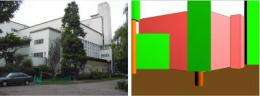
Computer vision systems can struggle to make sense of a single image, but a new method devised by computer scientists at Carnegie Mellon University enables computers to gain a deeper understanding of an image by reasoning about the physical constraints of the scene. Here, the computer uses virtual blocks to build a three-dimensional approximation of the image at left that makes sense based on volume and mass. Credit: Carnegie Mellon University
Computer vision systems can struggle to make sense of a single image, but a new method devised by computer scientists at Carnegie Mellon University enables computers to gain a deeper understanding of an image by reasoning about the physical constraints of the scene.
In much the same way that a child might use a set of toy building blocks to assemble something that looks like a building depicted on the cover of the toy set, the computer would analyze an outdoor scene by using virtual blocks to build a three-dimensional approximation of the image that makes sense based on volume and mass.
"When people look at a photo, they understand that the scene is geometrically constrained," said Abhinav Gupta, a post-doctoral fellow in CMU's Robotics Institute. "We know that buildings aren't infinitely thin, that most towers do not lean, and that heavy objects require support. It might not be possible to know the three-dimensional size and shape of all the objects in the photo, but we can narrow the possibilities. In the same way, if a computer can replicate an image, block by block, it can better understand the scene."
This novel approach to automated scene analysis could eventually be used to understand not only the objects in a scene, but the spaces in between them and what might lie behind areas obscured by objects in the foreground, said Alexei A. Efros, associate professor of robotics and computer science at CMU. That level of detail would be important, for instance, if a robot needed to plan a route where it might walk, he noted.
Gupta presented the research, which he conducted with Efros and Robotics Professor Martial Hebert, at the European Conference on Computer Vision, Sept. 5-11 in Crete, Greece.
Understanding outdoor scenes remains one of the great challenges of artificial intelligence. One approach has been to identify features of a scene, such as buildings, roads and cars, but this provides no understanding of the geometry of the scene, such as the location of walkable surfaces. Another approach, which Hebert and Efros pioneered with former student Derek Hoiem, now of the University of Illinois, Urbana-Champaign, has been to map the planar surfaces of an image to create a rough 3-D depiction of an image, similar to a pop-up book. But that approach can lead to depictions that are highly unlikely and sometimes physically impossible.
In the new method devised by Gupta, Efros and Hebert, the image is first broken into various segments corresponding to objects in the image. Once the ground and sky are identified, other segments are assigned potential geometric shapes. The shapes also are categorized as light or heavy, depending on appearance; a surface that appears to be a brick wall, for instance, would be classified as heavy.
The computer then attempts to reconstruct the image using the virtual blocks. If a heavy block appears unsupported, the computer must substitute an appropriately shaped block, or make assumptions that the original block was obscured in the original image.
Gupta said because this qualitative volumetric approach to scene understanding is so new, no established datasets or evaluation methodologies exist for it. He said in estimating the layout of surfaces, other than sky and ground, the method is better than 70 percent accurate, and its performance is almost as good when comparing its segmentation to ground truth. Overall, Gupta assesses the analysis as very good for 30 to 40 percent of the images and adequate for another 20 to 30 percent.
-
Seeing things: Researchers teach computers to recognize objects
Oct 13, 2009 |
not rated yet |
0
-
Crime scene measurements can be taken from a single image
Dec 01, 2009 |
not rated yet |
0
-
Findings about veracity of peripheral vision could lead to better robotic eyes (w/ Video)
Oct 15, 2009 |
not rated yet |
0
-
Humans ignore motion and other cues in favor of a fictional stable world
Feb 21, 2006 |
not rated yet |
0
-
Reconstruct Mars automatically in minutes
Sep 18, 2009 |
not rated yet |
0
-
Engineers build first sub-10-nm carbon nanotube transistor
Feb 01, 2012 |
4.9 / 5 (30) |
30
-
Something old, something new: Evolution and the structural divergence of duplicate genes
Jan 31, 2012 |
4.6 / 5 (7) |
1
-
The hidden nanoworld of ice crystals: Revealing the dynamic behavior of quasi-liquid layers
Jan 30, 2012 |
5 / 5 (3) |
1
-
Stock market network reveals investor clustering
Jan 27, 2012 |
3.9 / 5 (23) |
8
-
Of microchemistry and molecules: Electronic microfluidic device synthesizes biocompatible probes
Jan 26, 2012 |
5 / 5 (1) |
0
-
Synergistic relations between computer science and technology.
Feb 06, 2012
-
how do iphone gloves work?
Feb 05, 2012
-
iPhone battery over time
Jan 30, 2012
-
Best alternate Tablet to an iPad for writing math or physics equations?
Jan 26, 2012
-
Sending SMS to a website
Jan 20, 2012
-
Need help with my technical fest!
Jan 19, 2012
- More from Physics Forums - Computing & Technology
More news stories
Soraa LED light may dim 50-watt halogen rivals
(PhysOrg.com) -- Soraa, a Fremont, California company founded in 2008, this week launched its first product, a light that uses LEDS (light emitting diodes). The "Soraa LED MR16 lamp" is the "perfect" replacement ...
Samsung can continue selling Galaxy tabs in Germany: court
South Korea's Samsung Electronics can continue to sell its Galaxy Tab 10.1N tablet computer in Germany, a German court ruled Thursday, rejecting a bid by arch-rival Apple to have them banned.
19 hours ago |
3.7 / 5 (3) |
3
Google launches Chrome browser for Android smartphones
With more and more people connecting to the Internet through a phone or a tablet instead of a PC, Google Inc. is bringing its fast-growing browser, Chrome, to the newest Android-powered mobile devices.
17 hours ago |
5 / 5 (4) |
0
Digital photos could put kids at risk
A study published in the International Journal of Electronic Security and Digital Forensics this month suggests that parents and carers could be putting children at risk if they upload digital photos that are automatically "geota ...
15 hours ago |
5 / 5 (1) |
3
First Google hire leaving for online academy
The first person hired by Google's founders is leaving the Internet giant to devote himself to an innovative online education website called Khan Academy.
9 hours ago |
5 / 5 (1) |
0
'Dark plasmons' transmit energy
Microscopic channels of gold nanoparticles have the ability to transmit electromagnetic energy that starts as light and propagates via "dark plasmons," according to researchers at Rice University.
FDA-approved drug rapidly clears amyloid from the brain, reverses Alzheimer's symptoms in mice
Neuroscientists at Case Western Reserve University School of Medicine have made a dramatic breakthrough in their efforts to find a cure for Alzheimer's disease. The researchers' findings, published in the journal Science, show t ...
Hydrogen from acidic water: Researchers develop potential low cost alternative to platinum for splitting water
A technique for creating a new molecule that structurally and chemically replicates the active part of the widely used industrial catalyst molybdenite has been developed by researchers with the Lawrence Berkeley ...
Ultraviolet protection molecule in plants yields its secrets
Lying around in the sun all day is hazardous not just for humans but also for plants, which have no means of escape. Ultraviolet (UV) radiation from the sun can damage proteins and DNA inside cells, leading ...
Anyone can learn to be more inventive, cognitive researcher says
There will always be a wild and unpredictable quality to creativity and invention, says Anthony McCaffrey, a cognitive psychology researcher at the University of Massachusetts Amherst, because an "Aha moment" is rare and ...
Flexible paper robots
(PhysOrg.com) -- These inexpensive robots can stretch, bend and twist under control, and lift objects up to 120 times their own weight. Being soft, they can apply gentle and even pressure, and adapt to varied ...