A closer look at ring opening: Electron diffraction studies of photoswitchable molecules
September 9, 2010
A closer look at ring opening: Electron diffraction studies of photoswitchable molecules

Enlarge

(PhysOrg.com) -- We use a switch to turn lights off and on; however, light can also act as a switch itself, for example when molecules change their structure upon irradiation. Photoswitchable molecules are potentially interesting for use in holographic data storage, as molecular switches for nanomachines, or for switching biological functions in the biosciences. In order to tailor these molecules for different applications, it is necessary to have a comprehensive understanding of the underlying reaction mechanisms.

A team led by Nobel Laureate Ahmed Zewail and members of his group at Caltech in Pasadena (California, USA) now reports in the journal about their use of electron diffraction studies to observe a photoswitchable molecule in the process of "switching".

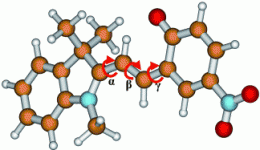
The molecule under examination was a complex ring system that switches between a closed form and an open form upon irradiation with UV light. In the closed spiropyran form it consists of two planar fused ring systems that form two orthogonal planes. When irradiated, a bond is broken to open a single ring. In this open merocyanin form, both units of the molecule are only connected through a bridge made by three bonds. Each of these bonds can theoretically have one of two spatial arrangements, which are designated as cis and trans. Furthermore, this molecule contains a nitro group (-NO2), which allows it to enter into two different electronic states—singlet or triplet—when excited by light.

Which form does it choose? This is what the researches wished to determine in order to study the reaction mechanism. To do this, they used a method known as laser-desorption electron diffraction. In this technique, a sample is heated and vaporized by laser so rapidly that the sample do not have time to decompose. The isolated molecules are then bombarded with electrons. The electrons are diffracted by the of the molecule, which results in a characteristic diffraction pattern. The scientists recorded diffraction patterns 100 nanoseconds before and after excitation with UV.

By using theoretical model calculations, the researchers were able to interpret these diffraction patterns. The result: “Ring opening leads primarily to the cis-trans-cis structure,” according to Zewail, “while competing, non-irradiative paths lead to other structures, such as the closed forms in their triplet and singlet ground states.”

“Our results demonstrate the enormous capability of the electron diffraction technique to solve such complex, nanometer-scale structures with minimal symmetry,” says Zewail.

More information: Ahmed H. Zewail, Direct Determination of Conformations of Photoswitchable Molecules by Laser Desorption-Electron Diffraction, Angewandte Chemie International Edition 2010, 49, No. 37, 6524-6527, http://dx.doi.org/ … ie.201003583

Provided by Wiley (news : web)


Rank 5 /5 (2 votes)
Relevant PhysicsForums posts
  • Stoichiometry
    created11 hours ago
  • Boiling and melting point of impure substances
    created12 hours ago
  • Safe nitrogen compound to decompose a 500 deg C in a furnace?
    created19 hours ago
  • [ask]electron inside drinking water
    createdFeb 08, 2012
  • How to avoid formation of Lithium Chromate ???
    createdFeb 08, 2012
  • how to choose a reduced or oxidated form in a redox
    createdFeb 08, 2012
  • More from Physics Forums - Chemistry

More news stories

Fool's gold may prove an unlikely alternative to overexploited catalytic materials

Catalytic materials, which lower the energy barriers for chemical reactions, are used in everything from the commercial production of chemicals to catalytic converters in car engines. However, with current catalytic materials ...

Chemistry / Materials Science

created 2 hours ago | popularity 5 / 5 (2) | comments 1 | with audio podcast

Unpicking HIV’s invisibility cloak

Drug researchers hunting for alternative ways to treat human immunodeficiency virus (HIV) infections may soon have a novel target—its camouflage coat. HIV hides inside a cloak unusually rich in a sugar ...

Chemistry / Biochemistry

created 2 hours ago | popularity 5 / 5 (2) | comments 0

Hydrogen from acidic water: Researchers develop potential low cost alternative to platinum for splitting water

A technique for creating a new molecule that structurally and chemically replicates the active part of the widely used industrial catalyst molybdenite has been developed by researchers with the Lawrence Berkeley ...

Chemistry / Materials Science

created 22 hours ago | popularity 5 / 5 (12) | comments 11 | with audio podcast

No entry without protein recycling: Researchers discover new coherence in enzyme transport

The group of Prof. Dr. Ralf Erdmann at the Ruhr-Universität Bochum, Germany, discovered a connection of peroxisomal protein import and receptor export. In the Journal of Biological Chemistry, they disclo ...

Chemistry / Biochemistry

created 2 hours ago | popularity not rated yet | comments 0

Flexible paper robots

(PhysOrg.com) -- These inexpensive robots can stretch, bend and twist under control, and lift objects up to 120 times their own weight. Being soft, they can apply gentle and even pressure, and adapt to varied ...

Chemistry / Materials Science

created 20 hours ago | popularity 5 / 5 (5) | comments 3 | with audio podcast


New understanding of DNA repair could eventually lead to cancer therapy

A research group in the Faculty of Medicine & Dentistry at the University of Alberta is hoping its latest discovery could one day be used to develop new therapies that target certain types of cancers.

Hovering not hard if you're top-heavy, researchers find

Top-heavy structures are more likely to maintain their balance while hovering in the air than are those that bear a lower center of gravity, researchers at New York University's Courant Institute of Mathematical Sciences ...

Grass to gas: Researchers' genome map speeds biofuel development

Researchers at the University of Georgia have taken a major step in the ongoing effort to find sources of cleaner, renewable energy by mapping the genomes of two originator cells of Miscanthus x giganteus, a large perenn ...

Zuckerberg's focus drives Facebook's ascent

When Mark Zuckerberg showed up to rent Judy Fusco's Los Altos, Calif., house in the fall of 2004, soon after he'd arrived in Silicon Valley, the landlord was immediately struck by his confidence.

Both maternal and paternal age linked to autism

Older maternal and paternal age are jointly associated with having a child with autism, according to a recently published study led by researchers at The University of Texas Health Science Center at Houston (UTHealth).

Night, weekend delivery OK for babies with birth defects

Weekday delivery is no better than night or weekend delivery for infants with birth defects, according to a new study presented today at The Pregnancy Meeting, the Society for Maternal-Fetal Medicine's annual conference. ...