Researchers give robots the capability for deceptive behavior
September 9, 2010
Researchers give robots the capability for deceptive behavior

Enlarge

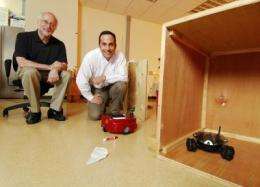
Georgia Tech Regents professor Ronald Arkin (left) and research engineer Alan Wagner look on as the black robot deceives the red robot into thinking it is hiding down the left corridor. Credit: Georgia Tech Photo: Gary Meek

A robot deceives an enemy soldier by creating a false trail and hiding so that it will not be caught. While this sounds like a scene from one of the Terminator movies, it's actually the scenario of an experiment conducted by researchers at the Georgia Institute of Technology as part of what is believed to be the first detailed examination of robot deception.

"We have developed algorithms that allow a to determine whether it should deceive a human or other intelligent machine and we have designed techniques that help the robot select the best deceptive strategy to reduce its chance of being discovered," said Ronald Arkin, a Regents professor in the Georgia Tech School of Interactive Computing.

The results of robot experiments and theoretical and cognitive deception modeling were published online on September 3 in the International Journal of Social Robotics. Because the researchers explored the phenomena of robot deception from a general perspective, the study's results apply to robot-robot and human-robot interactions. This research was funded by the Office of Naval Research.

In the future, robots capable of deception may be valuable for several different areas, including military and search and rescue operations. A search and rescue robot may need to deceive in order to calm or receive cooperation from a panicking victim. Robots on the battlefield with the power of deception will be able to successfully hide and mislead the enemy to keep themselves and valuable information safe.

"Most social robots will probably rarely use deception, but it's still an important tool in the robot's interactive arsenal because robots that recognize the need for deception have advantages in terms of outcome compared to robots that do not recognize the need for deception," said the study's co-author, Alan Wagner, a research engineer at the Georgia Tech Research Institute.

For this study, the researchers focused on the actions, beliefs and communications of a robot attempting to hide from another robot to develop programs that successfully produced deceptive behavior. Their first step was to teach the deceiving robot how to recognize a situation that warranted the use of deception. Wagner and Arkin used interdependence theory and game theory to develop algorithms that tested the value of deception in a specific situation. A situation had to satisfy two key conditions to warrant deception -- there must be conflict between the deceiving robot and the seeker, and the deceiver must benefit from the deception.

Once a situation was deemed to warrant deception, the robot carried out a deceptive act by providing a false communication to benefit itself. The technique developed by the Georgia Tech researchers based a robot's deceptive action selection on its understanding of the individual robot it was attempting to deceive.
Researchers give robots the capability for deceptive behavior
Enlarge

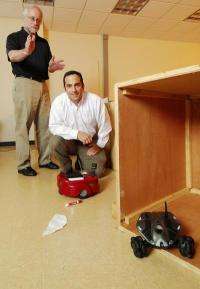
The black robot intentionally knocked down the red marker to deceive the red robot into thinking it was hiding down the left corridor. Instead, the black robot is hiding inside the box in the center pathway. Credit: Georgia Tech Photo: Gary Meek

To test their algorithms, the researchers ran 20 hide-and-seek experiments with two autonomous robots. Colored markers were lined up along three potential pathways to locations where the robot could hide. The hider robot randomly selected a hiding location from the three location choices and moved toward that location, knocking down colored markers along the way. Once it reached a point past the markers, the robot changed course and hid in one of the other two locations. The presence or absence of standing markers indicated the hider's location to the seeker robot.

"The hider's set of false communications was defined by selecting a pattern of knocked over markers that indicated a false hiding position in an attempt to say, for example, that it was going to the right and then actually go to the left," explained Wagner.

The hider robots were able to deceive the seeker robots in 75 percent of the trials, with the failed experiments resulting from the hiding robot's inability to knock over the correct markers to produce the desired deceptive communication.

"The experimental results weren't perfect, but they demonstrated the learning and use of deception signals by real robots in a noisy environment," said Wagner. "The results were also a preliminary indication that the techniques and algorithms described in the paper could be used to successfully produce deceptive behavior in a ."

While there may be advantages to creating robots with the capacity for deception, there are also ethical implications that need to be considered to ensure that these creations are consistent with the overall expectations and well-being of society, according to the researchers.

"We have been concerned from the very beginning with the ethical implications related to the creation of robots capable of and we understand that there are beneficial and deleterious aspects," explained Arkin. "We strongly encourage discussion about the appropriateness of deceptive robots to determine what, if any, regulations or guidelines should constrain the development of these systems."

Provided by Georgia Institute of Technology

4.3 /5 (7 votes)  

Filter


Move the slider to adjust rank threshold, so that you can hide some of the comments.


Display comments: newest first

jselin
Sep 09, 2010

Rank: not rated yet
We should call these robots something to denote their deceptive capabilities... is "Decepticon" taken? :)
jsa09
Sep 09, 2010

Rank: not rated yet
Now how will we go putting the three rules deception into their positronic brains?
CraigS
Sep 10, 2010

Rank: not rated yet
If they keep the Asimov 3rd law we should be fine:

1. A robot may not injure a human being or, through inaction, allow a human being to come to harm.
2. A robot must obey any orders given to it by human beings, except where such orders would conflict with the First Law.
3. A robot must protect its own existence as long as such protection does not conflict with the First or Second Law.
mysticfree
Sep 12, 2010

Rank: not rated yet
In the example given in the story, they only have to program the red robot to not be gullible in its assumption about the cone that it found knocked down. And now we back to where we started, robots doing stuff and others figuring out what those possible actions were.
Rank 4.3 /5 (7 votes)
Related Stories
Relevant PhysicsForums posts
  • Calling function with no input argument
    created18 hours ago
  • Force free body diagram problem on gym equipment
    created19 hours ago
  • Empirical data regarding shower heads and water
    createdFeb 10, 2012
  • feed hold button on CNC lathe
    createdFeb 09, 2012
  • RFAC in Fortran
    createdFeb 09, 2012
  • dynamics 2/32
    createdFeb 08, 2012
  • More from Physics Forums - General Engineering

More news stories

Japan scientist makes 'Avatar' robot

A Japanese-developed robot that mimics the movements of its human controller is bringing the Hollywood blockbuster "Avatar" one step closer to reality.

Electronics / Robotics

created Feb 10, 2012 | popularity 5 / 5 (7) | comments 11

Apple to debut 'iPad 3' in March: report

Apple will unveil a new version of its market-ruling iPad table computer in March, according to a report in Dow Jones-owned technology blog All Things D.

Electronics / Consumer & Gadgets

created Feb 09, 2012 | popularity 1.9 / 5 (21) | comments 0

New Kindle Touch is an impressive e-reader

When it comes to reading digital books, tablets are all the rage. But there's a lot to like about simple e-readers, which over the past year have become both a lot cheaper and a lot less clunky.

Electronics / Consumer & Gadgets

created Feb 09, 2012 | popularity 5 / 5 (4) | comments 1

Google rumored to have built Heads-Up-Display glasses prototype

(PhysOrg.com) -- 9to5Google is reporting that they have received a tip from someone they believe to be a reliable source saying that Google is working on a Heads-Up-Display (HUD) pair of eye-glasses. The per ...

Electronics / Consumer & Gadgets

created Feb 08, 2012 | popularity 4.3 / 5 (8) | comments 2 | with audio podcast weblog

Google to make home entertainment system: report

Google will mirror Apple's winning hardware-software formula with an Android-powered entertainment system that wirelessly streams content through homes, the Wall Street Journal reported on Thursday.

Electronics / Consumer & Gadgets

created Feb 09, 2012 | popularity 4.5 / 5 (2) | comments 0


Google users warned of threat to smartphone wallets

Users of Google smartphone wallets were being warned on Friday that there is a way to crack pass codes intended to thwart thieves from going on illicit shopping sprees.

New error-correcting codes guarantee the fastest possible rate of data transmission

Error-correcting codes are one of the triumphs of the digital age. They’re a way of encoding information so that it can be transmitted across a communication channel — such as an optical fiber o ...

The power of estrogen -- male snakes attract other males

A new study has shown that boosting the estrogen levels of male garter snakes causes them to secrete the same pheromones that females use to attract suitors, and turned the males into just about the sexiest ...

Anonymous knocks CIA website offline (Update)

The website of the Central Intelligence Agency was inaccessible on Friday after the hacker group Anonymous claimed to have knocked it offline.

Humans may have helped the decline of African rainforests 3000 years ago

(PhysOrg.com) -- Large areas of rainforests in Central Africa mysteriously disappeared over three thousand years ago, to be replaced by savannas. The prevailing theory has been that the cause was a change ...

Complex wiring of the nervous system may rely on a just a handful of genes and proteins

Researchers at the Salk Institute have discovered a startling feature of early brain development that helps to explain how complex neuron wiring patterns are programmed using just a handful of critical genes. ...