In attracting mates, male bowerbirds appear to rely on special optical effect
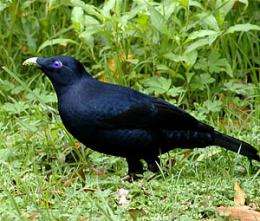
Bowerbird males are well known for making elaborate constructions, lavished with decorative objects, to impress and attract their mates. Now, researchers reporting online on September 9 in Current Biology have identified a completely new dimension to these showy structures in great bowerbirds. The birds create a staged scene, only visible from the point of view of their female audience, by placing pebbles, bones, and shells around their courts in a very special way that can make objects (or a bowerbird male) appear larger or smaller than they really are.
"Great bowerbirds are the first known animals besides humans who create a scene with altered visual perspective for viewing by other individuals," said John Endler of Deakin University in Australia. (He says the same principle is commonly used to make structures or scenes of buildings, gardens, or amusement parks appear larger than they are; bowerbirds appear to use it for the reverse effect, to make a scene appear smaller than it is.)
The effect only works from one viewing angle. Great bowerbirds ensure that females will see their courts from one particular spot by constructing an avenue—two rows of tightly packed sticks with a stick floor—that opens onto a court. That court is essentially a stage where the male displays for females.
Endler noticed something that had apparently been missed before, in part, he suspects, because no one had considered the females' viewpoint before. The great bowerbirds line their courts with objects whose absolute size increases with distance from the avenue entrance and the female viewers.
That makes the sizes of things appear to be more regular, a feature that might be aesthetically appealing to the birds and might also help the males to stand out. But there might be another advantage. Assuming the birds see things essentially the same way we do, that forced perspective could lead females to "perceive the court as smaller than it is and therefore perhaps perceive the male as larger than he is," Endler suggested.
Experimental manipulation of the courts by the researchers showed how important that geometrical pattern must be to the males. "When we reversed the gradient—putting smaller objects further away and larger objects closer to the avenue- the birds put the gradient back in three days."
Endler said it isn't yet completely clear why the males do this. Other aspects of bower decoration have been shown to influence mating success, and it is possible that the quality of the forced perspective may
The effect only works from one viewing angle. Great bowerbirds ensure that females will see their courts from one particular spot by constructing an avenue—two rows of tightly packed sticks with a stick floor—that opens onto a court. That court is essentially a stage where the male displays for females.
Endler noticed something that had apparently been missed before, in part, he suspects, because no one had considered the females' viewpoint before. The great bowerbirds line their courts with objects whose absolute size increases with distance from the avenue entrance and the female viewers.
That makes the sizes of things appear to be more regular, a feature that might be aesthetically appealing to the birds and might also help the males to stand out. But there might be another advantage. Assuming the birds see things essentially the same way we do, that forced perspective could lead females to "perceive the court as smaller than it is and therefore perhaps perceive the male as larger than he is," Endler suggested.
Experimental manipulation of the courts by the researchers showed how important that geometrical pattern must be to the males. "When we reversed the gradient—putting smaller objects further away and larger objects closer to the avenue- the birds put the gradient back in three days."
Endler said it isn't yet completely clear why the males do this. Other aspects of bower decoration have been shown to influence mating success, and it is possible that the quality of the forced perspective may be yet another way that females pick a winner. The researchers are now conducting experiments using motion-activated video cameras to test whether the size gradients are related to mating success.
It's also not clear how mentally challenging it really is for the birds to manage this feat. The males might get things placed just right through trial and error. But they may actually have a direct sense of perspective and "know" to put small objects close and larger objects further away, Endler says. That's something else the researchers intend to tease out through further investigation.
And that brings Endler to one last big question, whose answer is problematic even when one is talking about humans: Is it art?
For Endler, the answer is yes. "Visual art can be defined as the creation of an external visual pattern by one individual in order to influence the behavior of others, and an artistic sense is the ability to create art," he says. "Influencing behavior can range from attraction to and voluntary viewing of the art by others to viewers mating with the artist; this is what bowerbirds do. Our definition equates art with conventional signals that are not part of the artist's body. In this sense, bowerbirds are artists and their viewers judge the art, implying an aesthetic sense in birds."
More information: Endler, J. A., Endler, L. C. & Doerr, N. R. Curr. Biol. advance online publication doi:10.1016/j.cub.2010.08.033 (2010).
Provided by Cell Press


