Giant telescope to survey galaxies from Mexican volcano
September 9, 2010 by Sofia Miselem
Thee Large Millimeter Telescope (LMT) on the Sierra Negra volcano, in the Mexican state of Puebla on September 3.

Enlarge

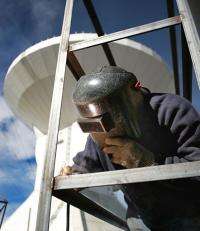
A worker does his job next to the Large Millimeter Telescope (LMT) on the Sierra Negra volcano, in the Mexican state of Puebla on September 3. Resembling a massive white satellite dish, the LMT will be the largest and most sensitive single-aperture telescope operating at its range.

A giant telescope, 50 meters (164 feet) across, will this year start unraveling mysteries of the birth and death of galaxies up to 14,000 light years away, from atop a Mexican volcano.

Resembling a massive white satellite dish, the Large Millimeter will be the largest and most sensitive single-aperture telescope operating at its range.

It sits at a height of 4,580 meters on the summit of Sierra Negra, an extinct volcano in the central state of Puebla, which lies alongside Mexico's highest mountain, the snowy-peaked Pico de Orizaba.

Built at a cost of 115 million dollars, it is the world's largest telescope operating in millimeter waves (mainly from 0.85 to three millimeters), which allow it to capture radiation from space, the coldest regions of the universe, or planetary formations.

After a 12-year construction process and a test run in 2008, it is due to start research operations at the end of this year.

"We'll make the first observation as part of an investigation," said Raul Mujica, a researcher from the joint project between the University of Massachusetts and the Instituto Nacional de Astrofisica, Optica, y Electronica (INAOE) in Mexico.

Three quarters of the investment is from the INAOE and one quarter from the US university, in a division to be mirrored in the observation time for each team of researchers, said Jose Guichard, director of INAOE.

The researchers admit they are unlikely to achieve concrete results in "earthly terms" in the short term, but that in the future the telescope will help advances in fields from telecommunications to medicine.

"We'll explore theories of the origin of life, like those which lead to the birth of a comet. We'll study comets, their , before they catch fire near the ground," Mujica said.

The telescope will also study the atmospheres of the planets, seeking possibilities of life, said researcher Miguel Chavez.

"As worlds, we're not alone," Chavez said, adding that the telescope could see possible traces of the presence of oceans or plants and identify if there were signs of life.

After receiving its first data, Mexico's massive telescope will be set to progressively observe more distant galaxies.

The observations are due to complement others carried out by telescopes such as an even bigger one under construction by the European Southern Observatory (ESO) in a multinational project in Chile.

(c) 2010 AFP

4.6 /5 (11 votes)  

Filter


Move the slider to adjust rank threshold, so that you can hide some of the comments.


Display comments: newest first

frajo
Sep 09, 2010

Rank: 5 / 5 (3)
galaxies up to 14,000 light years away
So far away? I'm impressed.
yyz
Sep 09, 2010

Rank: not rated yet
"We'll study comets, their chemical composition, before they catch fire near the ground"

Lost something in translation.

@frajo - 14Gly? (14kly is IN the Milky Way!)
tigger
Sep 09, 2010

Rank: 5 / 5 (3)
This article is a classic... comets on fire near the ground, galaxies a stones throw away being lauded as an epic achievement. Voted 5 stars for comedy value :-)
yyz
Sep 09, 2010

Rank: 5 / 5 (1)
""As worlds, we're not alone," Chavez said, adding that the telescope could see possible traces of the presence of oceans or plants and identify if there were signs of life."

I'd be interested in more details about these types of observations.

"After receiving its first data, Mexico's massive telescope will be set to progressively observe more distant galaxies."

Seems strange to allocate time on a telescope on the basis of the objects' distance from Earth, if this is what is being implied.

"This article is a classic..."

I guess it (really) might be a language problem.
Pkunk_
Sep 10, 2010

Rank: 5 / 5 (1)
galaxies up to 14,000 light years away
So far away? I'm impressed.


Yes , very impressive that it can see the birth and death of the Milky Way Galaxy.
rgwalther
Sep 10, 2010

Rank: not rated yet
Thousands, millions, billions? They all have 3 zeros at the end. Pick one. Of course maybe a light year is longer than a regular earth year after all.
Husky
Sep 12, 2010

Rank: not rated yet
maybe long distance objects need longer exposure times, just like optical telescopes receives less photons per hour from long distance objects?
Rank 4.6 /5 (11 votes)
Related Stories
Relevant PhysicsForums posts
  • Scale of the Universe
    created4 hours ago
  • Titan's lack of impact craters
    createdFeb 09, 2012
  • Real pictures of black hole eating a star?
    createdFeb 08, 2012
  • Hypothetical way to travel faster than light, but not technically exceed lightspeed
    createdFeb 06, 2012
  • How do scientists monitor the Sun's activity?
    createdFeb 05, 2012
  • Search patterns in observational studies
    createdFeb 05, 2012
  • More from Physics Forums - General Astronomy

More news stories

Humans may have helped the decline of African rainforests 3000 years ago

(PhysOrg.com) -- Large areas of rainforests in Central Africa mysteriously disappeared over three thousand years ago, to be replaced by savannas. The prevailing theory has been that the cause was a change ...

Space & Earth / Environment

created 15 hours ago | popularity 4.2 / 5 (9) | comments 10 | with audio podcast report

NASA sees wide-eyed cyclone Jasmine

Cyclone Jasmine's eye has opened wider on NASA satellite imagery, as it moves through the Southern Pacific Ocean.

Space & Earth / Earth Sciences

created 3 hours ago | popularity not rated yet | comments 1

NASA sees Giovanna reach cyclone strength, threaten Madagascar

Tropical Storm 12S built up steam and became a cyclone on February 10, 2012 as NASA's Terra satellite passed overhead. Residents of east-central Madagascar should prepare for this cyclone to make landfall ...

Space & Earth / Earth Sciences

created 3 hours ago | popularity not rated yet | comments 0

Could Venus be shifting gear?

(PhysOrg.com) -- ESA’s Venus Express spacecraft has discovered that our cloud-covered neighbour spins a little slower than previously measured. Peering through the dense atmosphere in the infrared, the ...

Space & Earth / Space Exploration

created 11 hours ago | popularity 5 / 5 (7) | comments 7 | with audio podcast

Mars Science Laboratory computer issue resolved

(PhysOrg.com) -- Engineers have found the root cause of a computer reset that occurred two months ago on NASA's Mars Science Laboratory and have determined how to correct it.

Space & Earth / Space Exploration

created 12 hours ago | popularity 4.7 / 5 (6) | comments 3 | with audio podcast


Google users warned of threat to smartphone wallets

Users of Google smartphone wallets were being warned on Friday that there is a way to crack pass codes intended to thwart thieves from going on illicit shopping sprees.

Anonymous knocks CIA website offline (Update)

The website of the Central Intelligence Agency was inaccessible on Friday after the hacker group Anonymous claimed to have knocked it offline.

Complex wiring of the nervous system may rely on a just a handful of genes and proteins

Researchers at the Salk Institute have discovered a startling feature of early brain development that helps to explain how complex neuron wiring patterns are programmed using just a handful of critical genes. ...

New error-correcting codes guarantee the fastest possible rate of data transmission

Error-correcting codes are one of the triumphs of the digital age. They’re a way of encoding information so that it can be transmitted across a communication channel — such as an optical fiber o ...

The power of estrogen -- male snakes attract other males

A new study has shown that boosting the estrogen levels of male garter snakes causes them to secrete the same pheromones that females use to attract suitors, and turned the males into just about the sexiest ...

Putting the squeeze on planets outside our solar system

(PhysOrg.com) -- Using high-powered lasers, scientists at Lawrence Livermore National Laboratory and collaborators discovered that molten magnesium silicate undergoes a phase change in the liquid state, abruptly ...