Random numbers game with quantum dice
September 9, 2010
Random numbers game with quantum dice

Enlarge

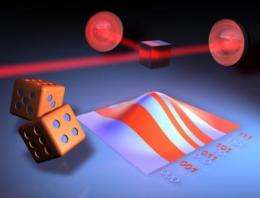
A true game of chance: Max Planck researchers produce true random numbers by making the randomly varying intensity of the quantum noise visible. To do this, they use a strong laser (coming from the left), a beam splitter, two identical detectors and several electronic components. The statistical spread of the measured values follows a Gaussian bell-shaped curve (bottom). Individual values are assigned to sections of the bell-shaped curve that correspond to a number. Credit: Max Planck Institute

(PhysOrg.com) -- A simple device measures the quantum noise of vacuum fluctuations and generates true random numbers.

Behind every coincidence lies a plan - in the world of , at least. In principle, every event, including the fall of dice or the outcome of a game of roulette, can be explained in mathematical terms. Researchers at the Max Planck Institute for the Physics of Light in Erlangen have constructed a device that works on the principle of true randomness. With the help of , their machine generates random numbers that cannot be predicted in advance. The researchers exploit the fact that measurements based on quantum physics can only produce a special result with a certain degree of probability, that is, randomly. True random numbers are needed for the secure encryption of data and to enable the reliable simulation of economic processes and changes in the climate. ( online publication, August 29, 2010)

The phenomenon we commonly refer to as chance is merely a question of a lack of knowledge. If we knew the location, speed and other classical characteristics of all of the particles in the universe with absolute certainty, we would be able to predict almost all processes in the world of everyday experience. It would even be possible to predict the outcome of a puzzle or lottery numbers. Even if they are designed for this purpose, the results provided by computer programs are far from random: "They merely simulate randomness but with the help of suitable tests and a sufficient volume of data, a pattern can usually be identified," says Christoph Marquardt. In response to this problem, a group of researchers working with Gerd Leuchs and Christoph Marquardt at the Max Planck Institute for the Physics of Light and the University of Erlangen-Nuremberg and Ulrik Andersen from the Technical University of Denmark have developed a generator for true random numbers.

True randomness only exists in the world of quantum mechanics. A quantum particle will remain in one place or another and move at one speed or another with a certain degree of probability. "We exploit this randomness of quantum-mechanical processes to generate random numbers," says Christoph Marquardt.

The scientists use vacuum fluctuations as quantum dice. Such fluctuations are another characteristic of the quantum world: there is nothing that does not exist there. Even in absolute darkness, the energy of a half photon is available and, although it remains invisible, it leaves tracks that are detectable in sophisticated measurements: these tracks take the form of quantum noise. This completely random noise only arises when the physicists look for it, that is, when they carry out a measurement.

To make the quantum noise visible, the scientists resorted once again to the quantum physics box of tricks: they split a strong laser beam into equal parts using a beam splitter. A beam splitter has two input and output ports. The researchers covered the second input port to block light from entering. The vacuum fluctuations were still there, however, and they influenced the two partial output beams. The physicists then send them to the detectors and measure the intensity of the photon stream. Each photon produces an electron and the resulting electrical current is registered by the detector.

When the scientists subtract the measurement curves produced by the two detectors from each other, they are not left with nothing. What remains is the quantum noise. "During measurement the quantum-mechanical wave function is converted into a measured value," says Christian Gabriel, who carried out the experiment with the random generator with his colleagues at the Max Planck Institute in Erlangen: "The statistics are predefined but the intensity measured remains a matter of pure chance." When plotted in a Gaussian bell-shaped curve, the weakest values arise frequently while the strongest occur rarely. The researchers divided the bell-shaped curve of the intensity spread into sections with areas of equal size and assigned a number to each section.

Needless to say, the researchers did not decipher this puzzle to pass the time during their coffee breaks. "True random numbers are difficult to generate but they are needed for a lot of applications," says Gerd Leuchs, Director of the Max Planck Institute for the Physics of Light in Erlangen. Security technology, in particular, needs random combinations of numbers to encode bank data for transfer. Random numbers can also be used to simulate complex processes whose outcome depends on probabilities. For example, economists use such Monte Carlo simulations to predict market developments and meteorologists use them to model changes in the weather and climate.

There is a good reason why the Erlangen-based physicists chose to produce the random numbers using highly complex vacuum fluctuations rather than other random quantum processes. When physicists observe the velocity distribution of electrons or the quantum noise of a laser, for example, the random quantum noise is usually superimposed by classical noise, which is not random. "When we want to measure the quantum noise of a laser beam, we also observe classical noise that originates, for example, from a shaking mirror," says Christoffer Wittmann who also worked on the experiment. In principle, the vibration of the mirror can be calculated as a classical physical process and therefore destroys the random game of chance.

"Admittedly, we also get a certain amount of classical noise from the measurement electronics," says Wolfgang Mauerer who studied this aspect of the experiment. "But we know our system very well and can calculate this noise very accurately and remove it." Not only can the quantum fluctuations enable the physicists to eavesdrop on the pure quantum noise, no one else can listen in. "The vacuum fluctuations provide unique random numbers," says Christoph Marquardt. With other quantum processes, this proof is more difficult to provide and the danger arises that a data spy will obtain a copy of the numbers. "This is precisely what we want to avoid in the case of random numbers for data keys," says Marquardt.

Although the quantum dice are based on mysterious phenomena from the quantum world that are entirely counterintuitive to everyday experience, the physicists do not require particularly sophisticated equipment to observe them. The technical components of their random generator can be found among the basic equipment used in many laser laboratories. "We do not need either a particularly good laser or particularly expensive detectors for the set-up," explains Christian Gabriel. This is, no doubt, one of the reasons why companies have already expressed interest in acquiring this technology for commercial use.

More information: Christian Gabriel, Christoffer Wittmann, Denis Sych, Ruifang Dong, Wolfgang Mauerer, Ulrik L. Andersen, Christoph Marquardt und Gerd Leuchs, A generator for unique quantum random numbers based on vacuum states. Nature Photonics, online publication August 29, 2010

Provided by Max-Planck-Gesellschaft (news : web)

4.9 /5 (18 votes)  

Filter


Move the slider to adjust rank threshold, so that you can hide some of the comments.


Display comments: newest first

Jarek
Sep 09, 2010

Rank: 5 / 5 (3)
True randomness only exists in the world of quantum mechanics.

That doesn't mean that it's really true randomness, but only that given quantum mechanics isn't able to predict it.
Theories we use on all levels are Lagrangian mechanics - they don't leave a place for any indeterminism and they are usually local.
We don't have full information, so we have to work on some statistical ensemble among possible scenarios representing our knowledge - such probabilistic model by definition is no longer deterministic and also doesn't longer have to be local (see maximal entropy random walk) - like quantum mechanics.

Returning to presented generator and quantum randomness, see http://en.wikiped...s_effect
And generally I don't understand why it is better than measuring polarized photon 45deg or choosing trajectory by half-silvered mirror?
fletch
Sep 09, 2010

Rank: not rated yet
Interesting that the parts are so readily available. I can imagine it would be super useful if they could get this tech down to keyfob size; plug in a little USB dongle thing and get a true RNG.

I've been thinking of making an RNG for fun, but as the article mentions it mainly works on a lack of knowledge. For example, I could mix the output of a wind sensor with the output of a radar gun pointed to a nearby highway. It would be almost impossible to reverse engineer these numbers without having sensors in exactly the same places as I put them, so, lack of knowledge = pseudo randomness. I read somewhere that SGI has a lava lamp RNG based on this principal. Neat stuff.
Jarek
Sep 09, 2010

Rank: not rated yet
There are plenty of RNG based different kind of physical processes, which are so complicated that in (todays?) description of our knowledge we can only say that we see noise: http://en.wikiped...enerator
and I'm far from being convinced that 'quantum' lack of knowledge is somehow better.
Anyway to be really sure, there should be also software whitening applied - and so we could just start with modern PRNG, which also can give really great quality ... but I've recently seen very surprising tests with self-avoiding random walk which occurs extremely dependent on PRNG ...
fletch
Sep 09, 2010

Rank: not rated yet
So what you're saying, Jarek, is that it's turtles all the way down? :-)
Jarek
Sep 09, 2010

Rank: not rated yet
Are you asking if for me quantum mechanics is really so different than classical physics?
We know well that it also represent our lack of knowledge - statistical ensemble among possible scenarios - the question is if this ensemble interpretation is enough - is QM something more than a different view on classical field theory with solitons needed to model physics ...
I thought a lot about it and I couldn't find any difference - properly made thermodynamics doesn't lead to Brownian motion but to quantum decoherence ... using spectral theorem on evolution operator of field theory, we can see this evolution literally as superposition of rotations ... interference experiments can be seen as quantum superposition of classical trajectories ... 'classical' solitons can be used for quantum computation ...
I really cannot find anything missing - I would gladly discuss about it
http://www.scienc...__st__33
Going
Sep 10, 2010

Rank: not rated yet
To paraphrase Einstein they are playing with God's dice.
DamienS
Sep 10, 2010

Rank: not rated yet
To paraphrase Einstein they are playing with God's dice.

I thought he didn't play dice.
Jarek
Sep 10, 2010

Rank: not rated yet
In realization of Wheeler's experiment
http://news.scien...-04.html
they also used Quantum Random Number Generator to decide if photon should behave classically (go through a single path) or quantum (go through both paths) ... AFTER it had chosen one of these behaviors - it looks like the photon already knew the result of this dice roll :)
geraldbrennan
Sep 10, 2010

Rank: not rated yet
Physics geeks, please enlighten me.

Re:this passage:
"The phenomenon we commonly refer to as chance is merely a question of a lack of knowledge. If we knew the location, speed and other classical characteristics of all of the particles in the universe with absolute certainty, we would be able to predict almost all processes in the world of everyday experience."

I thought that one of the big deals in modern physics was that identical starting conditions may yield different results, so that god does indeed play dice.

Thanks for any clarification.
Jarek
Sep 10, 2010

Rank: not rated yet
It depends.. :)
From one side we have Lagrangian field mechanics successfully used on all scales, also 'quantum ones' (GRT, EM, Klein-Gordon, QFT) - they are defined by local relations (propagating with at most light speed) and are completely deterministic - if you would know (not only particles, but) valuation of the field over the whole Universe, you theoretically could exactly predict future (..having infinite computational power)

I assume you don't have it, so from the other side there are thermodynamical models, which through mathematical theorem like maximum uncertainty principle, says that in such situations with limited knowledge, we should assume some natural ensemble among possible scenarios what allow us to work on some simplified effective picture - no longer deterministic and not necessarily local..

The strange social phenomenon is that people try to put Schroedinger's picture into the first category, and so imply that physics also isn't deterministic or local - is ugly.
hodzaa
Sep 10, 2010

Rank: 2 / 5 (4)
That doesn't mean that it's really true randomness, but only that given quantum mechanics isn't able to predict it
Actually it's a true randomness and even Lagrange mechanics isn't able to predict it because of irrecoverable lost of information in sufficient number of extradimensions. Even in quite simple systems the complete randomnes can be achieved - try to for example imagine the double, triple... etc. pendulum, which belong into realm of classical mechanics.
..is QM something more than a different view on classical field theory with solitons needed to model physic..
The QM wave packets cannot be modeled with classical solitons with infinite degree of precision - they're formed with infinite dimensional solitons.
Jarek
Sep 10, 2010

Rank: 3 / 5 (2)
Yes - additional dimensions is one of many desperate ways to hide behind formalism ugliness and lack of logic of physics created on blind belief that probabilistic model just have to be somehow fundamental - that this inconceivable picture is too awesome to be only effective ... http://abstrusegoose.com/235

No - we cannot model with infinite precision even in finite dimensions ... but maybe physics can or for example there are some discrete structures which effective picture our field theories are ... ??
Sirinx
Sep 10, 2010

Rank: 1 / 5 (3)
..additional dimensions is one of many desperate ways..
Actually additional dimensions is one of the best features of string theory. I even think, future formal models in physics cannot avoid this concept at all.

Effective theories are OK, but they must be always generalized with caution, as they're approximate from their very beginning.

The true is, formal theorists have no problem with it, though, because the mutual comparison of various models belongs into favourite hobby of many mathematicians, rather then their comparison with experiments.

We should neglect the fact, the number of possible combinations grows in much faster way at the former case, which gives safe job for many generations of another theorists...
Jarek
Sep 10, 2010

Rank: not rated yet
Before considering some exciting additional dimensions, try to understand what does it really mean to live in 4D spacetime - it's far nonintuitive for our 'evolving 3D' intuition http://www.scienc...mputers/
gwrede
Sep 13, 2010

Rank: not rated yet
http://en.wikiped...ications says:
In another extension, prominent physicists have gone so far as to suggest that astronomers observing dark energy in the universe in 1998 may have "reduced its life expectancy" through a pseudo-Schrödinger's Cat scenario, although this is a controversial viewpoint.
Prominent physicists?? If I were the Dean, I'd fire any professor for even mentioning this, let alone for supporting it.

True or not, this is just an example of Emperor-without-clothes in physics. Even at the top of the field, too many are entirely clueless, and hide that by presenting random ideas that they hope are too intractable for anyone to refute within their tenure.

I find it simply disgusting. If mathematics were like this, we'd still be living the stone age.
Quantum_Conundrum
Sep 25, 2010

Rank: not rated yet
Jarek:

"Additional dimensions" are already implied in classical physics.

Acceleration is measured in "Meters per second squared" or "meters per second per second".

While "force" is F = mA = Kg*m/s^2.

And I have seen a convincing argument that quantum mass is equivalent to time cubed divided by volume. In which case, a Force would actually equate to time divided by an area, even though it is supposed to be a vector.
SurfAlbatross
Oct 19, 2010

Rank: not rated yet
Why hasn't anyone created a RNG with thermal noise?

Place a tap on the 3.3V rail of your PC and add a high gain opamp and well designed ADC with 4 bits of resolution. After a few measurements are taken, you have a hex number that can be as long as you want.

Is there a reason why this wouldn't generate a truly random number? (is thermal noise not random)?
Rank 4.9 /5 (18 votes)
Related Stories
Relevant PhysicsForums posts
  • Simple Torque from Gravity Problem
    created2 hours ago
  • Books To Inspire a Beginnig Physics Student
    created4 hours ago
  • Pith balls problem
    created4 hours ago
  • Electrostatics
    created4 hours ago
  • what is phase constant
    created5 hours ago
  • Basics In electromagnetic wave
    created5 hours ago
  • More from Physics Forums - General Physics

More news stories

Putting the squeeze on planets outside our solar system

(PhysOrg.com) -- Using high-powered lasers, scientists at Lawrence Livermore National Laboratory and collaborators discovered that molten magnesium silicate undergoes a phase change in the liquid state, abruptly ...

Physics / Condensed Matter

created 15 hours ago | popularity 4.3 / 5 (7) | comments 0 | with audio podcast

Hovering not hard if you're top-heavy, researchers find

Top-heavy structures are more likely to maintain their balance while hovering in the air than are those that bear a lower center of gravity, researchers at New York University's Courant Institute of Mathematical Sciences ...

Physics / General Physics

created 16 hours ago | popularity 5 / 5 (2) | comments 1 | with audio podcast

SLAC, Stanford team focuses on high-energy electrons to treat cancer

Accelerator physicists at SLAC and cancer specialists from Stanford are working on a new technology that could dramatically reduce the time needed for cancer radiation treatments. The team ran an initial experiment ...

Physics / General Physics

created 19 hours ago | popularity 5 / 5 (2) | comments 0

Measurements from high-energy collisions lead to better understanding of why meson particles disappear

For several years, physicists at the Relativistic Heavy Ion Collider (RHIC) at Brookhaven National Laboratory (BNL), USA, have studied an unusual state of matter called the quark–gluon plasma, which they ...

Physics / General Physics

created 20 hours ago | popularity 4.5 / 5 (4) | comments 0

Explained: Sigma

It's a question that arises with virtually every major new finding in science or medicine: What makes a result reliable enough to be taken seriously? The answer has to do with statistical significance -- but ...

Physics / General Physics

created Feb 09, 2012 | popularity 5 / 5 (16) | comments 53


Anonymous knocks CIA website offline (Update)

The website of the Central Intelligence Agency was inaccessible on Friday after the hacker group Anonymous claimed to have knocked it offline.

New error-correcting codes guarantee the fastest possible rate of data transmission

Error-correcting codes are one of the triumphs of the digital age. They’re a way of encoding information so that it can be transmitted across a communication channel — such as an optical fiber o ...

Humans may have helped the decline of African rainforests 3000 years ago

(PhysOrg.com) -- Large areas of rainforests in Central Africa mysteriously disappeared over three thousand years ago, to be replaced by savannas. The prevailing theory has been that the cause was a change ...

Small modular reactor design could be a 'SUPERSTAR'

(PhysOrg.com) -- Though most of today's nuclear reactors are cooled by water, we've long known that there are alternatives; in fact, the world's first nuclear-powered electricity in 1951 came from a reactor ...

New power source discovered

(PhysOrg.com) -- Researchers at the Massachusetts Institute of Technology (MIT) and RMIT University have made a breakthrough in energy storage and power generation.

The power of estrogen -- male snakes attract other males

A new study has shown that boosting the estrogen levels of male garter snakes causes them to secrete the same pheromones that females use to attract suitors, and turned the males into just about the sexiest ...