Disembodied performance: New opera features robots as performers
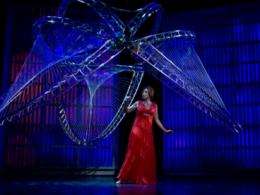
Later this month, the Opera of the Future Group at the MIT Media Lab will premiere Death and the Powers, an opera more than 10 years in the making. Featuring life-sized singing robots and a musical chandelier, the opera could redefine how technology can enhance live performance and help reestablish opera’s spirit of innovation.
Created by composer and MIT Media Lab Professor Tod Machover, who has designed customized instruments for musicians like Yo-Yo Ma and Prince, the one-act opera will premiere Sept. 24-26 in Monaco (the city-state’s ruler, Prince Albert II, is the honorary patron of the project and will attend the gala opening). More than 60 students and collaborators are traveling with Machover to help stage the complex production.
With Death and the Powers, Machover seeks to expand the traditional definition of opera through the use of technology — but in a way that enhances the human presence on stage and therefore strengthens the bond between audience and performers. “In theater, technology has consistently pulled music in the wrong direction,” says Machover. Recalling a Taylor Swift concert he recently attended with his teenage daughters, Machover bristles at the way in which “gigantic mega-screens and boom-box-like audio systems” have come to overshadow human performers, creating an experience that “forces rather than entices.”
For this project, Machover and his team attempted to use technology to bring the stage to life, almost as another character: Death and the Powers features an animated set and nine singing “OperaBots” that serve as the chorus and frame the narrative.
Creating “The System”
The opera tells the story of Simon Powers, a successful inventor who wants to ensure his legacy. To do so, he constructs “The System,” which makes it possible to download his memories and personality into the physical environment. As soon as Powers enters the system and disappears from the stage at the end of the first scene, the stage takes on his persona. His character expresses himself through giant bookcases with thousands of lights that move to the rhythm of the music, as well as a sinuous, light-emitting musical chandelier with resonant Teflon strings that can channel Simon’s presence while being strummed by his wife, Evvy.
By capturing the essence of a performer whom the audience can’t see, Death and the Powers creates what Machover calls a “disembodied performance.” This is done using software that Peter Torpey and Elly Jessop, two PhD students in Machover’s Opera of the Future Group, developed to measure aspects of a singer’s performance that the singer is likely aware of, including volume and pitch, as well as those he or she may not be monitoring, including muscle tension and breathing patterns. These conscious and unconscious elements then become part of the look and feel of “The System,” whether it’s through the movement of walls and chandeliers, pulsating lights or specially designed sounds.
This creative fusion of music and technology could reposition opera as an art form that embraces innovation, says Marc Scorca, president and CEO of Opera America, a nonprofit that serves U.S. opera companies. He notes that for hundreds of years, opera was known for welcoming innovation through new technologies and instrumentation. But that role was usurped in the late 19th century when film emerged as the most innovative art form; opera appeared staid in comparison.
“I’m always cheering when I see opera once again reasserting itself as the richest tapestry for innovative, live art,” Scorca says.
Not only does Scorca consider Death and the Powers to be groundbreaking because it tests the “definitional boundaries” of opera, but he also notes how rare it is for an opera to be conceived and produced outside the framework of a traditional opera company. The fact that Machover’s group at the Media Lab produced Death and the Powers “shows opera’s potent viability as a medium that has creative potential for anyone who is innovating in interdisciplinary art,” he says.
While Scorca hopes that the use of technology in Death and the Powers will inspire other operas, Machover cautions that it will be some time before the opera’s influence is clear — either within the world of opera or beyond. He notes that many of his larger endeavors have had unexpected results, such as his audience-interactive Brain Opera, which yielded many of the technologies behind the Guitar Hero video game.
Although Machover believes that techniques like disembodied performance will influence how emotions are captured and communicated in performances, he thinks that a major impact of Death and the Powers will be through its story and music. “‘Powers’ is packed with vivid melodies, quirky rhythms and pungent textures that I hope might stick in the ear, stir the imagination and resonate in unexpected ways,” he says.
This story is republished courtesy of MIT News (web.mit.edu/newsoffice/), a popular site that covers news about MIT research, innovation and teaching.
Provided by Massachusetts Institute of Technology


