For rapid non-linear information processing in the brain, small synaptic impulses are key
September 10, 2010
For rapid non-linear information processing in the brain, small synaptic impulses are key

Enlarge

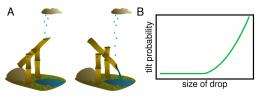
Figure 1: The dynamics of raindrops falling onto a shishi odoshi (deer scarer), a device used in Japanese gardens to scare away birds, provides an excellent model for understanding the operating principles of a nerve cell. (Artwork by Susanne Kunkel) A) The raindrops correspond to the incoming synaptic impulses, each of which increases the water level by a tiny amount. A single additional drop of water ultimately causes the shishi odoshi to tilt and drain. When the shishi odoshi swings back and hits the stone it produces a knocking sound. This corresponds to the emission of an action potential by the neuron. Thus, a single synaptic impulse can strongly affect the state of the neuron. The novel theory of the researchers takes this into account, while previous theories neglected this fact. B) The effect of a single drop on the tilting (response) of the shishi odoshi depends on the size of the drop. The probability that a response occurs is quadratically proportional to the size of the drop, meaning that a doubling of the drop size, for example, would make tilting four times more likely. This “non-linearity” is the basis for multiplications performed by neurons. Copyright : RIKEN

A novel theoretical framework for mathematically modeling nerve cells has illuminated for the first time how small synaptic impulses enable non-linear information processing in the brain. Reported in PLoS Computational Biology, the findings offer fundamental insights relevant to a wide range of biological, physical and technical systems.

In the field of neuroscience, are known to communicate via so-called “action potentials”, brief impulses which cause a cell’s membrane potential to rise and fall. Only when many such impulses together exceed a threshold value does the neuron “fire”, releasing its action potential to target neurons. How neurons transfer action potentials from inputs into outputs determines which elementary operations they are able to perform, and at what rate.

With their latest work, researchers at the RIKEN Brain Science Institute and Bernstein Center for set out to resolve contradictory findings uncovered earlier regarding this input-output relationship. At issue was the conventional theory of spiking , which approximates impulses in the limit where they become vanishingly tiny and infinitely numerous, limiting the capabilities of individual neurons to simple addition of inputs.

Using a newly-developed high-precision method for simulating nonlinear neuron models (see references), the team had previously uncovered contradictions in this theory. To unravel this mystery, the researchers developed a new analytic framework which explicitly incorporates the finite effect of each input at the critical boundary near the firing threshold. With this change, they show that not only can neurons process information far faster than previously believed, they can also perform nonlinear operations such as multiplication that are key to complex information processing.

While more accurately capturing the network aspect of neural dynamics, the new framework also reveals how cooperation between seemingly uncoordinated input signals enables neurons to perform many non-linear operations at the same time. Future work will build on these findings toward a better understanding of brain function, a fundamental requirement for treating neural diseases.

More information: Moritz Helias, Moritz Deger, Stefan Rotter and Markus Diesmann. Instantaneous non-linear processing by pulse-coupled threshold units. PLoS Computational Biology (2010).

Hanuschkin A, Kunkel S, Helias M, Morrison A and Diesmann M (2010). A general and efficient method for incorporating precise spike times in globally time-driven simulations. Front. Neuroinform. 4:113. doi:10.3389/fninf.2010.00113

he simulation software is freely available from the NEST Initiative: http://www.nest-initiative.org

Provided by RIKEN


Rank not rated yet
Related Stories
Relevant PhysicsForums posts
  • Protease cleavage
    created5 hours ago
  • Pertubance in a model
    created12 hours ago
  • Cancer drugs and Alzheimer's, Oh my!
    created20 hours ago
  • Squishing cells
    created21 hours ago
  • Any books/articles for evolutionary stable strategy models in humans?
    createdFeb 09, 2012
  • Science behind the bore feeling?
    createdFeb 09, 2012
  • More from Physics Forums - Biology

More news stories

The power of estrogen -- male snakes attract other males

A new study has shown that boosting the estrogen levels of male garter snakes causes them to secrete the same pheromones that females use to attract suitors, and turned the males into just about the sexiest ...

Biology / Plants & Animals

created 10 hours ago | popularity 4.8 / 5 (5) | comments 0 | with audio podcast

Grass to gas: Researchers' genome map speeds biofuel development

Researchers at the University of Georgia have taken a major step in the ongoing effort to find sources of cleaner, renewable energy by mapping the genomes of two originator cells of Miscanthus x giganteus, a large perenn ...

Biology / Biotechnology

created 7 hours ago | popularity 3.7 / 5 (3) | comments 0 | with audio podcast

Experts reveal how plants don't get sunburn

(PhysOrg.com) -- Experts at the University of Glasgow have discovered how plants survive the harmful rays of the sun.

Biology / Cell & Microbiology

created 10 hours ago | popularity 5 / 5 (2) | comments 0 | with audio podcast

Protein libraries in a snap

(PhysOrg.com) -- A Rice University undergraduate will depart with not only a degree but also a possible patent for his invention of an efficient way to create protein libraries, an important component of biomolecular ...

Biology / Cell & Microbiology

created 13 hours ago | popularity 5 / 5 (2) | comments 0 | with audio podcast

Miami battling invasion of giant African snails

No one knows how they got there. But an invasion of African giant snails has southern Florida in a panic over potential crop damage, disease and general yuckiness surrounding the slimy gastropods.

Biology / Ecology

created 14 hours ago | popularity 4 / 5 (1) | comments 4


Google users warned of threat to smartphone wallets

Users of Google smartphone wallets were being warned on Friday that there is a way to crack pass codes intended to thwart thieves from going on illicit shopping sprees.

Anonymous knocks CIA website offline (Update)

The website of the Central Intelligence Agency was inaccessible on Friday after the hacker group Anonymous claimed to have knocked it offline.

Complex wiring of the nervous system may rely on a just a handful of genes and proteins

Researchers at the Salk Institute have discovered a startling feature of early brain development that helps to explain how complex neuron wiring patterns are programmed using just a handful of critical genes. ...

NASA sees wide-eyed cyclone Jasmine

Cyclone Jasmine's eye has opened wider on NASA satellite imagery, as it moves through the Southern Pacific Ocean.

Putting the squeeze on planets outside our solar system

(PhysOrg.com) -- Using high-powered lasers, scientists at Lawrence Livermore National Laboratory and collaborators discovered that molten magnesium silicate undergoes a phase change in the liquid state, abruptly ...

NASA sees Giovanna reach cyclone strength, threaten Madagascar

Tropical Storm 12S built up steam and became a cyclone on February 10, 2012 as NASA's Terra satellite passed overhead. Residents of east-central Madagascar should prepare for this cyclone to make landfall ...