Robotics breakthrough: Scientists make artificial skin
September 12, 2010 by Richard Ingham
Engineers make artificial skin out of nanowires

Enlarge

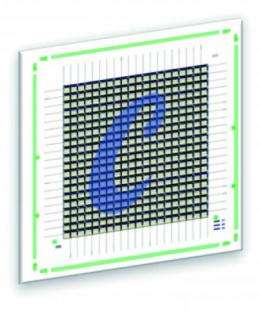
Shown is a design layout of the artificial e-skin developed by UC Berkeley engineers. The researchers used a mold in the shape of the letter C -- for Cal -- to verify that the e-skin could correctly map its pressure profile. Credit: Ali Javey and Kuniharu Takei

Biotech wizards have engineered electronic skin that can sense touch, in a major step towards next-generation robotics and prosthetic limbs.

The lab-tested material responds to almost the same pressures as human and with the same speed, they reported in the British journal .

Important hurdles remain but the exploit is an advance towards replacing today's clumsy robots and artificial arms with smarter, touch-sensitive upgrades, they believe.

"Humans generally know how to hold a fragile egg without breaking it," said Ali Javey, an associate professor of computer sciences at the University of California at Berkeley, who led one of the research teams.

"If we ever wanted a robot that could unload the dishes, for instance, we'd want to make sure it doesn't break the wine glasses in the process. But we'd also want the robot to grip the stock pot without dropping it."

The "e-skin" made by Javey's team comprises a matrix of made of and silicon rolled onto a sticky polyimide film.

The team then laid nano-scale transistors on top, followed by a flexible, pressure-sensitive rubber. The prototype, measuring 49 square centimetres (7.6 square inches), can detect pressure ranging from 0 to 15 kilopascals, comparable to the force used for such daily activities as typing on a keyboard or holding an object.

A different approach was taken by a team led by Zhenan Bao, a Chinese-born associate professor at Stanford University in California who has gained a reputation as one of the top women chemists in the United States.

Their approach was to use a rubber film that changes thickness due to pressure, and employs capacitors, integrated into the material, to measure the difference. It cannot be stretched, though.
Engineers make artificial skin out of nanowires
Enlarge

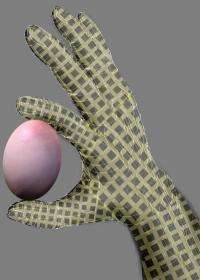
This is an artist's illustration of an artificial e-skin with nanowire active matrix circuitry covering a hand. A fragile egg is held, illustrating the functionality of the e-skin device for prosthetic and robotic applications. Credit: Ali Javey and Kuniharu Takei

"Our response time is comparable with human skin, it's very, very fast, within milliseconds, or thousandths of a second," Bao told AFP. "That means in real terms that we can feel the pressure instantaneously."

The achievements are "important milestones" in artificial intelligence, commented John Boland, a nanoscientist at Trinity College Dublin, Ireland, who hailed in particular the use of low-cost processing components.

In the search to substitute the human senses with electronics, good substitutes now exist for sight and sound, but lag for smell and taste.

Touch, though, is widely acknowledged to be the biggest obstacle.

Even routine daily actions, such as brushing one's teeth, turning the pages of a newspaper or dressing a small child would easily defeat today's robots.

Bao added important caveats about the challenges ahead.

One is about improving the new sensors. They respond to constant pressure, whereas in human skin more complex sensations are possible.

This is because the pressure-sensing cells in the skin can send different frequencies of signal -- for instance, when we feel something painful or sharp, the frequency increases, alerting us to the threat.

In addition, Bao warned, "connecting the artificial skin with the human nerve system will be a very challenging task".
Engineers make artificial skin out of nanowires
Enlarge

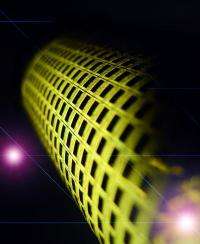
This is an optical image of a fully fabricated e-skin device with nanowire active matrix circuitry. Each dark square represents a single pixel. Credit: Ali Javey and Kuniharu Takei, UC Berkeley

"Ultimately, in the very distant future, we would like to make a skin which performs really like human skin and to be able to connect it to nerve cells on the arm and thus restore sensation.

"Initially, the prototype that we envision would be more like a handheld device, or maybe a device that connects to other parts of the body that have skin sensation.

"The device would generate a pulse that would stimulate other parts of the skin, giving the kind of signal 'my (artificial) hand is touching something', for instance."

In the future, could be studded with sensors that respond to chemicals, biological agents, temperature, humidity, radioactivity or pollutants.

"This would be especially useful in applications where we want to send robots into environments, including space, where it could be dangerous for humans to go," said Bao. "They could collect information and send it back."

More information: Nature Materials paper: http://www.nature. … mat2835.html

(c) 2010 AFP

4.7 /5 (19 votes)  

Filter


Move the slider to adjust rank threshold, so that you can hide some of the comments.


Display comments: newest first

fixer
Sep 12, 2010

Rank: 5 / 5 (4)
Great bit of work!
A bit spooky for "terminator" fans though.
210
Sep 12, 2010

Rank: 3 / 5 (2)
Indeed:

The moment tis is practically introduced, no longer a lab exercise, they will need an effect immune system and a nutrient transport system. We will have to foresee microbes or better, "Nano-probes" that violate or infect these prosthetic devices ESPECIALLY those that can adapt to the human-machine tactile interface.
WHat about microabrasions and outright tears and breaks...we will need a pseudo-DNA command structure to organize repair without visiting the repair depot.
Waste product removal: when that that was is too broken to repair (Apoptosis, for these machines) or needs nanological (as opposed to biological) upgrades, what is the down-time like?
Who decides what an upgrade is? And, what IS life anyway???! (A sum of parts? That cannot be right can it!?!)
HealingMindN
Sep 12, 2010

Rank: 1 / 5 (1)
This is like the basis for a new, cybernetic super hero, or villain - in the distant future.
kasen
Sep 13, 2010

Rank: not rated yet
Good to know wizardry is moving along. Biotech is nice, but I am looking forward to breakthroughs in the traditional fields of conjuration and evocation.

On a more on topic note, I wonder how are they planning to connect this to the nervous system, when the time comes. From what I've read, there are several types of receptors in the skin, whereas this artificial sensor apparently replaces only one type.
DaveGee
Sep 13, 2010

Rank: not rated yet
Brent should be shedding a tear right now....
Rank 4.7 /5 (19 votes)
Related Stories
Relevant PhysicsForums posts
  • Strength reduction factors for welded edge joints
    created4 hours ago
  • Specific heat of Al
    createdFeb 21, 2012
  • Strongest steel?
    createdFeb 19, 2012
  • stabilizing Zirconia
    createdFeb 18, 2012
  • How to calculate strength of welds (welded joints)?
    createdFeb 17, 2012
  • Polycarbonate fracture toughness????
    createdFeb 16, 2012
  • More from Physics Forums - Materials & Chemical Engineering

More news stories

New nanotechnology converts heat into power when it's needed most

Never get stranded with a dead cell phone again. A promising new technology called Power Felt, a thermoelectric device that converts body heat into an electrical current, soon could create enough juice to make another call ...

Nanotechnology / Nanophysics

created 17 hours ago | popularity 4 / 5 (8) | comments 6 | with audio podcast

New technique produces free-standing piezoelectric ferroelectric nanostructures from PZT material

(PhysOrg.com) -- Researchers have developed a “soft template infiltration” technique for fabricating free-standing piezoelectrically active ferroelectric nanotubes and other nanostructures from PZT ...

Nanotechnology / Nanophysics

created 18 hours ago | popularity 5 / 5 (5) | comments 4 | with audio podcast

Graphene is thinnest known anti-corrosion coating

New research has established the "miracle material" called graphene as the world's thinnest known coating for protecting metals against corrosion. Their study on this potential new use of graphene appears ...

Nanotechnology / Nanomaterials

created 14 hours ago | popularity 4.6 / 5 (7) | comments 2 | with audio podcast

Researchers discover how different nanomaterial surfaces affect proteins

A new study led by nanotechnology and biotechnology experts at Rensselaer Polytechnic Institute is providing important details on how proteins in our bodies interact with nanomaterials. In their new study, published in the ...

Nanotechnology / Bio & Medicine

created 11 hours ago | popularity 5 / 5 (2) | comments 1 | with audio podcast

A new twist on nanowires

Nanowires — microscopic fibers that can be “grown” in the lab — are a hot research topic today, with a variety of potential applications including light-emitting diodes (LEDs) and sensors. ...

Nanotechnology / Nanophysics

created 20 hours ago | popularity 4.8 / 5 (4) | comments 0 | with audio podcast


Researchers build first physical 'metatronic' circuit

(PhysOrg.com) -- The technological world of the 21st century owes a tremendous amount to advances in electrical engineering, specifically, the ability to finely control the flow of electrical charges using ...

Spitzer finds solid buckyballs in space

(PhysOrg.com) -- Astronomers using data from NASA's Spitzer Space Telescope have, for the first time, discovered buckyballs in a solid form in space. Prior to this discovery, the microscopic carbon spheres ...

Faster than light neutrinos? More like faulty wiring

You can shelf your designs for a warp drive engine (for now) and put the DeLorean back in the garage; it turns out neutrinos may not have broken any cosmic speed limits after all.

Physicists surprised by disappearing and reappearing superconductivity in iron selenium chalcogenides

Superconductivity is a rare physical state in which matter is able to conduct electricity -- maintain a flow of electrons -- without any resistance. This phenomenon can only be found in certain materials at low temperatures, ...

Stanford research team cracks animated NuCaptcha

(PhysOrg.com) -- The research team from Stanford University, led by Elie Bursztein, that previously had cracked regular CAPTCHAs and then audio CAPTCHAs, now has also successfully cracked the animated version called NuCapt ...

Going up: Japan builder eyes space elevator

A Japanese construction firm claimed Wednesday it could execute an out-of-this-world plan to put tourists in space within 40 years by building an elevator that stretches a quarter of the way to the moon.