First sighting of Halley’s comet pushed back two centuries
September 13, 2010 by Lin Edwards
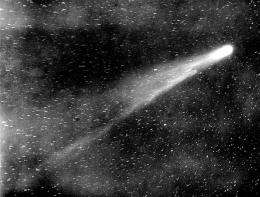
A photograph of Halley's Comet taken during its 1910 approach. Image credit: The Yerkes Observatory / Wikipedia
(PhysOrg.com) -- Researchers have modeled the likely path taken by Halley's comet in the 5th century BC and compared their findings to ancient Greek texts from the period. They now suggest the ancient Greeks saw the comet, which would make the sightings over two centuries earlier than previous known observations.
Chinese astronomers first described the comet in 240 BC, but in ancient Greece in 466-467 BC Greek authors described a meteor the size of a wagon that crashed into the Hellespont region of northern Greece during daylight hours, frightening the population and creating a tourist attraction that lasted five centuries. The ancient authors describe a comet in the sky at the time.
Researchers Daniel Graham, a philosopher, and Eric Hintz, an astronomer, from Brigham Young University at Provo in Utah, compared their model of the comet’s likely path with the texts describing the meteor crash. Halley’s comet would have been visible for 82 days maximum, depending on atmospheric conditions at the time, while the ancient texts say the comet was visible for 75 days.
When the meteor fell, the comet was said to be in the western sky, and according to the model comet Halley would have been visible from 4 June to 25 August in 466 BC, and would have been in the western sky from July 18th. The comet was said to be accompanied by winds and shooting stars, and in July strong winds are common in the region. If the model is correct, at this time the Earth would have been moving under the comet’s tail, and shooting stars could have been created from its debris field.
According to Plutarch, writing in the 1st century AD, Anaxagoras, a young astronomer, had predicted the meteor crash, but this has puzzled historians because a meteor collision is a random event difficult to predict. Graham suggests Anaxagoras probably actually predicted that rocks might fall from the sky rather than a particular meteorite.
Anaxagoras made the prediction after observing the solar eclipse of 478 BC and concluding that heavenly bodies such as the moon were not lighter than air, as previously believed, but were actually made of rock. If nudged out of position, they could therefore crash to earth. It is possible that Halley’s comet could have nudged a small asteroid off course, and this was the meteor that hit northern Greece, but Dr Hintz is doubtful and said his feeling is that “it was just a really cool coincidence.”
Halley’s comet becomes visible to the unaided eye around every 75-6 years, but calculations of its appearance are difficult because sometimes its orbits bring it close to planets, whose gravity can change its course. The comet was named after the English astronomer Edmond Halley, who in 1705 correctly predicted the 1758 return of a comet that had previously been observed in 1682. The comet was last seen on 9th February 1986, and is expected to return in 2061.
More information: An Ancient Greek Sighting of Halley's Comet? Journal of Cosmology, 2010, Vol 9, 2130-2136. http://journalofco … nomy106.html
© 2010 PhysOrg.com
-
Meteor shower is possible next week
May 17, 2006 |
not rated yet |
0
-
Orionids Meteor Shower Lights Up the Sky
Oct 21, 2009 |
not rated yet |
0
-
Spitzer Telescope Sees Trail of Comet Crumbs
May 11, 2006 |
not rated yet |
0
-
New Comet Discovered from Mauna Kea
Dec 05, 2005 |
not rated yet |
0
-
SOHO Mission Discovers Rare Comet
Sep 27, 2007 |
not rated yet |
0
-
Stars containing dark matter should look different from other stars
Feb 20, 2012 |
4.5 / 5 (17) |
11
-
Physicists discover evidence of rare hypernucleus, a component of strange matter
Feb 17, 2012 |
4.7 / 5 (38) |
22
-
Fast photon control brings quantum photonic technologies closer
Feb 13, 2012 |
5 / 5 (8) |
1
-
Engineers build first sub-10-nm carbon nanotube transistor
Feb 01, 2012 |
4.9 / 5 (36) |
32
-
Something old, something new: Evolution and the structural divergence of duplicate genes
Jan 31, 2012 |
4.6 / 5 (7) |
1
-
Calculating the magnitude
2 hours ago
-
What is this spectrum I took?
12 hours ago
-
Orientation of Space
13 hours ago
-
Geologically Active Moon Now: NASA
20 hours ago
-
advice on building a science fair telescope
Feb 22, 2012
-
Rise of the Sun
Feb 22, 2012
- More from Physics Forums - General Astronomy
More news stories
Spitzer finds solid buckyballs in space
(PhysOrg.com) -- Astronomers using data from NASA's Spitzer Space Telescope have, for the first time, discovered buckyballs in a solid form in space. Prior to this discovery, the microscopic carbon spheres ...
14 hours ago |
4.7 / 5 (12) |
8
|
Going up: Japan builder eyes space elevator
A Japanese construction firm claimed Wednesday it could execute an out-of-this-world plan to put tourists in space within 40 years by building an elevator that stretches a quarter of the way to the moon.
Space & Earth / Space Exploration
21 hours ago |
3.5 / 5 (13) |
26
ENASA satellite finds Earth's clouds are getting lower
(PhysOrg.com) -- Earth's clouds got a little lower -- about one percent on average -- during the first decade of this century, finds a new NASA-funded university study based on NASA satellite data. The results ...
Space & Earth / Earth Sciences
18 hours ago |
5 / 5 (8) |
13
|
Fresh scandal embroils US climate science debate
A fresh scandal over climate change has erupted in the United States after leaked documents appeared to show a right-wing funded campaign to influence how climate science is taught in schools.
11 hours ago |
4.1 / 5 (9) |
8
World's oceans get an acid bath
Among the repercussions of global climate change, the effect of ocean acidification on marine life is one of the least-understood variables.
18 hours ago |
4.3 / 5 (6) |
4
|
Researchers build first physical 'metatronic' circuit
(PhysOrg.com) -- The technological world of the 21st century owes a tremendous amount to advances in electrical engineering, specifically, the ability to finely control the flow of electrical charges using ...
Faster than light neutrinos? More like faulty wiring
You can shelf your designs for a warp drive engine (for now) and put the DeLorean back in the garage; it turns out neutrinos may not have broken any cosmic speed limits after all.
Physicists surprised by disappearing and reappearing superconductivity in iron selenium chalcogenides
Superconductivity is a rare physical state in which matter is able to conduct electricity -- maintain a flow of electrons -- without any resistance. This phenomenon can only be found in certain materials at low temperatures, ...
Stanford research team cracks animated NuCaptcha
(PhysOrg.com) -- The research team from Stanford University, led by Elie Bursztein, that previously had cracked regular CAPTCHAs and then audio CAPTCHAs, now has also successfully cracked the animated version called NuCapt ...
Flesh-eating bacteria inspire superglue
(PhysOrg.com) -- A bio-inspired superglue has been developed by Oxford University researchers that cant be matched for sticking molecules together and not letting go.
Scientists create potent molecules aimed at treating muscular dystrophy
While RNA is an appealing drug target, small molecules that can actually affect its function have rarely been found. But now scientists from the Florida campus of The Scripps Research Institute have for the first time designed ...
Sep 13, 2010
Rank: 4.7 / 5 (3)