Japan takes another step in replacing humans with robots
September 15, 2010
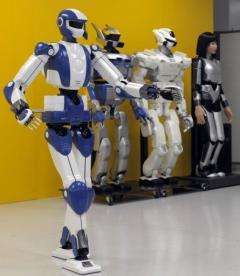
The HRP-4 robot (left) walks beside its previous models during a press conference in Tsukuba, Japan. Its makers -- Kawada Industries and the National Institute of Advanced Industrial Science and Technology -- hope the new "slim athlete" model is a step towards a robot that can help ease greying Japan's looming labour shortage.
The replacement of humans by machines in the workplace took another step on Wednesday, as Japanese researchers unveiled a model they hope could lead to humanoid menial workers.
Its makers, Kawada Industries and the National Institute of Advanced Industrial Science and Technology (AIST), hope the robot will be a step towards creating a model that can help ease greying Japan's looming labour shortage.
"We designed a working robot in the image of a lean but well-muscled track-and-field athlete," Noriyuki Kanehira, robotic systems manager at Kawada, told a news conference to unveil the blue-and-white "HRP-4."
Designed to help researchers develop models that could replace humans in repetitive manual labour, the latest "athlete" model in a near 10-year-old series updates the feminine, catwalk-strutting, karaoke-singing HRP-4C.
But the tone this time is altogether more serious, according to a joint statement from its developers.
"It is Japan's urgent task for the early 21st Century to develop robots that could carry out simple, repetitive works ... in a bid to complement the workforce in a country that is rapidly ageing with fewer and fewer children".
Standing at 151 centimetres (59 inches) tall, the robot in a demonstration Wednesday stood on one foot, twisted its waist, struck poses, walked in accordance to given voice commands and moved its head to track objects.
The HRP-4 boasts joints that move more freely than its predecessors and can run a range of separately-developed software applications, its makers said.
Kawada and AIST will start selling the robot to universities and research institutes in Japan and abroad from January 2011.
The price tag for what is described as a "low cost" model is 26 million yen (306,000 dollars) each. Its creators hope to sell three-to-five units a year.
(c) 2010 AFP
-
Fashion robot to hit Japan catwalk
Mar 16, 2009 |
not rated yet |
0
-
Japan's new robot brings visitors home by video-phone
Aug 01, 2010 |
not rated yet |
0
-
Greying Japan plans robo-nurses in five years: govt
Mar 25, 2009 |
not rated yet |
0
-
Panasonic breaks into robotics with medical robot
Jul 07, 2009 |
not rated yet |
0
-
Japan child robot mimicks infant learning
Apr 05, 2009 |
not rated yet |
0
-
Stars containing dark matter should look different from other stars
Feb 20, 2012 |
4.5 / 5 (17) |
11
-
Physicists discover evidence of rare hypernucleus, a component of strange matter
Feb 17, 2012 |
4.7 / 5 (38) |
22
-
Fast photon control brings quantum photonic technologies closer
Feb 13, 2012 |
5 / 5 (8) |
1
-
Engineers build first sub-10-nm carbon nanotube transistor
Feb 01, 2012 |
4.9 / 5 (36) |
32
-
Something old, something new: Evolution and the structural divergence of duplicate genes
Jan 31, 2012 |
4.6 / 5 (7) |
1
-
Writing shear and moment equations for a simple beam problem?
2 hours ago
-
Furnace Shell Spray Cooling Design
17 hours ago
-
Ways to measure the speed of a golf ball?
Feb 21, 2012
-
Water Skin Effect in Plastic Pipe
Feb 21, 2012
-
Undergraduate Engineering Physics To Graduate Aerospace Engineering
Feb 21, 2012
-
Shaft Sizing
Feb 21, 2012
- More from Physics Forums - General Engineering
More news stories
PlayStation Vita game gadgets debut outside Asia
Sony's slick PlayStation Vita handheld videogame gadget hit major markets around the world on Wednesday as the Japanese entertainment titan bucked a trend towards play on smartphones.
Electronics / Consumer & Gadgets
7 hours ago |
not rated yet |
0
Energy-recycling computer technology from UM goes global through AMD
An energy-recycling computer circuit born at the University of Michigan will enable a new generation of power efficient laptop PCs and servers.
15 hours ago |
5 / 5 (1) |
0
Review: Vita sets new standard for portable games
(AP) -- The PlayStation Vita won't replace your smartphone. For starters, it isn't a telephone (although it will eventually let you use Skype). And it's too big to fit in your pants pocket, unless you're wearing ...
Electronics / Consumer & Gadgets
Feb 21, 2012 |
3.7 / 5 (3) |
2
Engineering research brings seven adult-sized humanoid robots together for first time in US
Seven adult-sized humanoid robots took the stage during Drexel University's celebration of National Engineers Week, in a first-of-its-kind assembly of robotic technology. A showcase event on Feb. 20 introduced all seven of ...
Feb 21, 2012 |
not rated yet |
2
British firm develops 'cheapest wireless tablet'
A British technology company claims to have developed the world's least expensive computer tablet for wireless Internet access.
Electronics / Consumer & Gadgets
Feb 19, 2012 |
4.6 / 5 (10) |
2
Researchers build first physical 'metatronic' circuit
(PhysOrg.com) -- The technological world of the 21st century owes a tremendous amount to advances in electrical engineering, specifically, the ability to finely control the flow of electrical charges using ...
Faster than light neutrinos? More like faulty wiring
You can shelf your designs for a warp drive engine (for now) and put the DeLorean back in the garage; it turns out neutrinos may not have broken any cosmic speed limits after all.
Spitzer finds solid buckyballs in space
(PhysOrg.com) -- Astronomers using data from NASA's Spitzer Space Telescope have, for the first time, discovered buckyballs in a solid form in space. Prior to this discovery, the microscopic carbon spheres ...
Physicists surprised by disappearing and reappearing superconductivity in iron selenium chalcogenides
Superconductivity is a rare physical state in which matter is able to conduct electricity -- maintain a flow of electrons -- without any resistance. This phenomenon can only be found in certain materials at low temperatures, ...
Scientists create potent molecules aimed at treating muscular dystrophy
While RNA is an appealing drug target, small molecules that can actually affect its function have rarely been found. But now scientists from the Florida campus of The Scripps Research Institute have for the first time designed ...
Stanford research team cracks animated NuCaptcha
(PhysOrg.com) -- The research team from Stanford University, led by Elie Bursztein, that previously had cracked regular CAPTCHAs and then audio CAPTCHAs, now has also successfully cracked the animated version called NuCapt ...
Sep 15, 2010
Rank: 1 / 5 (4)
Sep 15, 2010
Rank: 2.5 / 5 (2)
The robot seems slightly improved from HRC-4C, but still it appears clumsy.
Sep 15, 2010
Rank: 5 / 5 (1)
Sep 15, 2010
Rank: 3.9 / 5 (7)
False logic. Machines have never led to less jobs for humans. A robot wont either. It frees labor force up to do other jobs.
Sep 15, 2010
Rank: 3 / 5 (1)
Sep 15, 2010
Rank: 1 / 5 (1)
Sep 15, 2010
Rank: 1 / 5 (1)
Sep 15, 2010
Rank: 5 / 5 (1)
There will be the risk of the tech falling into criminal hands although built in safe guards will mitigate the risk. Intellegent computers will revolutionize our life styles by freeing up the work week, perhaps from 5 days to 2 days or zero. The leissure industry will grow as a result.
Sep 16, 2010
Rank: 5 / 5 (4)
I bet laborers at the turn of the century thought the same thing about putting machines in factories. We can't stop progress because some people will be put out of jobs. People will adapt, be retrained, and a new market will emerge for them to move to.
Sep 16, 2010
Rank: not rated yet
An earlier model doing just that.
watch?v=1tiOs0vlJig&NR=1
Sep 16, 2010
Rank: 1 / 5 (1)
And would probably do a much better job lol.
Sep 16, 2010
Rank: 1 / 5 (1)
That would be cool, would free us to pursue other fields of work suck as art, philosophy and Reserch.
Sep 16, 2010
Rank: 2 / 5 (1)
Sep 16, 2010
Rank: 4.7 / 5 (27)
Sep 16, 2010
Rank: not rated yet
Sep 16, 2010
Rank: 5 / 5 (1)
In all seriousness though, it would be nice to have robots do jobs no one else would do. I.E. clean the trash from our freeways or just roads in general.
Like any mechanical creations, there will be people who will be trained to fix them = high tech jobs.
Then you might have third party groups who design clothes or accessories for them haha just like dressing up puppies :)
Sep 19, 2010
Rank: 1 / 5 (1)
It IS xenophobia. Japan has a long history of not accepting foreigners as citizens.
Sep 19, 2010
Rank: 5 / 5 (25)
Sep 19, 2010
Rank: 1 / 5 (1)
http://www.youtub...uETw68zc
Its really crazy what they can do already!
Sep 20, 2010
Rank: not rated yet
Sep 21, 2010
Rank: not rated yet
The mental state of many workers there leads to suicide - another form of depression - but the USA rates are climbing also.
Robots are cool, no doubt, but the population of the country is such that it makes no sense to replace that many workers. There is a real world limit to using robotic tools and automation.
Sep 22, 2010
Rank: not rated yet
If you Google the subject,you will find that Japan is quite reticent to admit foreign workers.Japanese society is highly homogeneous,and they want it kept that way,although that may change because of a shrinking native Japanese population.