Promising biotech device bred from undergrad's 'crazy idea'
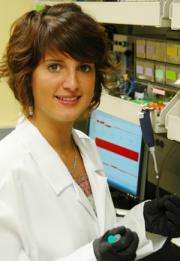
In Nader Pourmand's bioinstrumentation class, students are encouraged to come up with their own ideas for new biotechnology devices and applications. Sometimes, their "crazy ideas" turn into important research projects.
That was the case for Queralt Vallmajo Martin, an exchange student from Spain who took Pourmand's course during her first quarter at UC Santa Cruz last fall. Pourmand, a professor of biomolecular engineering in the Baskin School of Engineering at UCSC, saw the potential in Vallmajo's idea for a calcium detector and invited her to work on it in his lab. Now she is busy finishing up her work on the project before returning to Spain for her senior year at the Autonomous University of Barcelona.
"She's been working very hard," Pourmand said. "We still need to complete the final experiments, but I expect this project will lead to a publication in a high-impact journal. We combined her crazy idea and our tool to create a new device for the measurement of calcium."
Although she looks forward to seeing family and friends back in Spain, Vallmajo said she will miss Santa Cruz. "I really liked UCSC, and working in the lab has been a great opportunity," she said. "The upper division classes are small, so the professors really get to know you, and you can interact with them a lot. It's a good environment for students to come up with their own ideas."
When Vallmajo proposed a new type of sensor to measure calcium, she was thinking of medical applications because of the importance of calcium in pregnancy and diseases such as osteoporosis. Calcium also plays an important role in a wide range of biological processes within individual cells in the body. Pourmand realized that, although Vallmajo's idea might not have clinical applications, a device that could measure calcium concentrations inside living cells would be a valuable tool for biomedical researchers. This could be achieved by basing the device on the "nanopipette sensor" technology that Pourmand's lab has developed.
"With the nanopipette, you can put the sensor into a cell and it will not kill the cell because the tip is so small," Vallmajo said.
Camilla Forsberg, an assistant professor of biomolecular engineering, said she sees great potential for this technology in stem cell research. Forsberg studies blood stem cells, which give rise to all the different types of blood cells in the body. One of her goals is to understand why a stem cell chooses one fate over another. "The ability to measure biological signals at the single-cell level would be great," she said.
Pourmand's nanopipette sensors use a technology called STING, for Signal Transduction by Ion NanoGating. Paolo Actis and Boaz Volozny, postdoctoral researchers in Pourmand's group, have been leading the development of the STING technology and worked closely with Vallmajo on her project.
To make the device, researchers start with a small tube of quartz glass. Using a laser, a special machine heats the midpoint of the tube and pulls it apart as the glass melts, yielding two tubes that taper to very fine points. The diameter of the pore at the tip of each nanopipette is about 50 nanometers.
The next step is to make the device recognize a particular molecule or ion, which could be an antibody, a toxin, a DNA sequence, or an ion such as calcium. To detect calcium, Vallmajo coated the inside of the nanopipette with a protein called calmodulin that binds calcium. Several steps are involved in attaching a layer of calmodulin to the glass. Finally, an electrode is placed inside the nanopipette to measure the tiny current generated as ions flow through the pore.
While the STING sensor had been used successfully to detect large particles such as proteins and antibodies, it was unknown whether the device would respond to specific ions, which are hundreds of times smaller. Vallmajo's experiments showed a strong calcium response, likely due to the local change in surface charge as the calcium ions bind to calmodulin, Pourmand said.
"The nanopipette sensor is a versatile platform that can be customized for many different applications, anywhere from detecting biomolecules in single cells to monitoring contamination in the environment," he said. "A highly sensitive STING sensor can be precisely positioned, unlike other nanosensing technologies, at any subcellular region of a single living cell using a micromanipulator. The nanoscale ion sensor can also be used in remote devices for continuous water monitoring."
Vallmajo has not yet tested the calcium sensor in living cells, focusing first on perfecting the device and testing it in different solutions that mimic biological environments. Soon she will be back in Barcelona, taking the courses needed to complete her degree in biotechnology. But working in a lab has made her think seriously about continuing her research career in graduate school. She might even end up back in Santa Cruz.
"I don't have definite plans yet, but I have thought about coming back here for graduate school," she said.
Provided by University of California - Santa Cruz


