Scientists genetically engineer silkworms to produce artificial spider silk (w/ Video)
September 29, 2010
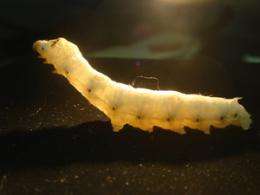
(PhysOrg.com) -- A research and development effort by the University of Notre Dame, the University of Wyoming, and Kraig Biocraft Laboratories, Inc. has succeeded in producing transgenic silkworms capable of spinning artificial spider silks.
"This research represents a significant breakthrough in the development of superior silk fibers for both medical and non-medical applications," said Malcolm J. Fraser Jr., a Notre Dame professor of biological sciences. "The generation of silk fibers having the properties of spider silks has been one of the important goals in materials science."
Natural spider silks have a number of unusual physical properties, including significantly higher tensile strength and elasticity than naturally spun silkworm fibers. The artificial spider silks produced in these transgenic silkworms have similar properties of strength and flexibility to native spider silk.
Silk fibers have many current and possible future biomedical applications, such as use as fine suture materials, improved wound healing bandages, or natural scaffolds for tendon and ligament repair or replacement. Spider silk-like fibers may also have applications beyond biomedical uses, such as in bulletproof vests, strong and lightweight structural fabrics, a new generation athletic clothing and improved automobile airbags.
This video is not supported by your browser at this time.
Until this breakthrough, only very small quantities of artificial spider silk had ever been produced in laboratories, but there was no commercially viable way to produce and spin these artificial silk proteins. Kraig Biocraft believed these limitations could be overcome by using recombinant DNA to develop a bio-technological approach for the production of silk fibers with a much broader range of physical properties or with pre-determined properties, optimized for specific biomedical or other applications.The firm entered into a research agreement with Fraser, who discovered and patented a powerful and unique genetic engineering tool called "piggyBac". PiggyBac is a piece of DNA known as a transposon that can insert itself into the genetic machinery of a cell.
"Several years ago, we discovered that the piggyBac transposon could be useful for genetic engineering of the silkworm, and the possibilities for using this commercial protein production platform began to become apparent."
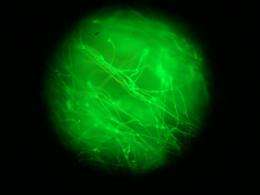
transgenic silk
Fraser, with the assistance of University of Wyoming researcher Randy Lewis, a biochemist who is one of the world's foremost authorities on spider silk, and Don Jarvis, a noted molecular geneticist who specializes in insect protein production, genetically engineered silkworms in which they incorporated specific DNAs taken from spiders. When these transgenic silkworms spin their cocoons, the silk produced is not ordinary silkworm silk, but, rather, a combination of silkworm silk and spider silk. The genetically engineered silk protein produced by the transgenic silkworms has markedly improved elasticity and strength approaching that of native spider silk."We've also made strides in improving the process of genetic engineering of these animals so that the development of additional transgenics is facilitated," Fraser said. "This will allow us to more rapidly assess the effectiveness of our gene manipulations in continued development of specialized silk fibers."
Since silkworms are already a commercially viable silk production platform, these genetically engineered silkworms effectively solve the problem of large scale production of engineered protein fibers in an economically practical way.
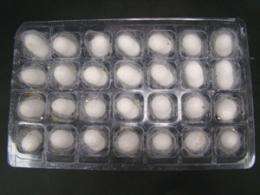
spinned cocoons
"Using this entirely unique approach, we have confirmed that transgenic silkworms can be a potentially viable commercial platform for production of genetically engineered silk proteins having customizable properties of strength and elasticity," Fraser said. "We may even be able to genetically engineer fibers that exceed the remarkable properties of native spider silk."The genetic engineering breakthrough was announced today (Sept. 29) by Fraser, Lewis and Kraig Biocraft CEO Kim Thompson at a press conference on the Notre Dame campus.
-
Scientist Will Examine Spider Silk Use for Sutures
Jun 27, 2006 |
not rated yet |
0
-
Scientists breed goats that produce spider silk
May 31, 2010 |
not rated yet |
0
-
Native-like spider silk produced in metabolically engineered bacterium
Jul 27, 2010 |
not rated yet |
0
-
Fascinating Spider Silk
Apr 04, 2007 |
not rated yet |
0
-
Artificial bee silk a big step closer to reality
Feb 03, 2010 |
not rated yet |
0
-
Stars containing dark matter should look different from other stars
Feb 20, 2012 |
4.5 / 5 (17) |
11
-
Physicists discover evidence of rare hypernucleus, a component of strange matter
Feb 17, 2012 |
4.7 / 5 (38) |
22
-
Fast photon control brings quantum photonic technologies closer
Feb 13, 2012 |
5 / 5 (8) |
1
-
Engineers build first sub-10-nm carbon nanotube transistor
Feb 01, 2012 |
4.9 / 5 (36) |
32
-
Something old, something new: Evolution and the structural divergence of duplicate genes
Jan 31, 2012 |
4.6 / 5 (7) |
1
-
Eye biology videos
1 hour ago
-
Flowering Plant Revived After 30,000 Years in Permafrost
Feb 21, 2012
-
Toba volcano eruptions - 1.000 - 10,000 breeding pairsunb
Feb 20, 2012
-
How is a specific gene removed from DNA
Feb 20, 2012
-
Reproduction and Human evolution
Feb 19, 2012
-
Viruses: Living or Non-living organisms
Feb 19, 2012
- More from Physics Forums - Biology
More news stories
Surprising diversity at a synapse hints at complex diversity of neural circuitry
A new study reveals a dazzling degree of biological diversity in an unexpected place a single neural connection in the body wall of flies.
8 hours ago |
5 / 5 (4) |
0
|
Men might not 'become extinct' after all: Theory of the 'rotting' Y chromosome dealt a fatal blow
If you were to discover that a fundamental component of human biology has survived virtually intact for the past 25 million years, you'd be quite confident in saying that it is here to stay.
11 hours ago |
5 / 5 (6) |
1
|
Climate change affects bird migration timing in North America
Bird migration timing across North America has been affected by climate change, according to a study published Feb. 22 in the open access journal PLoS ONE.
7 hours ago |
4.5 / 5 (2) |
2
New family of legless amphibians found in India
Since before the age of dinosaurs it has burrowed unbothered beneath the monsoon-soaked soils of remote northeast India - unknown to science and mistaken by villagers as a deadly, miniature snake.
18 hours ago |
5 / 5 (8) |
3
New iridescent lizard species found in Cambodia
A new species of lizard with striking iridescent rainbow skin, a long tail and very short legs has been discovered in the rainforest in northeast Cambodia, conservationists announced Wednesday.
7 hours ago |
not rated yet |
0
CT colonography shown to be comparable to standard colonoscopy
Computerized tomographic (CT) colonography (CTC), also known as virtual colonoscopy, is comparable to standard colonoscopy in its ability to accurately detect cancer and precancerous polyps in people ages 65 and older, according ...
Study: Virtual colonoscopy effective screening tool for adults over 65
Computed tomography (CT) colonography can be used as a primary screening tool for colorectal cancer in adults over the age of 65, according to a new study published online in the journal Radiology.
Researchers build first physical 'metatronic' circuit
(PhysOrg.com) -- The technological world of the 21st century owes a tremendous amount to advances in electrical engineering, specifically, the ability to finely control the flow of electrical charges using ...
Spitzer finds solid buckyballs in space
(PhysOrg.com) -- Astronomers using data from NASA's Spitzer Space Telescope have, for the first time, discovered buckyballs in a solid form in space. Prior to this discovery, the microscopic carbon spheres ...
Faster than light neutrinos? More like faulty wiring
You can shelf your designs for a warp drive engine (for now) and put the DeLorean back in the garage; it turns out neutrinos may not have broken any cosmic speed limits after all.
Physicists surprised by disappearing and reappearing superconductivity in iron selenium chalcogenides
Superconductivity is a rare physical state in which matter is able to conduct electricity -- maintain a flow of electrons -- without any resistance. This phenomenon can only be found in certain materials at low temperatures, ...


Sep 29, 2010
Rank: 1 / 5 (1)
Sep 29, 2010
Rank: 5 / 5 (4)
Hee hee hee...
Does anyone think in the future, suspension bridges might use some sort of composite spider silk cables?
Think of what you can do with this. You could weave a sleeve of this around a power line or telephone line to allow you to stretch the line across distances of 5 to 10 times greater between poles.
You might be able to make ULTRA light high altitude air ships for weather experiments, or ULTRA large low altitude air ships for heavy lifting in construction.
And with ten times the tensile strength of steel, you might be able to replace steel cables in cranes with a composite spider silk cable, which would be both lighter and 10 time stronger.
Of course, that would take a hell of a lot of silk worms...
Sep 30, 2010
Rank: 5 / 5 (1)
Sep 30, 2010
Rank: 5 / 5 (2)
Sep 30, 2010
Rank: not rated yet
With a silk cable with a cover to protect from elements......
Suspended Trains!
Or anything else that uses cables. This of course depends on the production capabilaties of this worm.
Sep 30, 2010
Rank: not rated yet
Sep 30, 2010
Rank: 5 / 5 (1)
Sep 30, 2010
Rank: not rated yet
Sep 30, 2010
Rank: not rated yet
http://www.physor...934.html