From Dinosaurs to Birds: Researchers Derive Lessons about Human Evolution from Chicken Genome
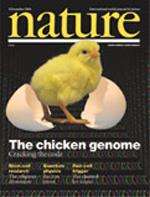
Experts in bioinformatics at the University of California, San Diego have co-authored with other scientists the first large-scale comparison of mammal and bird genomes, published in the December 9 edition of Nature. The journal's cover story includes a draft sequence of the chicken genome assembled and analyzed by members of the International Chicken Genome Sequencing Consortium.
The chicken genome provides several firsts: it is the first bird, the first agricultural animal, and the first descendant of the dinosaurs to have its genome sequenced. The consortium confirmed that humans and chickens share more than half of their genes, but their DNA sequences diverge in ways that may explain some of the important differences between birds and mammals.
UCSD professors participating in the consortium focused on evolutionary implications. They analyzed changes in gene orders on chromosomes -- so-called genome rearrangements -- and used computational biology techniques to compare rearrangements in the chicken genome to those in the previously-sequenced human, mouse and rat genomes. "The chicken provides a reference point and allows us to split the evolutionary tree and look for what features are in common in the DNA sequence," said Department of Mathematics professor Glenn Tesler, who led the work on genome rearrangements with scientists from Germany and Singapore, as well as UCSD computer scientist Pavel Pevzner. "We might infer that those that were most in common were probably there at some ancestral point."
"The surprising discovery was that chickens are much closer to humans than previously thought when it comes to genomic architecture," said Pevzner, a professor in UCSD's Jacobs School of Engineering and academic participant in the San Diego division of the California Institute for Telecommunications and Information Technology. "This may reflect some still-unknown evolutionary constraints on genomic makeup of diverse species that lead to apparent conservation of genomic architectures over hundreds of millions of years." The researchers found a very low rate of rearrangement between chromosomes in the chicken genome -- about one-third the rate in the mouse genome, but roughly similar to human evolution.
Sequencing of the chicken genome began in March 2003 with funding from the National Human Genome Research Institute (NHRGI), one of the National Institutes of Health (NIH). Researchers led by Richard Wilson of the Washington University School of Medicine in St. Louis assembled the genome of the red jungle fowl (Gallus gallus), an ancestor of domestic chickens. The analysis showed that chickens and humans share about 60 percent of their genes, as opposed to the approximately 88 percent shared by humans and rodents. "The chicken is really in an evolutionary sweet spot," said Wilson. "It's at just the right evolutionary distance from all the other genomes we already have to provide us with a great deal of fresh insight into the human genome."
The chicken genome is the first for a non-mammal vertebrate that is close enough to mammals to make comparison possible. The analysis also affords a much longer view of evolution: the common vertebrate ancestor of mammals and birds is now believed to reach back 310 million years, compared to roughly 87 million years since humans and rodents split off from their evolutionary 'family tree.'
Added NHRGI director Francis Collins: "Sequencing the chicken genome provides an opportunity to reconstruct the architecture of the ancestral mammalian genome by using chicken as an outgroup."
At roughly one billion 'letters', or DNA base pairs, the chicken genome is only one-third the size of the human genome, although at 20,000 to 23,000 genes, the chicken genome has roughly the same number of genes as the human genome. Scientists made it a priority for sequencing because of the bird's importance to humans as a source of nutrition, as well as for its role in medical research. Outbreaks of avian flu and their potential impact on human disease factors were also a major concern.
Further details of Pevzner and Tesler's work on the chicken genome project with co-authors Guillaume Bourque of the Genome Institute of Singapore, as well as Evgeny M. Zdobnov and Peer Bork of the European Molecular Biology Laboratory, will appear in the January 2005 issue of Genome Research.
"Looking at chicken versus mammals, we found that in the chicken genome there is a much higher rate of reordering within chromosomes than movement from one chromosome to another-2.8 times as much," said Tesler. "Intra-chromosomal rearrangements are also more frequent for mammals, but less so. For instance, from the common mammal ancestor to the rat it is 1.7 times more common, and only 1.4 times more frequent when looking at the human genome compared to the common mammalian ancestor. But the number of rearrangements between chromosomes is roughly the same comparing the human to chicken genomes, as human to rodents."
The first detailed analysis of the chicken genome has identified a chicken counterpart to an important human immune system protein, revised scientists' assessment of the chicken's sense of smell, and suggested that the chicken, long used to study gene activity in the earliest stages of life, may provide a good model for studying changes in DNA linked to aging and death. Scientists also identified genes that affirm the chicken's value as a model for study of developmental disorders like cleft palate and diseases like muscular dystrophy.
The draft of the chicken genome published in Nature is far from complete, but the focus now shifts to other efforts to sequence and analyze genomes and compare them to the human genome. The sequencing of dog and chimpanzee are already in rough draft form, with large-scale analysis pending. Cattle, macaque and honeybee are just some of the 18 genomes on an international timeline for completion.
The International Chicken Genome Sequencing Consortium includes scientists from China, Denmark, France, Germany, Japan, Poland, Singapore, Spain, Sweden, Switzerland, the United Kingdom and the United States.
Source: University of California, San Diego


