Deep tremors under San Andreas Fault could portend earthquakes
University of California, Berkeley, seismologists have discovered mysterious tremors deep under the San Andreas Fault that may portend future earthquakes.
The continuous tremors are "a kind of chatter" emanating from a depth of 20 to 40 kilometers below the surface, near the boundary between the Earth's crust and the hot mantle and much deeper than the 15 kilometer limit of most earthquakes, said study leader Robert M. Nadeau, an assistant research seismologist at the Berkeley Seismological Laboratory. Most of the tremors are five times deeper than the average quake on this segment of the fault.
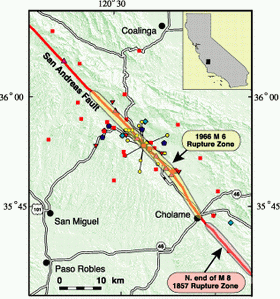
The Cholame area showing some of the geophysical instrument networks (colored symbols) concentrated around the town of Parkfield, which is located near the center of the instrument cluster. (Courtesy USGS)
Earthquake:
A tremor of the surface of the Earth, sometimes severe and devastating, which results from shock waves generated by the movement of rock masses deep within the Earth, particularly near boundaries of tectonic plates. (See fault, Richter scale, and seismology.)
Earthquakes are particularly likely where such plates are sliding past each other, as in the San Andreas Fault.
Earthquakes cannot be accurately predicted, although the likelihood of a region's suffering an earthquake can be estimated.
The faint tremors, which were detected beneath the town of Cholame, 15 miles southeast of Parkfield, are similar to those discovered in the past two years at subduction zones in Japan and the Pacific Northwest. This is the first time, however, that such tremors have been recorded under a transform fault. At a subduction zone, one of Earth's plates slides under another at roughly a 45 degree angle. Transform faults, on the other hand, slide horizontally against one another. The most common type of fault in California slides this way, where the slipping surface is nearly vertical.
Variations in the low-amplitude, low-frequency tremors, which last more than four minutes each, occur several weeks before variations in the rate of microquakes on the San Andreas Fault, Nadeau said, suggesting that deformation associated with the tremors may cause the small quakes. Interestingly, the Parkfield segment of the San Andreas Fault ruptured in a magnitude 6 quake on September 28, 2004, only nine months after the end of Nadeau's analysis period. The epicenter of the event was particularly close to the tremor region, and there might be a relationship between the tremor activity and the occurrence of the September Parkfield earthquake, Nadeau said.
"This is new information from an area deep down under the fault we have not been able to look at before," Nadeau said. "If these tremors are precursory to earthquakes, there is potential here for earthquake forecasting and prediction."
A brief note by Nadeau and graduate student David Dolenc describing the tremors appears online this week in Science Express, and will be published soon in the print edition of the journal Science.
Cholame is just down the road from Parkfield, a city that bills itself as the "Earthquake Capital of the World" because of some 20 years of attention from seismologists, who have heavily instrumented the fault that cuts through the city in order to understand what triggers earthquakes. The Cholame Valley northwest of Parkfield is the drilling site of the San Andreas Fault Observatory at Depth (SAFOD), a project that hopes to go 3.2 kilometers under the fault to answer fundamental questions about the physical and chemical processes controlling faulting and earthquake generation. SAFOD is a component of EarthScope, a major international effort funded by the National Science Foundation and conducted in partnership with the U.S. Geological Survey.
Cholame also is thought to be the origin of the last big quake to hit southern California, the magnitude 8 Fort Tejon quake of 1857, when the San Andreas ruptured south from Cholame for about 200 miles. The San Andreas Fault is locked at Cholame, leading some seismologists to predict a big quake in the near future. The average time between big quakes on this area of the fault is 140 years, which means that another could happen at any time, Nadeau said.
Tremors are common under volcanoes, and recently led to predictions of the eruption of MountSt Helens in Washington state. They are thought to result from fluids flowing deep underground, Nadeau said.
So when seismologists detected tremors at a subduction zone in Japan in 2002, they ascribed them to fluid carried down into the mantle in fluid-saturated rocks from the seafloor. The detection of similar tremors in the Cascadia subduction zone off Oregon and Washington in 2003 seemed to support that hypothesis.
The new findings throw this into question, Nadeau said.
"Transform faults like the San Andreas have no obvious source of fluid, so it's not clear what's causing the tremors," he said. "Either tremors don't need fluid, or there is another, unknown source of fluid, perhaps from the Earth's mantle."
The tremors have gone undetected until now because earthquake monitoring instruments to date have ignored continuous activity and only recorded jerky, episodic shaking. Now that it's possible to store and analyze large amounts of information, seismologists like Nadeau can look at long records of activity in search of patterns.
He and Dolenc pulled out three years' worth of continuous records from UC Berkeley's High Resolution Seismic Network at Parkfield, from Dec. 22, 2001, to Dec. 22, 2003, and identified 110 separate tremors lasting four minutes or longer. The tremor profiles matched those from Japan and Cascadia, which have been dubbed "episodic tremors and slip," or ETS, events.
Tremor rate transients in the Cascadia subduction zone appear to be indicators of deep slip events that stress the overlying locked zone, Nadeau said. The correlation between the tremor and local microseismicity rates at Cholame suggests that similar deep slip and stressing processes may also be occurring along the central San Andreas Fault.
Seismologists also have suggested that tremor-related stressing may ultimately trigger a large event on the megathrust locked zone in Cascadia.
"It is conceivable that stressing related to the San Andreas Fault tremors could also ultimately trigger a large event on the overlying locked zone in the Cholame area of California," Nadeau said. Whether or not this pans out, he said, "the San Andreas Fault tremors provide important new constraints on the mechanics and possible role of fluids in tremor generation."
The work was supported by the U.S. Geological Survey and the Department of Energy, which funds the Center for Computational Seismology at Lawrence Berkeley National Laboratory.
Source: University of California, Berkeley


