Historic Himalayan ice dams created huge lakes, mammoth floods
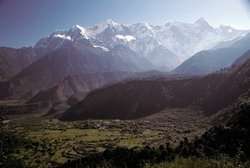
Ice dams across the deepest gorge on Earth created some of the highest-elevation lakes in history. New research shows the most recent of these lakes, in the Himalaya Mountains of Tibet, broke through its ice barrier somewhere between 600 and 900 AD, causing massive torrents of water to pour through the Himalayas into India.
Geological evidence points to the existence of at least three lakes, and probably four, at various times in history when glacial ice from the Himalayas blocked the flow of the Tsangpo River in Tibet, said University of Washington geologist David Montgomery, a professor of Earth and space sciences.
Carbon dating shows the most recent lake, about 780 feet deep, burst through the ice dam between 1,100 and 1,400 years ago, rapidly draining some 50 cubic miles of water. The second lake, more than 2,200 feet deep, dates from about 10,000 years ago, and likely held more than 500 cubic miles of water. When that ice dam broke, it caused one of the greatest floods on Earth since the last ice age.
The Tsangpo is the world's highest river, with an average elevation of 13,000 feet, about 500 feet higher than South America's Lake Titicaca, the highest lake. The Tsangpo flows to the eastern edge of Tibet before it turns south and plunges through a deep gorge into India, where it eventually becomes the Brahmaputra River and flows into the Bay of Bengal.
The new evidence indicates that several times in the Tsangpo's history, moisture from strengthening monsoons built Himalayan glaciers into huge ice dams, stopping the river before it could leave Tibet. A group of researchers led by Montgomery found evidence of the resulting lakes in ledges carved into the sides of the Tsangpo gorge.
"It is possible that there would have been water close to the crest of the Himalayas," Montgomery said. "Not the high peaks but the passes, and they were probably blocked by ice too. It probably was like an ice-dammed ocean up there."
The group will present evidence of repeated damming and flooding of the Tsangpo gorge on Wednesday at the American Geophysical Union fall meeting in San Francisco. Co-presenters are Bernard Hallet, Alan Gillespie, Noah Finnegan, Matthew Kuharic, Amanda Henck, Alison Anders and Harvey Greenberg, all of the UW Department of Earth and Space Sciences; and Liu Yuping of the Chengdu Institute of Geology and Mineral Resources in Chengdu, China.
The smaller lake appears to have coincided with China's Tang Dynasty and appears to have been the border between China and Tibet, Montgomery said. When the lake suddenly drained, it opened a large amount of rich farmland on the valley floor, farmland that today serves as the Tibetan breadbasket.
The Tsangpo River Gorge is considered some of the most spectacular terrain on Earth, as the river drops 7,800 feet (about 1.3 miles) in elevation over the course of about 125 miles. Parts of the gorge still have not been mapped because they are so rugged, possible evidence of the repeated sudden barrages of vast amounts of water unleashed by broken ice dams.
"You can carve a lot of beautiful deep valleys that way," Montgomery said. "To a geologist, that opens the question of, 'What is the role of these big floods? Are they responsible for carving that beautiful topography or are they merely second-bit players?'"
Source: University of Washington


