Toshiba and NEC Develop Key Technologies for High-Density MRAM
December 15, 2004
Toshiba Corporation and NEC Corporation today announced two key advancements toward development of a magnetoresistive random access memory, a technology seen as key to the development of future generations of high performance mobile equipment. Unveiling the latest fruits of a joint development program dating back to 2002, the two companies announced a new cell design that halves power consumption during data writes and cuts writing errors, and a novel MRAM architecture with high speed characteristics and a performance that will support development of high-density devices.
Full details of the new technology were presented on December 14 at IEDM (International Electron Devices Meeting) 2004 in San Francisco, USA.
The features of MRAM are fast read/write, high density, unlimited endurance and non-volatility?the ability to retain data when switched off. While MRAM show great promise for application in mobile information equipment, cell size and power consumption must be reduced, and no loss of operating speed achieved, before commercial application is possible. The advancements reported by NEC and Toshiba point the way forward.
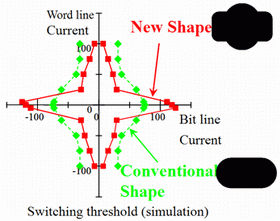
NEC and Toshiba reduced write current by developing a new shape for the magnetic tunneling junction (MTJ) that stores information in the cell. The MTJ shape is similar to the standard rectangular shape, but with arc-shaped bulges on both sides, in the middle of the longer length. Seen from above, the outline of the shape resembles a coin placed on a rectangle. With this new design, write current is approximately half that of present MRAM, and writing errors are reduced, even if there is some fluctuation in the switching characteristics of each memory cell. (Please refer to the figure 1.)
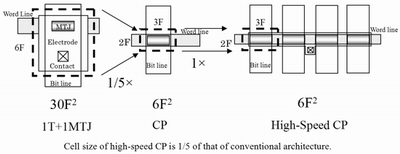
Toshiba and NEC have also developed highly promising new cell architecture. Research to date has produced two basic proposals on MRAM cell structure. The first of these couples each cell with a transistor, which advances read times, but at a cost in increased cell size. The second, the cross point (CP) structure, removes the transistor from each individual cell, a move that reduces cell size, but read access time gets longer and read errors occur due to generation of sneak current, the tendency of current to be directed to the unselected cell. Toshiba and NEC have realized a high-speed CP cell structure that uses one transistor to control four cells. This achieves a cell that is the same size as a standard DRAM cell and conventional CP cell, and much smaller than an MRAM cell with transistor. (Please refer to figure 2.) The new architecture also achieves a 250 nanosecond read time, four times faster than the conventional CP cell structure.
Through continued joint development, Toshiba and NEC aim to define fundamental technologies required for realizing a 256 megabit MRAM, utilizing MTJ based on 250 nanometer design rule and CMOS technologies based on 130-180 nanometer design rules by fiscal year 2005.
Development of the new MRAM technologies was supported by grants from Japan's New Energy and Industrial Technology Development Organization (NEDO).
-
NEC Develops World's Fastest SRAM-Compatible MRAM With Operation Speed of 250MHz
Nov 30, 2007 |
5 / 5 (7) |
0
-
Magnetic attraction: NIST microchip demonstrates concept of 'MRAM for biomolecules'
Oct 14, 2011 |
5 / 5 (1) |
0
-
Visualizing the future: Lab team develops better, simpler, cheaper display technologies
Oct 11, 2011 |
5 / 5 (1) |
0
-
Researchers engineer functioning small intestine in laboratory experiments
Jul 05, 2011 |
5 / 5 (3) |
0
-
World's first Content Addressable Memory stores data without using power
Jun 13, 2011 |
4.7 / 5 (13) |
7
-
Engineers build first sub-10-nm carbon nanotube transistor
Feb 01, 2012 |
4.9 / 5 (31) |
30
-
Something old, something new: Evolution and the structural divergence of duplicate genes
Jan 31, 2012 |
4.6 / 5 (7) |
1
-
The hidden nanoworld of ice crystals: Revealing the dynamic behavior of quasi-liquid layers
Jan 30, 2012 |
5 / 5 (3) |
1
-
Stock market network reveals investor clustering
Jan 27, 2012 |
3.9 / 5 (23) |
8
-
Of microchemistry and molecules: Electronic microfluidic device synthesizes biocompatible probes
Jan 26, 2012 |
5 / 5 (1) |
0
More news stories
Anonymous knocks CIA website offline (Update)
The website of the Central Intelligence Agency was inaccessible on Friday after the hacker group Anonymous claimed to have knocked it offline.
16 hours ago |
4.7 / 5 (14) |
21
New power source discovered
(PhysOrg.com) -- Researchers at the Massachusetts Institute of Technology (MIT) and RMIT University have made a breakthrough in energy storage and power generation.
Technology / Energy & Green Tech
Feb 10, 2012 |
4.7 / 5 (36) |
11
|
Google users warned of threat to smartphone wallets
Users of Google smartphone wallets were being warned on Friday that there is a way to crack pass codes intended to thwart thieves from going on illicit shopping sprees.
15 hours ago |
5 / 5 (3) |
0
Engineering images bring life to submerged city
(PhysOrg.com) -- Photo-realistic 3D mapping and digital reconstruction of an ancient underwater city in Greece have earned a team from the University of Sydney's Faculty of Engineering and Information Technologies ...
Feb 10, 2012 |
4.3 / 5 (3) |
5
Zuckerberg's focus drives Facebook's ascent
When Mark Zuckerberg showed up to rent Judy Fusco's Los Altos, Calif., house in the fall of 2004, soon after he'd arrived in Silicon Valley, the landlord was immediately struck by his confidence.
21 hours ago |
1 / 5 (2) |
2
Could Venus be shifting gear?
(PhysOrg.com) -- ESAs Venus Express spacecraft has discovered that our cloud-covered neighbour spins a little slower than previously measured. Peering through the dense atmosphere in the infrared, the ...
Fool's gold may prove an unlikely alternative to overexploited catalytic materials
Catalytic materials, which lower the energy barriers for chemical reactions, are used in everything from the commercial production of chemicals to catalytic converters in car engines. However, with current catalytic materials ...
The power of estrogen -- male snakes attract other males
A new study has shown that boosting the estrogen levels of male garter snakes causes them to secrete the same pheromones that females use to attract suitors, and turned the males into just about the sexiest ...
Employers feel no love for unscrupulous practice of 'service sweethearting'
A new study led by two Florida State University marketing professors finds that some frontline service employees who are rewarded for hikes in customer loyalty and satisfaction also may engage in "service ...
Two new moons for Jupiter
Advances in technology have lead to the discovery of new planets outside of our Solar System, and now even new moons in our own backyard.
Complex wiring of the nervous system may rely on a just a handful of genes and proteins
Researchers at the Salk Institute have discovered a startling feature of early brain development that helps to explain how complex neuron wiring patterns are programmed using just a handful of critical genes. ...