Aging Universe May Still Be Spawning Massive Galaxies
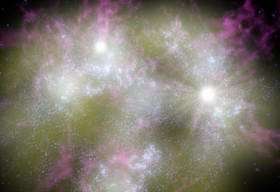
December 21st, 2004 Newborn Galaxy

NASA's Galaxy Evolution Explorer has spotted what appear to be massive "baby" galaxies in our corner of the universe. Previously, astronomers thought the universe's birth rate had dramatically declined and only small galaxies were forming.
"We knew there were really massive young galaxies eons ago, but we thought they had all matured into older ones more like our Milky Way. If these galaxies are indeed newly formed, then this implies parts of the universe are still hotbeds of galaxy birth," said Dr. Chris Martin. He is principal investigator for the Galaxy Evolution Explorer at the California Institute of Technology (Caltech), Pasadena, Calif., and co-author of the study.

Martin and colleagues, led by Dr. Tim Heckman of Johns Hopkins University, Baltimore, unearthed three-dozen bright, compact galaxies that greatly resemble the youthful galaxies of more than 10 billions years ago. These new galaxies are relatively close to us, ranging from two to four billion light-years away. They may be as young as 100 million to one billion years old. The Milky Way is approximately 10 billion years old.

The recent discovery suggests our aging universe is still alive with youth. It also offers astronomers their first, close-up glimpse at what our galaxy probably looked like when it was in its infancy.

"Now we can study the ancestors to galaxies much like our Milky Way in much more detail than ever before," Heckman said. "It's like finding a living fossil in your own backyard. We thought this type of galaxy had gone extinct, but in fact newborn galaxies are alive and well in the universe," he added.

The new discoveries are called ultraviolet luminous galaxies. They were discovered after the Galaxy Evolution Explorer scanned a large portion of the sky with its highly sensitive ultraviolet light detectors. Since young stars pack most of their light into ultraviolet wavelengths, young galaxies appear to the spacecraft like diamonds in a field of stones. Astronomers mined for these rare gems before, but missed them; since they weren't able examine a large enough slice of the sky.

"The Galaxy Evolution Explorer surveyed thousands of galaxies before finding these few dozen ultraviolet-bright ones," said Dr. Michael Rich, a co-author of the study from the University of California, Los Angeles.

The newfound galaxies are about 10 times as bright in ultraviolet wavelengths as the Milky Way. This indicates they are teeming with violent star-forming regions and exploding supernova, which are characteristics of youth.

When our universe was young, massive galaxies were regularly bursting into existence. Over time, the universe bore fewer and fewer galactic progeny, and its newborn galaxies grew up into ones that look like our own. Until now, astronomers thought they had seen the last of these giant babies.

The results will be published in an upcoming special issue of Astrophysical Journal Letters, along with several other papers describing new results from the Galaxy Evolution Explorer.

The Galaxy Evolution Explorer was launched on April 28, 2003. Its mission is to study the shape, brightness, size and distance of galaxies across 10 billion years of cosmic history. The Explorer's 50-centimeter-diameter (19.7-inch) telescope sweeps the skies in search of ultraviolet-light sources.

Caltech leads the Galaxy Evolution Explorer mission and is responsible for science operations and data analysis. NASA's Jet Propulsion Laboratory, Pasadena, Calif., manages the mission and built the science instrument. The mission was developed under NASA's Explorers Program managed by the Goddard Space Flight Center, Greenbelt, Md. South Korea and France are the international partners in the mission.


print this article email this article download pdf blog this article bookmark this article     Digg this Stumble it share on Facebook share on Reddit add to delicious save to Yahoo! bookmarks
not rated yet


December 21st, 2004 all stories
Space & Earth /

Comments: 0
Rank: not rated yet

  • Stumble this up

  • Digg this

  • Share it:
  • share on Facebook
  • share on MySpace
  • share on Slashdot
  • rss-newsfeed
  • share on Google
  • share on Reddit
  • add to delicious
  • save to Yahoo! bookmarks
  • share on Windows Live
  • Add to Mixx!
Rating: not rated yet

  • Related Stories

  • Galaxy Evolution Explorer Mission Celebrates Sixth Anniversary
    created Apr 28, 2009 | popularity not rated yet | comments 0
  • Dramatically backlit dust in giant galaxy
    created Apr 07, 2009 | popularity not rated yet | comments 0
  • Astrophysicists explore a blazar
    created Mar 18, 2009 | popularity not rated yet | comments 0
  • New stars from old gas surprise astronomers
    created Feb 18, 2009 | popularity not rated yet | comments 0
  • NASA's SkyView Delivers the Multiwavelength Cosmos
    created Feb 04, 2009 | popularity not rated yet | comments 0

Tags


  • Physicists Demonstrate Quantum Memory with Matter Qubits
    Physicists Demonstrate Quantum Memory with Matter Qubits
    Physics / General Physics
    created Jul 03, 2009 | popularity 4.4 / 5 (17) | comments 1
  • 'Holey' Nanosheets for Wastewater Dye Removal
    Nanotechnology / Nanomaterials
    created Jul 01, 2009 | popularity 5 / 5 (5) | comments 1
  • Jellyfish Robot Swims Like its Biological Counterpart
    Jellyfish Robot Swims Like its Biological Counterpart
    Electronics / Robotics
    created Jun 26, 2009 | popularity 4.4 / 5 (8) | comments 1
  • Could Maxwell's Demon Exist in Nanoscale Systems?
    Could Maxwell's Demon Exist in Nanoscale Systems?
    Physics / General Physics
    created Jun 24, 2009 | popularity 4.4 / 5 (18) | comments 29
  • Living Safely with Robots, Beyond Asimov's Laws
    Living Safely with Robots, Beyond Asimov's Laws
    Electronics / Robotics
    created Jun 22, 2009 | popularity 4.6 / 5 (52) | comments 40
  • Other News

    Forty years ago man first walked on the moon

    Space & Earth / Space Exploration

    created 10 hours ago | popularity 5 / 5 (2) | comments 0

    Forty years ago on July 20, 1969, American astronaut Neil Armstrong realized the oldest dream of human civilizations when he became the first man to walk on the moon.


    The least sea ice in 800 years

    The least sea ice in 800 years

    Space & Earth / Earth Sciences

    created Jul 01, 2009 | popularity 4.3 / 5 (59) | comments 52

    New research, which reconstructs the extent of ice in the sea between Greenland and Svalbard from the 13th century to the present indicates that there has never been so little sea ice as there is now. The ...


    Gas around young galaxy

    Intense heat killed the Universe's would-be galaxies, researchers say

    Space & Earth / Astronomy

    created Jul 01, 2009 | popularity 3.2 / 5 (19) | comments 26

    (PhysOrg.com) -- Our Milky Way galaxy only survived because it was already immersed in a large clump of dark matter which trapped gases inside it, scientists led by Durham University's Institute for Computational ...


    Scientists' Drill Hits Magma: Only Third Time on Record

    Scientists' Drill Hits Magma: Only Third Time on Record

    Space & Earth / Earth Sciences

    created Jun 29, 2009 | popularity 4.7 / 5 (20) | comments 19

    (PhysOrg.com) -- Scientists drilling a borehole deep into Iceland’s rocky crust to explore new methods of using geothermal energy hit a major roadblock on Thursday: Their drill ran into molten rock at a depth ...


    NASA manager pitches a cheaper return-to-moon plan

    Space & Earth / Space Exploration

    created Jun 30, 2009 | popularity 4 / 5 (7) | comments 18

    (AP) -- Like a car salesman pushing a luxury vehicle that the customer no longer can afford, NASA has pulled out of its back pocket a deal for a cheaper ride to the moon.