World's Most Powerful Infrared Camera Opens Its Eyes on the Heavens
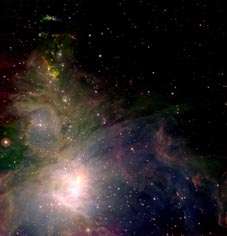
Stunning image of Orion released
A new astronomical camera has begun operations on the United Kingdom Infrared Telescope (UKIRT) in Hawaii. The Wide Field Camera (WFCAM), built at the UK Astronomy Technology Centre (UK ATC), Edinburgh, is the world's most powerful infrared survey camera. It will survey large regions of the sky at infrared wavelengths and is expected to discover both the nearest objects outside our Solar System and the farthest known objects in the Universe.
Central region of the full tile, showing dramatic clouds of gas and dust illuminated by stars in the southern half of the Orion nebula. This is an image at three infrared wavelengths (red represents narrow-band emission from molecular hydrogen gas at 2.12 microns, green represents K-band emission at 2.2 microns, and blue represents J-band emission at 1.25 microns). The region is 11 light years across.
WFCAM has the largest field of view of any astronomical infrared camera in the world. In a single exposure it can image an area of the sky equal to that of the full moon.
"The ability to see such a large area at once, with state-of-the-art detectors, makes WFCAM the fastest infrared survey instrument in the world, bar none." said Dr Andy Adamson, Head of Operations for UKIRT.
WFCAM detects infrared light, or heat radiation, which is the key to understanding many types of astronomical objects. These include stars in our own Galaxy and beyond, interstellar clouds, the mysterious "failed stars" known as brown dwarfs, and quasars at the edge of the observable Universe.
"WFCAM will be used to do surveys of the infrared sky which will detect objects one hundred times fainter than those in the deepest existing surveys. This survey programme will take up to seven years to complete and will provide astronomers with a picture of the infrared sky to unprecedented depth." said Dr Paul Hirst, WFCAM Instrument Scientist at UKIRT.
As part of its commissioning, led by Dr Hirst and Project Scientist Dr Mark Casali, WFCAM was trained on a region of star formation in the constellation of Orion, about 1500 light years from Earth. The full WFCAM image area is 1200 times larger than that covered by UKIRT's previous infrared camera UFTI, and 3600 times larger than that covered by the Hubble Space Telescope's infrared camera NICMOS. The astronomers combined observations with different infrared filters to give a 'colour' image, showing dramatic clouds of gas and dust in the southern half of the Orion nebula. The images reveal not only the illuminated edges of clouds and filaments, but also thousands of young stars that are otherwise hidden from view at visible light wavelengths by the gas and dust.
"Getting this unique instrument designed, built and tested was a major technical challenge that has been successfully completed through the dedication and skills of the multi-disciplined team at the UK ATC. To provide UK astronomers with this huge improvement in capability is part of the core mission of the UK ATC and marks the end of 5 years of hard work for the team." said David Lunney, WFCAM Project Manager at UK ATC.
At the heart of WFCAM are four "detector arrays". These are similar in concept to the CCD chips in everyday digital cameras, but use a Mercury Cadmium Telluride crystal to make them sensitive to infrared radiation rather than visible light. Whilst a typical digital camera may take snapshots containing a few million pixels, WFCAM will map the infrared sky in vast tiles that contain over 250 million pixels each. When WFCAM is scanning the sky, it produces images at a phenomenal rate. In a single night, it will generate over 200 gigabytes of data - enough to fill over 300 CD-ROM disks.
Although the detector arrays occupy a space not much larger than a Compact Disc case, the entire WFCAM camera is huge. It is an imposing black cylinder, 5.4 metres (18 feet) long and weighing 1500 kilograms (1.7 tons), which points towards the sky from the telescope's primary mirror.
"This is a novel and unusual 'forward-cassegrain' optical design with WFCAM mounted just above the centre of the mirror. WFCAM's critical components are cooled to temperatures below -200C (-325F) so that their own heat glow doesn't swamp the tiny amounts of infrared radiation that we're trying to detect." explained Dr Hirst.
WFCAM's size, weight, and unusual position made even its installation at UKIRT an engineering challenge. It was built by the UK ATC in Edinburgh, and shipped to UKIRT in Hawaii. The team of engineers used a custom designed fork-lift truck to lift WFCAM carefully and very precisely into position over the telescope mirror.
"Achieving first light with WFCAM is the exciting result of many years of international collaboration between staff at the Joint Astronomy Centre in Hawaii and at the UK ATC. These stunning images are a testament to the hard work of everyone involved and we now look forward to several years of exciting scientific discoveries." said Professor Gary Davis, Director of the JAC.
Professor Ian Robson, Deputy Director of the UK ATC said "Building an infrared camera is relatively easy, but building the World's largest at an affordable price requires a high level of design ingenuity and professionalism. WFCAM is a tribute to the engineers of the UK ATC and we all look forward to sharing in the fantastic discoveries that WFCAM and UKIRT will bring, ranging from understanding the secrets of star formation to figuring out the formation of the first galaxies in the Universe."
Source: PPARC


