Disappearing in dry quicksand
December 23, 2004
People and even vehicles disappearing in the desert: they are popular myths of desert travelers. In famous books writers like T.E. Lawrence, 'Lawrence of Arabia', let these things happen. They could be more realistic than readers would assume, according to research of prof. Detlef Lohse and his Physics of Fluids group at the University of Twente (Netherlands). They report about 'dry quicksand' in 9 December's issue of Nature.
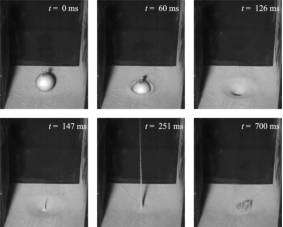
Image: Six snapshots from a high speed image recording: The snapshots correspond to (a) ball release, (b) sinking, (c) disappearing, (d) void collapse, (e) jet, and (f) granular eruption.
Lohse and his researchers Remco Rauhé, Raymond Bergmann and Deveraj van der Meer created something they call ‘dry quicksand’. Sand is usually able to support weight relying on internal force chains. The well known quicksand is a mixture with force chains that are substantially weaker. In other words: it is possible to influence the 'support capabilities' of sand.
To create dry quicksand, the scientist filled a container with very fine grain sand (grains of about 0,04 millimetres). The bottom of the container has holes in it, through which air is blown. When the stream of air is closed off, the grains move down to form a very loose packing (just 41 vol percent).
Touching the surface of the sand, the researcher hung a four centimetre pingpong ball on a thin rope. The ball was filled with tiny bronze balls to be able to vary the weight. After the rope is burnt, the ball falls into the sand in one movement. Without any effort, it moves through the sand. The researchers measured the depth by attaching a vertical tail –almost without mass- to the ping pong ball.
Source: University of Twente
-
Calit2's Reefbot Designed to Autonomously Monitor Ocean's Disappearing Coral Reefs
Dec 18, 2008 |
3 / 5 (1) |
1
-
Photo from NASA Mars orbiter shows wind's handiwork
Jan 26, 2012 |
5 / 5 (5) |
3
-
An easier way to remove gallstones
Jan 17, 2012 |
5 / 5 (2) |
0
-
Two cities, one vast gap in child obesity
Jan 05, 2012 |
not rated yet |
0
-
Glass that cleans itself
Dec 07, 2011 |
4.7 / 5 (10) |
4
-
Engineers build first sub-10-nm carbon nanotube transistor
Feb 01, 2012 |
4.9 / 5 (29) |
30
-
Something old, something new: Evolution and the structural divergence of duplicate genes
Jan 31, 2012 |
4.6 / 5 (7) |
1
-
The hidden nanoworld of ice crystals: Revealing the dynamic behavior of quasi-liquid layers
Jan 30, 2012 |
5 / 5 (3) |
1
-
Stock market network reveals investor clustering
Jan 27, 2012 |
4 / 5 (22) |
8
-
Of microchemistry and molecules: Electronic microfluidic device synthesizes biocompatible probes
Jan 26, 2012 |
5 / 5 (1) |
0
More news stories
Physicists build highly efficient 'no-waste' laser
A team of University of California, San Diego researchers has built the smallest room-temperature nanolaser to date, as well as an even more startling device: a highly efficient, "thresholdless" laser that ...
2 hours ago |
5 / 5 (6) |
1
|
Transparent iron? For the first time, an experiment shows that atomic nuclei can become transparent
At the high-brilliance synchrotron light source PETRA III, a team of DESY scientists headed by Dr. Ralf Röhlsberger has succeeded in making atomic nuclei transparent with the help of X-ray light. At the ...
2 hours ago |
5 / 5 (3) |
1
|
Quantum physicist explains $100K offer for proof scaled-up quantum computing is impossible
(PhysOrg.com) -- MIT researcher Scott Aaronson has certainly riled the physics community with his offer this past Friday, of $100,000 to anyone who can prove that scaled-up quantum computing is impossible. ...
Flipping a light switch in the cell: Quantum dots used for targeted neural activation
By harnessing quantum dotstiny light-emitting semiconductor particles a few billionths of a meter acrossresearchers at the University of Washington (UW) have developed a new and vastly more targeted ...
4 hours ago |
5 / 5 (2) |
0
|
Unusual 'collapsing' iron superconductor sets record for its class
(PhysOrg.com) -- A team from the National Institute of Standards and Technology and the University of Maryland has found an iron-based superconductor that operates at the highest known temperature for a material ...
6 hours ago |
4 / 5 (2) |
1
|
Chandra finds Milky Way's black hole grazing on asteroids
(PhysOrg.com) -- The giant black hole at the center of the Milky Way may be vaporizing and devouring asteroids, which could explain the frequent flares observed, according to astronomers using data from NASA's ...
Short fasting cycles work as well as chemotherapy in mice
Man may not live by bread alone, but cancer in animals appears less resilient, judging by a study that found chemotherapy drugs work better when combined with cycles of short, severe fasting.
Study shows how DNA finds its match
It's been more than 50 years since James Watson and Francis Crick showed that DNA is a double helix of two strands that complement each other. But how does a short piece of DNA find its match, out of the millions ...
'Explorers,' who embrace the uncertainty of choices, use specific part of cortex
Life shrouds most choices in mystery. Some people inch toward a comfortable enough spot and stick close to that rewarding status quo. Out to dinner, they order the usual. Others consider their options systematically ...
Scientists delve into the brain roots of hunger and eating
Synaptic plasticity the ability of the synaptic connections between the brain's neurons to change and modify over time -- has been shown to be a key to memory formation and the acquisition of new learning behaviors. ...
New kind of solar cell could capture significantly more energy than current cells
New solar cells could increase the maximum efficiency of solar panels by over 25%, according to scientists from the University of Cambridge.