Season's Greetings at the Speed of Light
December 23, 2004 Season's Greetings at the Speed of Light

MIT presents an ultrafast holiday offering

Most days, MIT chemist Keith Nelson and his team do cutting-edge research with femtosecond laser pulses—flashes of light that last about a thousandth-of-a-trillionth (10-15) of a second, or roughly the amount of time it takes a light beam to cross from one circuit feature to the next in a conventional computer chip.
And most days, the scientists are focused on the serious, long-term applications of their work, which include a variety of potential uses in fundamental science, as well as in communications and signal-processing technologies.

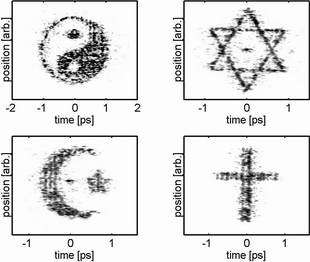
Image: Each image shows the "snapshot" of a highly structured, half-millimeter-wide laser pulse. The vertical axis is in arbitrary units; the horizonal axis is in picoseconds (10-12 seconds), which refers to the time when that part of the pulse arrived at the detector. Credit: Joshua C. Vaughan, T. Feurer and Keith A. Nelson, MIT

As 2004 draws to a close, however, Nelson and his coworkers have demonstrated their techniques for shaping and manipulating the femtosecond pulses with a seasonal offering. Each of the symbols shown here is actually a highly structured, half-millimeter-wide swarm of laser photons flying in formation from left to right at the speed of light. The images are produced by analyzing the photons in an ultrafast detection system, then plotting their vertical position and time of arrival.

Result: the world's fastest holiday greeting.

Source: MIT


print this article email this article download pdf blog this article bookmark this article     Stumble it Digg this share on Facebook retweet share on Reddit add to delicious
Rate this story - 2 /5 (2 votes)


December 23, 2004 all stories

Comments: 0

2 /5 (2 votes)
  • Stumble this up

  • Digg this

  • share this

  • hide
  • Related Stories


Other News

Visual assistance for cosmic blind spots

Visual assistance for cosmic blind spots

Physics / General Physics

created 45 minutes ago | popularity not rated yet | comments 0

A bit of imagination on the part of a measuring instrument wouldn't be a bad thing. It could help to add data from areas where the instrument is unable to measure. However, it must do so constructively. In ...


Predicting the fate of underground carbon

Physics / General Physics

created 42 minutes ago | popularity not rated yet | comments 0

A team of researchers at the Massachusetts Institute of Technology has developed a new modeling methodology for determining the capacity and assessing the risks of leakage of potential underground carbon-dioxide reservoirs.


Straightening messy correlations with a quantum comb

Straightening messy correlations with a quantum comb

Physics / Quantum Physics

created 2 minutes ago | popularity not rated yet | comments 0

Quantum computing promises ultra-fast communication, computation and more powerful ways to encrypt sensitive information. But trying to use quantum states as carriers of information is an extremely delicate ...


Big Bang atom smasher sends beams in 2 directions (AP)

Large Hadron Collider sends beams in 2 directions

Physics / General Physics

created 3 hours ago | popularity 5 / 5 (5) | comments 0

(AP) -- The world's largest atom smasher made another leap forward Monday by circulating beams of protons in opposite directions at the same time in the $10 billion machine after more than a year of repairs, ...


A quantum leap forward?

A quantum leap forward?

Physics / Quantum Physics

created 1hour ago | popularity not rated yet | comments 0

The dusty boxes that line the walls of Jeff Barrett's UC Irvine office mark a high point in his academic career. Their contents: pages and pages of notes, most more than 50 years old, penned by late quantum ...