400-Meter Asteroid May Hit Earth on 13 April, 2029
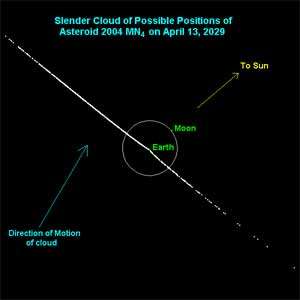
A recently rediscovered 400-meter Near-Earth Asteroid (NEA) is predicted to pass near the Earth on 13 April 2029. The flyby distance is uncertain and an Earth impact cannot yet be ruled out. The odds of impact, presently around 1 in 300, are unusual enough to merit special monitoring by astronomers, but should not be of public concern. These odds are likely to change on a day-to-day basis as new data are received. In all likelihood, the possibility of impact will eventually be eliminated as the asteroid continues to be tracked by astronomers around the world.
Earth impact
Since 1994 when Comet Shoemaker-Levy 9 collided with Jupiter, scientists have been researching if it may be possible to deflect incoming asteroids. With the discovery in 1999 that asteroid (29075) 1950 DA may collide with the Earth in 2880, this problem has been taken more seriously by politicians and scientists. The most significant recorded impact in recent times was the Tunguska event, which occurred at Tunguska in Russia, in 1908.
This object is the first to reach a level 2 (out of 10) on the Torino Scale. According to the Torino Scale, a rating of 2 indicates "a discovery, which may become routine with expanded searches, of an object making a somewhat close but not highly unusual pass near the Earth. While meriting attention by astronomers, there is no cause for public attention or public concern as an actual collision is very unlikely. New telescopic observations very likely will lead to re-assignment to Level 0 [no hazard]." This asteroid should be easily observable throughout the coming months.
The brightness of 2004 MN4 suggests that its diameter is roughly 400 meters (1300 feet) and our current, but very uncertain, best estimate of the flyby distance in 2029 is about twice the distance of the moon, or about 780,000 km (480,000 miles). On average, an asteroid of this size would be expected to pass within 2 lunar distances of Earth every 5 years or so.
Most of this object's orbit lies within the Earth's orbit, and it approaches the sun almost as close as the orbit of Venus. 2004 MN4's orbital period about the sun is 323 days, placing it within the Aten class of NEAs, which have an orbital period less than one year. It has a low inclination with respect to the Earth's orbit and the asteroid crosses near the Earth's orbit twice on each of its passages about the sun.
2004 MN4 was discovered on 19 June 2004 by Roy Tucker, David Tholen and Fabrizio Bernardi of the NASA-funded University of Hawaii Asteroid Survey (UHAS), from Kitt Peak, Arizona, and observed over two nights. On 18 December, the object was rediscovered from Australia by Gordon Garradd of the Siding Spring Survey, another NASA-funded NEA survey. Further observations from around the globe over the next several days allowed the Minor Planet Center to confirm the connection to the June discovery, at which point the possibility of impact in 2029 was realized by the automatic SENTRY system of NASA's Near-Earth Object Program Office. NEODyS, a similar automatic system at the University of Pisa and the University of Valladolid, Spain also detected the impact possibility and provided similar predictions.
Source: by Don Yeomans, Steve Chesley and Paul Chodas, NASA's Near Earth Object Program Office


