Los Alamos wizardry to aid new Mars science laboratory
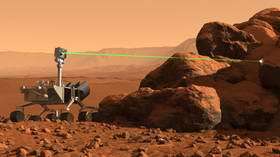
December 24th, 2004 Mars Science Laboratory rover using ChemCam to analyze a rock

Having analyzed Mars from afar via orbiting satellite, Los Alamos National Laboratory instruments will next be on their way to get out and play in the Martian dirt. Two of the eight instruments aboard NASA's planned Mars Science Laboratory rover, scheduled for launch in 2009, include Los Alamos technology.

Image: Mars Science Laboratory rover using ChemCam to analyze a rock. Artist's conception, courtesy French Space Agency (CNES) and Los Alamos National Laboratory.

The laboratory's contribution to the new Mars effort is two-fold, providing a laser unit to measure elemental composition of rocks and soils, plus an x-ray diffraction device to analyze minerals in complex soil and rock samples from a different perspective. The rolling Mars Science Laboratory rover will be designed to operate for a full Martian year, or two Earth years, exploring potential habitats for evidence of past or present life.

The Los Alamos laser unit, called ChemCam, uses laser-induced breakdown spectroscopy (LIBS), to measure the chemical content of the target samples. ChemCam works by firing an intense pulse of laser light at a surface from as far as 13 meters away.

The laser beam zaps a pinhead-sized area on the target, ablating or vaporizing it. A spectral analyzer then peers closely at the light from the vaporized sample. Atoms ablated in ionized states emit light and each sample yields a unique spectral emission of bright lines characteristic of the elements present in the material. Like fingerprints, the emission line wavelengths can be matched to a library of known chemical compounds. Even dust-covered rocks will reveal their inner secrets to the ChemCam interrogation. The laser also can be used to clean dust or weathering coatings from the sample prior to the analysis without the need to drive up to the target rock.

"ChemCam is the only instrument that can determine the elemental compositions of dust-covered rocks remotely," said Roger Wiens, Los Alamos' principal investigator on the project. The unit can recognize all known elements, noted Wiens, so detailed information on possible future Mars base sites can then begin flowing back to Earth for analysis.

The other piece of the ChemCam combo, the Remote Micro-Imager, will give very close-up images of the samples being analyzed, with an effective resolution that exceeds MER's Pancam by 5-10 times. The laser and camera are provided by the French space agency. Los Alamos is in charge of the spectrographs, data processing unit, power supply, software and project management.

Another of the rover's planned instruments is CheMin: an x-ray diffraction/x-ray fluorescence instrument for mineralogical analysis. Its principal investigor is David Blake of NASA's Ames Research Center in Moffett Field, Calif. Partnering with him are Los Alamos geologists Steve Chipera and David Vaniman. CheMin will identify and quantify all minerals in complex samples such as basalts, evaporites and soils, one of the principle objectives of Mars Science Laboratory.

"CheMin is named for its ability to obtain chemical and mineralogical data simultaneously from samples of soil or rock. The mineralogical capability is particularly powerful because it is based on x-ray diffraction, the standard method for mineral identification used in laboratories on Earth and required by the International Mineralogical Association for recognition of any new mineral," said Vaniman.

Both ChemCam and CheMin are previous winners in the "R&D 100" competition sponsored by Research and Development Magazine.

Source: Los Alamos National Laboratory


print this article email this article download pdf blog this article bookmark this article     Digg this Stumble it share on Facebook share on Reddit add to delicious save to Yahoo! bookmarks
5/5 after 1 votes


December 24th, 2004 all stories
Space & Earth /

Comments: 0
Rank: 5/5 after 1 votes

  • Stumble this up

  • Digg this

  • Share it:
  • share on Facebook
  • share on MySpace
  • share on Slashdot
  • rss-newsfeed
  • share on Google
  • share on Reddit
  • add to delicious
  • save to Yahoo! bookmarks
  • share on Windows Live
  • Add to Mixx!
Rating: 5/5 after 1 votes

  • Related Stories

  • NASA Tests Lunar Rovers and Oxygen Production Technology
    created Nov 13, 2008 | popularity not rated yet | comments 0
  • Mars Rover Laser Tool Ready for Testing
    created Jun 22, 2007 | popularity not rated yet | comments 0
  • Geologists suggest Mars features are result of meteorite strikes, not of evaporated lakes
    created Dec 21, 2005 | popularity not rated yet | comments 0
  • Simulations Show Liquid Water Could Exist on Mars
    created Nov 08, 2005 | popularity not rated yet | comments 0
  • Laser to be used to analyze Mars' soil
    created Jul 14, 2005 | popularity not rated yet | comments 0

Tags


  • Physicists Demonstrate Quantum Memory with Matter Qubits
    Physicists Demonstrate Quantum Memory with Matter Qubits
    Physics / General Physics
    created Jul 03, 2009 | popularity 4.4 / 5 (17) | comments 1
  • 'Holey' Nanosheets for Wastewater Dye Removal
    Nanotechnology / Nanomaterials
    created Jul 01, 2009 | popularity 5 / 5 (5) | comments 1
  • Jellyfish Robot Swims Like its Biological Counterpart
    Jellyfish Robot Swims Like its Biological Counterpart
    Electronics / Robotics
    created Jun 26, 2009 | popularity 4.4 / 5 (8) | comments 1
  • Could Maxwell's Demon Exist in Nanoscale Systems?
    Could Maxwell's Demon Exist in Nanoscale Systems?
    Physics / General Physics
    created Jun 24, 2009 | popularity 4.4 / 5 (18) | comments 29
  • Living Safely with Robots, Beyond Asimov's Laws
    Living Safely with Robots, Beyond Asimov's Laws
    Electronics / Robotics
    created Jun 22, 2009 | popularity 4.6 / 5 (52) | comments 40
  • Other News

    Forty years ago man first walked on the moon

    Space & Earth / Space Exploration

    created 17 hours ago | popularity 4.3 / 5 (4) | comments 2

    Forty years ago on July 20, 1969, American astronaut Neil Armstrong realized the oldest dream of human civilizations when he became the first man to walk on the moon.


    The least sea ice in 800 years

    The least sea ice in 800 years

    Space & Earth / Earth Sciences

    created Jul 01, 2009 | popularity 4.2 / 5 (62) | comments 59

    New research, which reconstructs the extent of ice in the sea between Greenland and Svalbard from the 13th century to the present indicates that there has never been so little sea ice as there is now. The ...


    Gas around young galaxy

    Intense heat killed the Universe's would-be galaxies, researchers say

    Space & Earth / Astronomy

    created Jul 01, 2009 | popularity 3.4 / 5 (21) | comments 27

    (PhysOrg.com) -- Our Milky Way galaxy only survived because it was already immersed in a large clump of dark matter which trapped gases inside it, scientists led by Durham University's Institute for Computational ...


    Scientists' Drill Hits Magma: Only Third Time on Record

    Scientists' Drill Hits Magma: Only Third Time on Record

    Space & Earth / Earth Sciences

    created Jun 29, 2009 | popularity 4.7 / 5 (22) | comments 19

    (PhysOrg.com) -- Scientists drilling a borehole deep into Iceland’s rocky crust to explore new methods of using geothermal energy hit a major roadblock on Thursday: Their drill ran into molten rock at a depth ...


    NASA manager pitches a cheaper return-to-moon plan

    Space & Earth / Space Exploration

    created Jun 30, 2009 | popularity 4 / 5 (7) | comments 18

    (AP) -- Like a car salesman pushing a luxury vehicle that the customer no longer can afford, NASA has pulled out of its back pocket a deal for a cheaper ride to the moon.